
How finance-sector jobs drive income inequality in global cities
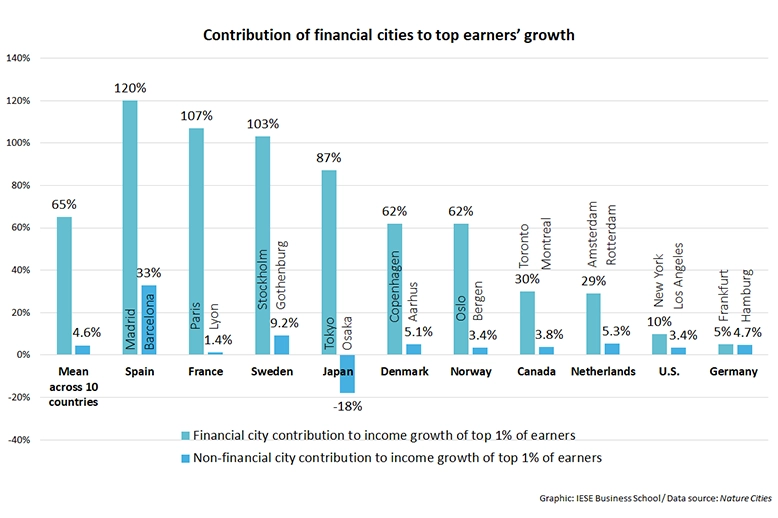
In 10 countries across Europe, North America and Asia, cities that house financial markets account for 65% of income growth of top earners.

The presence of a financial sector, with its lucrative jobs and related professions, is one of the biggest drivers of the growing concentration of top earners in select cities around the globe.
A major study published in Nature Cities examines earnings in cities in 10 countries across Europe, North America and Asia. It analyzes two decades of linked employer-employee data, encompassing over one billion data points, and is coauthored by Marta Elvira, who contributed data on Spain.
In each country, the research compares two types of cities: the financial hub housing the main national markets and related industries, and a second, comparison city that is closest in terms of population, employment and GDP share. The cities are: Toronto/Montreal (Canada), Copenhagen/Aarhus (Denmark), Paris/Lyon (France), Frankfurt/Hamburg (Germany), Tokyo/Osaka (Japan), Amsterdam/Rotterdam (Netherlands), Oslo/Bergen (Norway), Madrid/Barcelona (Spain), Stockholm/Gothenburg (Sweden) and New York/Los Angeles (U.S.).
In all of the countries, national top earners were more concentrated in financial cities than in comparison cities. Top earners were 1 to 3.6 times more likely to work in the financial city than elsewhere, and that gap has widened over time; in 1990, the figure was 1.7 times.
Growing income inequality
Some of the key findings:
- Financial cities were consistently responsible for an outsized percentage of the income growth among very top earners. On average, financial cities accounted for 65% of the increase in national top 1% earnings. In places such as Paris, Madrid and Stockholm, financial city earnings accounted for more than 100% of the increase (implying that earnings in other cities declined).
- On average, individuals in financial cities contribute six times more to the growth of top earnings than individuals in cities of similar size but that aren’t the financial hub.
- In all 10 countries, the earnings of the top 1% increased over time. The mean increase across countries was 0.17% per year; Denmark registered the smallest increase at 0.05% per year and the U.S. the largest at 0.46% annually.
These trends were not simply the result of a greater number of jobs in finance, the research found, but rather the product of firms distributing surging profits during the 1990s and 2000s to employees clustered in cities hosting the main national stock exchange. In most of the cities, employment numbers in finance were stagnant or declined over the study period.
How national contexts shape data
National contexts — including the level of overall income inequality, the degree of economic centralization and the size of other high-earning sectors in addition to finance — are key to interpreting the data.
In countries such as Spain, Sweden and Denmark, financial cities contributed substantially to relatively modest increases in overall top 1% earnings. In contrast, in Germany, the U.S. and Canada, financial cities played a smaller role in much larger aggregate increases in national top earnings.
The levels of spatial concentration of top earnings were particularly high in Stockholm, Oslo and Madrid, due to the large role these cities play in highly centralized national economies. In contrast, Germany, Canada and the U.S. had much lower levels of spatial concentration of top earnings in their financial hubs because their economies are more decentralized.
Additionally, in North America, while finance contributed significantly to rising earnings in the late 1980s and 1990s, the industry’s wage-setting practices spread to other sectors such as tech. Meanwhile, in Scandinavian countries, finance has remained a niche sector with exceptionally high wages and limited spillover to other sectors.
Finance, globalization and skills
The study adds to a growing body of research on the root causes of widening income inequality in cities. Previous research has attributed the concentration of top earners in certain cities to globalization: hubs like New York and Tokyo provide the high-paying infrastructure for global business — professions like consulting and legal services along with finance. But as this new research shows, some of the cities with the largest surge in earnings concentration are places like Stockholm and Madrid — important European capitals but not centers of global commerce.
Another possible cause is that highly educated workers and productive firms cluster in amenities-rich cities. But this research pairs cities that are similar in amenities and skill levels, yet one of the pair contributes disproportionately to top earnings, and the other does not. The presence of a financial sector is the determining factor, and the concentration is not merely a byproduct of scale or urban growth.
Related research has shown that finance-sector salaries surge during boom years, exacerbating income inequalities. But during downturns, those salaries remain high, even when countries enact specific regulations, such as capping bonuses, to bring them down.
ALSO OF INTEREST:
Top earners are increasingly isolated at work
The stickiness of finance-related income inequality
London, New York and Paris ranked all-around smartest cities for 5th year