
Beyond hiring the best: making meritocracy work
Why focusing only on “top talent” can hide bias and overlook potential — and how leaders can ensure fairer talent management strategies that expand opportunity and reward real merit.

“Hire the best.” Which company doesn’t make that boast? Nearly every organization claims to select talent based on the excellence of their ideas or abilities, not where they come from. This belief lies at the heart of what many call meritocracy.
Consider the notion of the famous “idea meritocracy,” popularized by the legendary investor Ray Dalio, who credits his business success to cultivating “the best portfolio of the best individuals, who possess the exceptional values, abilities and skills required for the role today.”
And it’s not just businesses that emphasize meritocracy in their mission statements, but educational institutions do it, too. MIT, where I work, prides itself on rewarding merit — opening doors to talent from all over the world, regardless of background or financial means. Merit scholarships, for example, are designed to ensure that exceptional talent can access the best education regardless of their ability to pay. Consultants and headhunters follow a similar logic. Their business model is built on identifying and recruiting “top talent” — even “star talent,” some would say — wherever it may be found.
This idea of rewarding and advancing “the best” regardless of background is a meritocratic principle that is generally considered progressive and legitimate. And let’s face it, who would want it to be otherwise? Who wants to work for an organization where you never get promoted, you never get a raise, you never get recognition, and everyone receives the exact same, no matter how hard you work, how much effort you put in, or how smart and talented you are? Where’s the merit in that?
Merit, after all, is supposed to matter. In practice, the language of merit is invoked constantly in managerial decisions: hiring new employees, promoting high performers, distributing bonuses or allocating budgets across teams. Because it’s such a central management concern, I was inspired to write my book The Meritocracy Paradox: Where Talent Management Strategies Go Wrong and How to Fix Them. It’s based on years of research to explore why an ideal built on fairness and opportunity can sometimes lead to unfair outcomes — and what organizations can do to fix things, so that meritocratic claims actually live up to their promise.
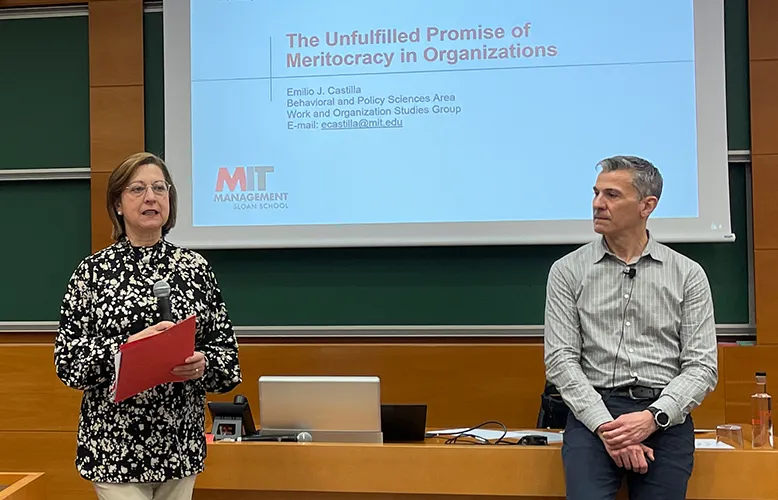
Emilio J. Castilla (right) shared insights from his book The Meritocracy Paradox in a session moderated by IESE Prof. Marta Elvira (left).
What is meritocracy? Clarifying the definition
Despite its ancient-sounding roots, the word “meritocracy” is actually relatively recent. It was coined by the British sociologist Michael Young in his book The Rise of the Meritocracy (1958). In that work, Young imagined a society in which those with merit (i.e., intellectual talent and effort) would replace a system historically dictated by social class. His idea has deeply shaped how we think about meritocracy today.
In my own work, I define meritocracy somewhat differently. A meritocratic organization (whether a business school, a company or a professional service firm) is one that advances individuals on the basis of their abilities, talents and efforts, rather than unrelated characteristics such as demographics, family background, social class, wealth or any other personal attributes determined at birth.
Notice my definition doesn’t mention performance. That’s intentional. I view performance as the outcome or result of one’s abilities, talents and efforts, not as core to the idea of merit itself. Many times, when companies say they reward merit, they mean results. But merit, for me, should focus on the abilities, talents and efforts that will produce the desired results. The distinction may seem subtle, but it matters greatly when organizations design systems for hiring, promotion and development.
In my view, two conditions are fundamental if meritocracy is to function properly.
First, meritocracy allows and even maintains inequality in professional outcomes. In other words, not everyone is going to get hired, promoted or selected for the most desirable roles in the organization. Meritocratic systems, by definition, produce differences in career outcomes. In fact, research suggests that unequal rewards can motivate individuals to invest greater effort and develop their skills.
But this leads directly to the second condition, arguably the most important: Everyone has to have an equal chance to succeed. Without fair access to opportunities, not everyone will have the chance to put their merits to work and have a fair shot at success.
To sum up both points: Not everybody will get promoted, but everybody should have a real chance of being promoted.
In practice, this means that organizations sometimes need to allocate resources unequally so that everyone can compete on more equal footing. Access to mentoring, developmental assignments, training or visibility with senior leaders may need to be deliberately structured to give individuals a meaningful opportunity to demonstrate their capabilities.
It’s important that we agree on what meritocracy means for two reasons: first, because many leaders and managers often invoke the term (or a similar one, such as excellence) without ever clarifying its meaning; and second, because, armed with a proper understanding, managers can reorient their actions toward creating meaningful opportunities for people to succeed in their organizations.
This requires an important shift in thinking: Instead of focusing all your efforts exclusively on recruiting “the best,” you should consider hiring candidates who are “good enough” — and then invest seriously in onboarding, development and support that truly give them the opportunity to learn and prove themselves. They may turn out to be outstanding employees. And even if they ultimately are not the right fit and leave, what matters is that you did everything in your power to give them a genuine opportunity to succeed.
That is where the focus should move: away from the narrow pursuit of the “best talent,” what I call the top talent mindset, and toward an approach centered on creating the conditions in which people have the opportunity to develop, perform and grow, and ultimately become their best. I call this the opportunity mindset.
The contradictions of claiming meritocracy
Let’s do a simple thought experiment: Imagine you have $1,000 to distribute among three employees as an end-of-year bonus. Two of them received a 4 out of 5 in their annual performance appraisal, and one scored a 3. How would you allocate the bonus?
There’s no obvious answer. Sometimes, people may divide the money equally among the three employees. Some may give $500 to each of the two employees who scored 4 and nothing to the one who scored a 3. Some may give nothing to any of them because nobody received a 5.
What this small exercise reveals is something important concerning the inherently subjective nature of deciding who merits what — unless you have done some prior work to clearly define the meritocratic criteria your managers should use when translating merit into rewards.
This matters because of research that Stephen Benard and I conducted using a version of this bonus allocation experiment. In one study, we asked two groups of participants to distribute bonuses to two employees who each had the exact same job performance score and like-for-like qualitative assessments. The only difference between the employees: one was a man; one was a woman. Participants assigned to the neutral condition awarded equal bonuses, on average, to both employees. However, the group instructed to reward based on merit ended up giving the man more than the woman. In a more recent study, I found that the same appeared when the candidate had an English name versus a Latino name: The group told to reward based on merit gave a bigger bonus to Brad than to José.
Why would emphasizing merit produce such outcomes?
One explanation is that simply emphasizing meritocracy (something many organizations proudly do, because it signals fairness and is considered best practice) can actually introduce biases. Once the language of merit is introduced, people may feel confident that their decisions are meritocratic, even when subtle biases shape how they interpret the same information. This is one of the paradoxes that inspired the title of my book.
This dynamic is closely related to what psychologists call moral credentialing. When individuals believe they have already demonstrated their fairness or moral intentions, they may feel less constrained about expressing judgments that might otherwise raise concerns. It’s a bit like what sometimes happens at a dinner party when a guest begins a statement with “I’m not sexist, but…” or “I’m not racist, but…” and then proceeds to express some biased opinions they might otherwise suppress. The prefacing disclaimer gives them license to do so.
Something similar can happen inside organizations. When companies strongly emphasize that their systems are meritocratic, managers may feel reassured that the rules themselves guarantee fairness. That confidence can unintentionally lower their vigilance about how subjective (often biased) interpretations enter decisions about rewards, promotions or opportunities.
This is one of the central insights behind what I call the meritocracy paradox: The stronger the belief that a system is meritocratic, the more easily bias can creep into the decisions made within it.
Companies have a responsibility to make meritocracy work
How can organizations guard against these tendencies? The first step is to examine how you recruit and select.
Where do you go to find candidates? How many applications do you get from different recruitment sources? Who proceeds to the interview or the next stages? And ultimately, how do you decide who receives an offer?
Looking closely at the data behind these decisions often reveals patterns that would otherwise remain invisible. You may discover that certain groups or profiles move more easily through the hiring pipeline, or that your recruiting channels consistently produce a relatively homogeneous set of candidates. When this happens, organizations may need to broaden their recruiting sources to expand the candidate pool and ensure that individuals truly have equal opportunities to compete.
The same type of analysis should apply to how employees are rewarded. Organizations should examine whether demographic characteristics systematically predict differences in pay or bonuses even after accounting for merit-related factors such as performance, experience or skills. When those patterns appear, it becomes necessary to revisit the criteria and processes that govern performance evaluation and reward allocation.
In short, organizations must test whether their systems actually operate in a meritocratic way — regardless of whether they explicitly claim to be meritocratic. Most companies state that they are committed to rewarding individuals who deserve opportunities. But achieving that goal requires organizational accountability. Someone within the organization must be responsible for monitoring how decisions are made and ensuring that the criteria used to evaluate employees are applied consistently and fairly.
Organizational transparency is also essential. Applicants, employees and managers should clearly understand which criteria matter when decisions are made about hiring, promotion and compensation. When expectations are explicit, individuals know what is required to succeed, and organizations are better able to demonstrate that their systems operate fairly.
In fact, these kinds of practices are increasingly becoming legal requirements. In Spain, for example, the upcoming EU Pay Transparency Directive, which takes effect in June 2026, will require companies to make their pay structures and progression criteria much more transparent. Employees and managers will have the right to request information about the average pay of individuals performing the same or equivalent work, and organizations will need to explain any significant pay gaps.
For many companies, this represents a major new compliance obligation. But it also reflects a broader principle: If organizations want meritocracy to work as intended, they must move beyond simply declaring it. They must design systems that make it visible, measurable and accountable.
Gather data and systematize your processes
Returning to my bonus allocation experiments and the phenomenon of moral credentialing, I would add that a data-driven organizational approach to review talent management processes will also serve to test whether meritocracy is a value you are serious about or simply a slogan you believe in because meritocracy is considered “best practice.”
“Best practice” can be a trap. I see many companies adopting other firms’ best practices even when they do not face the same problem. Instead, I urge organizations to use their resources to locate their own particular inefficiencies or biases. Doing so allows them to target their own problems and therefore pursue the outcomes more effectively, rather than imitating someone else just because it sounds good on a website or in a presentation.
Meritocracy is a moving target. We can never be 100% bias-free. We’re humans, after all. I’m not advocating that all companies simply do anti-bias training; for some, that may be useful in helping their professionals become aware of how biases can cloud their judgment.
However, a systematic, data-driven, analytical approach may prove more fruitful. Analyzing your own company data should not only help identify problem areas; it should also help you understand where you are making efficient decisions. When successful practices are identified and structured, they can be shared with other parts of the organization for everyone to learn from — so that good decisions are the product of rigorous, replicable processes, not merely of intuition. This means surfacing the interventions that work, monitoring them, refining them and ensuring that outcomes improve over time.
In this regard, technological tools, including artificial intelligence and digitalization, can help you collect and code high-quality data from multiple sources, structure and analyze the data, and detect patterns. Used carefully, these tools can help ensure that processes, from recruitment to hiring to promotions, are as free as possible from bias and inefficiency.
I’ve worked with companies that are so systematic in how they leverage data that they can trace the specific experiences and opportunities that helped individuals succeed. This information can then be used to accelerate the growth and development of future talent. If the past offers clues about the future, organizations should analyze and leverage data dynamically to detect patterns, accelerate and realize potential, and raise future performance.
Companies often offer professional development programs, but how many systematically code and track who is doing what? I remember one company that had done exactly that. So when the COVID-19 pandemic hit, leaders knew precisely which individuals already had the skills to work remotely. Those individuals were then asked to train others across the organization. If you’re busy measuring things that are merit-worthy, and you maintain a database on which employees have the merits to be successful, then you’re well on the way toward constructing a meritocratic company, which will lend competitive advantage.
Define the performance metrics most relevant to your organization and consider what you would expect to observe if everyone were truly afforded an equal chance to express their abilities, talents and best efforts. Then build good dashboards to monitor those indicators.
Recognizing different forms of merit
When rewarding and advancing employees, also remember that merit can take many forms. Not everyone will earn a bonus or become a manager — indeed, not everyone should. But organizations need to create pathways for opportunity and growth, so people, particularly those who have been in the organization for a long time, feel their contributions continue to be recognized over time. Some rewards may be nonmonetary, and employees may value them. But organizations can only discover this by actually asking them.
Do you regularly survey your employees about what kinds of rewards they value? There is no single definition of success. For some, success means moving upward in the hierarchy; for others, it may involve lateral moves or new responsibilities. Performance evaluation should be not just scoring someone a 3 or 4 and deciding whether they merit a bonus, but having an authentic conversation, asking employees what excites them and what else they would like to do in the future. If they stay in their current role, what will help them continue learning and be the best in it?
In this sense, performance evaluation is not merely an assessment of the present — it is an opportunity to understand where people want to go. And then those insights can feed back into the talent management system, allowing managers to identify broader patterns and redirect resources toward the initiatives employees value most.
Rewarding merit is more complex than a simple formula: “If I pay for A, people will do A but not necessarily B or C.” Meritocracy involves identifying potential and discovering what people have the ability and desire to do, even if those contributions are not yet being measured. People may indeed be willing to do B and C — if you take the time to understand what motivates them.
Because drivers are often subjective, there is always a risk that bias and inefficiency may creep in. That is why your conversations must go deeper and be precise: Ask employees to provide specific examples so your measures are more structured inputs into the broader organizational system of decision-making.
Meritocracy must be continually examined
We all carry multiple understandings of what merit means, but meritocracy shouldn’t amount to a popularity contest. Make sure you are constantly checking your organization’s understanding, particularly how merit is defined, measured and applied.
Meritocracy is not a fixed system but an ongoing process; a target. You should introduce and rely on criteria that truly promote excellence and talent development; give people opportunities to learn and grow before expecting top performance; avoid giving up on employees who don’t perform well straight away; and provide additional opportunities to improve. At the same time, you need to regularly assess whether all your organizational practices are well aligned to support employees in delivering their best work.
Is everyone clear on what’s expected of them in your organization? Do they understand the steps required to succeed in their roles? Are there processes in place that reward the behaviors and contributions the organization truly values? And when circumstances change, are those criteria revisited and refined?
Only you can answer those questions. And asking them consistently is the first step toward building a truly meritocratic talent management system that genuinely rewards merit.
MORE INFO: The Meritocracy Paradox: Where Talent Management Strategies Go Wrong and How to Fix Them by Emilio J. Castilla (Columbia University Press, 2025).
This article is based on sessions that Emilio J. Castilla delivered at IESE Business School in Madrid and Barcelona, which were organized in cooperation with IESE’s Institute for Sustainability Leadership in February 2026.
This article is included in IESE Business School Insight online magazine No. 172 (May-Aug. 2026).
READ ALSO: