
Data-driven pricing: unlocking profits with the right mix of data, tech, people and values
Pricing can be a source of competitive advantage, as long as you understand the essentials and manage the data and technology well (and don’t let the data and technology manage you).

We’ve all experienced it: You hail an Uber when it’s raining, and the fare may be twice as much for the same journey you made the day before when it was sunny and traffic was light. You go to order a Christmas present on Amazon and discover a limited-time sale with the gadget you wanted offered at discount, and even cheaper on Tuesday than when you last looked on Saturday. You plan to book a summer flight and notice seats in your cabin class fast disappearing and the price going up.
These are everyday examples of data-driven pricing — when companies harness the power of data and advanced analytics to set and update prices tactically and dynamically, in a way that serves the broader strategy of the company.
Determining the price of your offer is no longer a simple matter of calculating margins and benchmarking against competitors. Big data, information technology and artificial intelligence have revolutionized the whole process. Increasingly, profitability and competitive advantage stem from price optimizations made possible through granular, real-time, on-the-ground data insights.
This article explains the practical considerations for incorporating data-driven pricing into your business, making the most of this powerful tool to boost profitability and performance.
How it started: revenue management takes flight
In some ways, data-driven pricing is no different from any other kind of managerial decision-making process. First, the C-suite sets the direction of its pricing strategy based on long-term corporate goals. In alignment with those goals, business unit heads choose which pricing tactics to try, based on their chosen market segments and demand curves. These are then executed by functional teams, who carry out day-to-day operations, making pricing adjustments in line with what their analytics are telling them.
However, there are some distinct differences. To appreciate what those are, we need to go back to how this field started.
Back in the 1980s, deregulation of the airline industry in the U.S. gave rise to a new, low-cost carrier called People Express (akin to Ryanair or EasyJet today), which began growing very fast. This threatened traditional airlines whose fares were being aggressively undercut.
In response, American Airlines’ CEO Robert Crandall introduced a super-saver fare to fill up empty seats on its planes that were flying at undercapacity. Previously, this had not been such a concern, as flying at the time was largely considered a luxury paid for by late-booking business travelers. But People Express revealed a new market segment: price-sensitive travelers like college kids going home or leisure travelers going away for the weekend. So, besides discounting a certain number of seats on its flights, American Airlines made them available only for those who stayed over the weekend and booked well in advance, thus targeting People Express’ same market segment.
American Airlines had another trick up its sleeve: It made strategic use of a computerized system for real-time flight booking, called SABRE. Crandall’s response to the competitive threat posed by People Express was not to turn American Airlines into another low-cost carrier. Instead, with the help of SABRE data, he could calculate how many seats were being sold at each fare class, making sure to reserve enough business class seats to more than make up for the number of low-cost seats being sold.
Through clever use of data, American Airlines was effectively able to control the number of seats being offered at different prices, and fly at capacity. This increased its profit margins while simultaneously turning the tables on People Express by luring away its customers, who could enjoy lower fares and American Airlines’ better in-flight experience, as opposed to People Express’ no-frills one.
By 1985, People Express was in financial trouble and desperately tried to pivot in the opposite direction, adding a first-class section to entice business travelers, but to no avail. The airline was sold off in 1987. People Express’ CEO later admitted that he hadn’t fully appreciated the art of revenue management (termed “yield management” at the time) the way that Crandall had.
It is from this business case that modern data-driven pricing was born. Revenue management, similar to that described, is a common tactic today, not least because the key tool that made it possible in the ’80s — a powerful computer system brimming with useful data — is no longer unique but ubiquitous, with even richer datasets available to everyone.
Pillars of data-driven pricing success
This success story shows an alternative path to profitability — through pricing. While all managerial decisions are intended to create some value, well-conceived pricing decisions have the capacity to capture more of that value and unlock entirely new value besides.
But it requires pulling different levers than the usual ones of cost-cutting, benchmarking or uniformly charging existing customers more. If American Airlines had simply adjusted its prices to match or undercut People Express’ or if it had just doubled-down on its own business travelers, it would likely have locked itself in a price war and missed out on valuable untapped customer segments.
Instead, it discovered lucrative new opportunities for value creation and capture, thanks to four essential ingredients that apply today:
A framework for pricing decisions
When it comes to actually making pricing decisions, you will need to factor together the following dimensions (summarized in the framework below):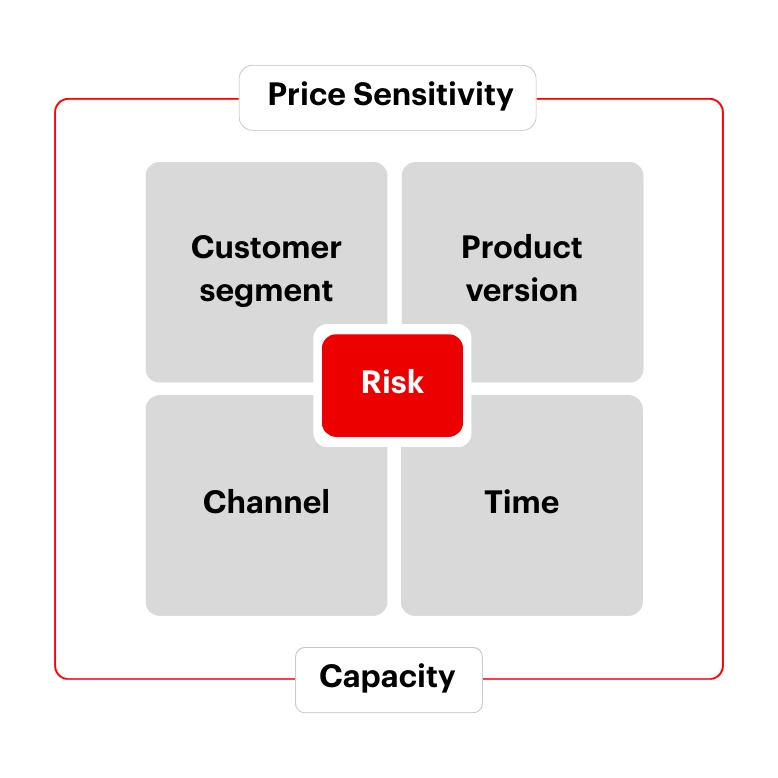
Most pricing decisions can be organized around four primary factors:
Price Sensitivity
Some (if not all) of the above factors correlate strongly with the Price Sensitivity of target customers, influencing their purchasing behavior. Using data and analytics to understand the price sensitivity of relatively narrow customer segments — to a given product, delivered through a given channel, at a given time — is key to setting the right price and then updating it accordingly.
Capacity
Another overarching variable that influences what’s feasible and what will work is Capacity. To optimize revenue through pricing, you have to stay fully on top of your capacity to deliver (e.g., seats, rooms, slots, inventory, hours of service). This means knowing exactly the resources and volumes available at any given time, as well as their utilization rates, both current and future, to prevent waste (through underutilization) or lost sales (by running out or failing to deliver as promised).
Risk
At the center of everything sits Risk. When the whole pricing process takes place under significant demand uncertainty, I like to think of it as a portfolio selection problem. In other words, in every pricing decision, you’re weighing the expected revenue or profitability against the risk of losses, which means you have to keep hedging your bets. And as with any portfolio, it pays to diversify. You might even find yourself sacrificing a bit of revenue or profitability at times if, in the end, it means substantially reducing the risk levels in certain factors.
Not all factors and constraints described above may apply at once. The pricing decision-maker must continually evaluate and identify the relevant dimensions on a case-by-case basis. But your lodestar is this: to offer the right product to the right customer at the right time via the right channel and at the right price.
Main data-driven pricing methods
There are various ways in which the previously described principles, factors and constraints of data-driven pricing manifest themselves in practice, according to the nature of the industry/sector and of the product/service offering. I’ll highlight the main ones.
Revenue management
As discussed with the airline example, certain key factors lend themselves to revenue management, namely:
- high fixed costs.
- relatively fixed capacity.
- perishable service capacity.
- time-variable demand.
- an ability to forecast.
These same factors apply to hotels, car rentals, freight transportation, cruises, cloud computing and the like. In such cases, it pays to introduce pricing tiers and reserve some capacity for different types of customers, to avoid selling out too early.
Personalized/customized pricing
This method entails tailoring prices to customer characteristics. This would be a pricing strategy used by banks and insurance companies. By analyzing transaction data and risk profiles, banks and insurance companies can adjust rates and fees according to individual clients.
The same applies in B2B settings like consulting. What’s the best bid for a project? Instead of one-size-fits-all pricing, consultants can aggregate CRM data, real-time demand and competitor pricing to optimize margins for each client segment.
That being said, here is where intuition and experience may come in, because sometimes the data can point you in the wrong direction, e.g., if it is limited in size or biased. Personalized pricing, by nature, requires that a degree of personal judgment be applied to what the data is telling you. In some cases, your intuition may function as a hypothesis, which you then test out with data, rather than letting the data alone determine your pricing.
Dynamic pricing
This is what most of us are familiar with when we think of Uber or Amazon: real-time price adjustments that go up and down in response to fluctuations in supply and demand and competitor pricing. Although digital apps have turbocharged the practice, the same phenomenon happens with utilities: the price of electricity goes up or down at different times of the day when there are different consumption patterns.

It also happens with ticket sales. Take Bruce Springsteen’s 2023 concert tour, which my IESE colleague Fede Sabria and I both wrote a case study about. As demand for tickets was expected to exceed supply, the rockstar and his agent decided to allocate some tickets to Ticketmaster’s Official Platinum Seats program, which meant they would be priced dynamically.
Ostensibly, this practice is meant to set aside a certain number of seats to be sold at “market rates.” The problem is when the market rate goes through the roof, those seats end up costing several thousands of dollars each, and they aren’t even the best seats in the house. Two fans can be seated close to each other, with one paying $200 and the other $2,000 for a seat that is otherwise identical.
This is the danger of dynamic pricing schemes as opposed to tiered pricing, where prices are set the same per section (floor, lower/middle/upper tier, box seat, standing room only). When opting for dynamic pricing, there’s more to consider than just “the market rate,” as Springsteen found out the hard way. As our case explores, questions of fairness must also be factored into any pricing decision. Springsteen, idolized as a working-class hero, faced a huge public backlash for selling tickets that cost nearly 10% of someone’s yearly take-home pay. It was for that reason that Taylor Swift avoided using Ticketmaster’s Official Platinum Seats program in her subsequent Eras Tour.
Perceptions of price-gouging can leave a bad taste and degrade your brand, undermining your future profitability and performance. Just because you can optimize pricing doesn’t mean you should on every occasion. Your pricing strategy must reflect your brand identity, values and mission, especially when trust is key to your business proposition.
AI is no substitute for human managers in pricing decisions
Concerns like these are growing bigger with the widespread adoption of AI tools to automate pricing, particularly in dynamic pricing scenarios. I would emphasize that AI is a tool, which can enhance data analytics and pricing decisions, but it shouldn’t eliminate human judgment. Human managers must sense-check pricing models, especially in high-stakes contexts.

Javier Egaña (pictured) is an executive with vast experience in using data and analytics to generate revenue growth in areas as diverse as airlines and the wine industry, in B2B as well as in B2C settings.
Regarding the use of AI in pricing decisions, he puts it this way: If a hospital patient were alive for nine days but died on the tenth day, how would you feel about an AI-generated report saying: “Everything fine 90% of the time; only 10% failure rate”?
“Evidence” works both ways as data is often unstructured and open to interpretation. Egaña insists on keeping your antennas up, constantly receiving new signals from the market and always being prepared to adapt course in response to incoming information. Don’t put blind faith in automated reports or analyses, even if they come from advanced AI.
As much as Egaña believes in the power of data and analytics to improve pricing decisions, he stresses the importance of human instinct and judgment.
The best data-driven pricing experts are those who keep it simple, he says. They ask good business questions, first and foremost, and then apply data to test those questions and arrive at conclusions.
His other advice: Culture matters. No matter how much empirical evidence you present in support of a pricing decision, not every organizational member will embrace it. Even if the CEO supports it, you may face internal pushback at the functional unit level.
Egaña recommends identifying the enthusiasts in the organization and building alliances with them. Start small with simple experiments and then build outward from there to overcome organizational detractors. While it helps to have buy-in from the top, it may be more effective to start with those at the operational level.
And be sure to measure the impact of pricing decisions and communicate the results, because if you’re achieving good results, it becomes that much harder for detractors to say no, and you’re much more likely to win them over.
To this end, Egaña is a big fan of data visualizations. Too many spreadsheets can make people’s eyes glaze over, but data visualization tools can help bring numbers to life with a compelling chart or eye-popping infographic. Oftentimes, seeing is believing.
Who should own pricing?
This leads to another make-or-break consideration: Who in your organization should lead this price-setting function? Should it be Sales, Marketing, Finance or Operations? We even see some firms appointing a Chief Revenue Officer (CRO) to centralize authority. Yet, in case after case, we see there’s no strong consensus.
I would say three things. One is that pricing decisions need cross-functional input and executive sponsorship. To Egaña’s point, organizational dynamics matter. Many people have vested interests and stakes in setting prices. For that reason, data analyses, and the insights to be drawn from them, should not belong to any one person. It may be necessary to align incentives to ensure individual members are being measured consistent with corporate pricing goals.
Second, the sharing of multiple perspectives helps, not only to avoid bias, but also to enrich the learning. Sharing your intuition, your data and your analyses with colleagues, including those from other areas of your company, can help you spot things you hadn’t thought about before — revealing blind spots, opening your mind to new possibilities, and unblocking some issues or constraints you might have been facing in your analyses.
Finally, and most important, data is useless without skilled interpreters. Of course, you need technical experts skilled in data analytics and, increasingly, AI. However, the ability of data scientists to connect data analyses to pricing tactics, and to internalize the strategic trade-offs of the company, may be limited. This requires executives with the ability to assemble, lead and collaborate effectively with cross-functional teams that include both managers and data scientists — not just people proficient in Excel.
The beauty of data-driven pricing is that, even the tiniest revenue improvement can have a disproportionately large effect on the bottom line because it leaves the cost of goods sold (COGS) mostly unaffected. But it’s for this very same reason you don’t want to let novices make consequential decisions based on bad or clumsy interpretations of the data. As I stated before, data-driven pricing isn’t just technical — it’s strategic, tactical and operational, with ethical implications for your reputation and brand values. You might even say it’s priceless.
MORE INFO:
IESE Business School offers a live-online Focused Program on Data-Driven Pricing, aimed at managers with responsibilities for pricing, revenue growth, sales, marketing, commercial finance, operations and supply chains. Find out more about this program, and the date of the next intake, here.
The business case study “Born in the U.S.A. and Priced by Ticketmaster: Bruce Springsteen and The E-Street Band 2023 Tour,” by Mihalis G. Markakis and Fede Sabria, is available from IESE Publishing.
This article is included in IESE Business School Insight online magazine No. 172 (May-Aug. 2026).
READ ALSO:
Using data to drive better business decisions
TSMC: lessons in strategy and operational excellence from the world’s chipmaker
Hurry! Only 3 left in stock! When scarcity signals are most powerful