
A record in new international search funds launched
Search funds remain an attractive model for young talent to acquire and run a company, with global acquisitions reaching a new high and eight new markets debuting.

- The search funds launched internationally in 2025 outnumber those formed in the U.S. and Canada for the first time, and the model has debuted in eight additional markets.
- Return on investment (ROI) has risen from 2.0 to 2.8 times the invested capital, and the internal rate of return (IRR) increased from 18% to 30%, compared to the 2024 study.
- 73% of completed searches result in an acquisition, compared to 58% in the U.S. and Canada.
The international search fund model has achieved record results, with 96 new search funds launched in 2024 as well as 46 acquisitions in 2025, according to the latest report from IESE.
Search funds in the United States and Canada have long been the subject of an ongoing Stanford study. The IESE report studies search funds everywhere but those two countries, from 1992 to 2025.
The newest iteration of the report (register for free to download) shows the model continuing to mature globally, particularly in Europe and Latin America. Search funds are now present in 48 countries on five continents. Funds also debuted in eight new countries — Malaysia, Norway, Saudi Arabia, Singapore, Taiwan, Thailand, Turkey and Uruguay — while first-time acquisitions were reported in Austria, Singapore and South Africa.
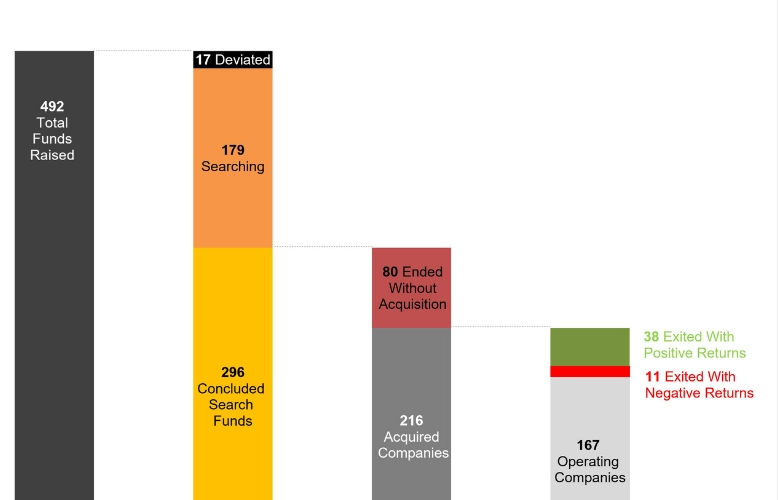
As of 2025 year-end, 179 of a total 492 international funds were either searching for or fundraising an acquisition. A further 216 had acquired companies, 80 had abandoned their search without acquiring and 17 had deviated from the search-fund model.
Of the 216 funds that had made an acquisition, 167 were operating the company, 38 exited with positive returns to investors and 11 exited at a loss.
The report also catalogues the financial returns from investing in search funds. There was an aggregate ROI of 2.8x (up from 2.0x from the 2024 study) and an IRR of 30% (up from 18% in the previous study).
Search funds are investment vehicles that allow an entrepreneur or “searcher” to raise capital from investors to find, acquire and manage an established small-to-medium-sized enterprise. They are a noteworthy way for people from a variety of professional backgrounds to gain CEO experience.
In this report, there were fewer searchers with MBAs than in previous iterations: 60% of the new cohort as compared to 71% overall.
Meanwhile, the number of female searchers has increased overall in the past five years but remains very low — 7% since 2022 and 5% overall.
Europe and Latin America are the biggest search fund ecosystems outside of the U.S. and Canada, with Spain, the United Kingdom, Italy, France and Germany featuring the largest number in Europe, while in Latin America, Mexico and Brazil lead the way, followed by Colombia, Chile and the Dominican Republic. Together, these two regions account for 88% of known international search funds and 93.5% of international acquisitions as of December 2025.
Among concluded international searches, 73% resulted in an acquisition, compared with 79% in the previous study. The corresponding rate reported for the U.S. and Canada was 58%.
More broadly, the international search fund model can be seen to be maturing. Terminated search funds (those that have reached a final conclusion, either by exiting with a gain/loss or closing without an acquisition) represented 23% of all international funds in the sample, up from 14% in the previous study.
What should searchers and their backers keep in mind as keys to success?
The report featured several takeaways that potential searchers and investors should keep in mind.
- Prioritize preparedness and continuous learning. Among searchers who recently concluded their searches, those who acquired a company typically signed their first LOI (letter of intent) by month six, compared with month eight among those who ended without an acquisition. They also reported fewer LOIs on average: 4.6 versus 8.2. These patterns reinforce the importance of engaging seriously with potential targets early while maintaining an active pipeline, although they do not establish why some searches resulted in an acquisition and others did not.
- Know the acquisition profile. In the international sample, recurring revenue exceeded two-thirds of total revenue in 59% of reported cases. Median EBITDA margins at acquisition were 26%, while median trailing annual revenue and EBITDA growth were 11% and 12%, respectively.
- Partner up? While multiple searchers working together don’t necessarily make for more profitable search funds, partnerships demonstrate slightly higher acquisition rates than solo searches (77.5% vs. 69.9%) and significantly lower rates of capital loss (12% vs. 27%), shifting the bulk of outcomes into the steady 2x–5x ROI range.
International search funds: the view from 2026
Since the first search fund was launched in 1984, the core model has continued to grow and gain popularity and is now spreading across the globe through the efforts of international entrepreneurs. While remaining a small asset class overall, this study may show a historical inflection point in both exposure and maturity.
As of December 2025, nearly a quarter of known search fund businesses had terminated, largely with strong returns, even as new searchers continue to bring the model to untried markets.
About the research
Based on surveys and quantitative research, this biennial report — conducted in close collaboration with the Stanford Graduate School of Business — analyzes the financial returns and other key characteristics of search funds identified outside the United States and Canada as of December 31, 2025.
ALSO OF INTEREST:
Search funds asset class maintains global growth
Why some search fund acquisitions fail and how to prevent it