
Keeping work human and relational in the age of AI
The real test of artificial intelligence is whether it strengthens the human relations that make work worth doing.

A company introduces generative AI (GenAI) for customer service. On the face of it, it makes sense — customer queries are dealt with faster — but the quality is questionable. Exchanges are efficient but less personal. The time saved is replaced with an ever-growing number of tasks resulting from the greater amount of customer data being generated. And though employees are freed from doing the same routine work as before, they find the new job demanded of them to be less meaningful.
This is what some people are experiencing as GenAI is rolled out across workplaces on the basis of speed, cost and output. But work is not just about those factors. Other measures matter: human agency, shared purpose, teamwork and dignity — both the dignity that is innate to the person (ontological) as well as social dignity, expressed in the quality and conditions of work and in the respect afforded to people through their work. These are things that managers must also pay attention to before introducing any new system that changes or potentially weakens the relational aspects of work that get people out of bed in the morning, beyond the need for pay.
This article proposes a relational test for AI adoption. As inevitable as the advent of AI may be, the form it takes is not. Whether AI acts as a help or hindrance depends, among other factors, on managerial choices.
Giulio Maspero and Ilaria Vigorelli, speakers at IESE’s Dignity at Work Conference, framed the issue in terms of the Latin words limes and limen. Limes is a boundary, which gives us the English word limit or limitation. Limen, on the other hand, means threshold, also a boundary but, as in the English derivative liminal, it’s more of a transitional space, an entryway from one place into another.
This is a useful way of thinking about technology in relation to work. AI may pose a barrier to relational work, but if managed well, it can become a doorway to relational work, opening pathways to more reciprocal trust, deeper social connection and collaborative achievement.
Let’s consider how.
The dehumanizing dangers posed by AI
Used well, AI can improve workers’ lives, removing repetitive tasks and allowing more flexibility and autonomy in how people organize their time and contribute their talents. Yet the same technology can also deepen dehumanizing tendencies already present in modern work. Job replacement springs to mind, but there are other dangers, such as:
Fragmentation
Digital platforms make it easier to assemble teams quickly and distribute tasks globally for project-based work. This less hierarchical, more networked form of work brings flexibility but also runs the risk of reducing people to interchangeable parts who come together and disband as soon as they are no longer needed. The worker feels less a member of a community, and more a temporary input in someone else’s workflow.
Surveillance
Meta announced it was adjusting its practice of using AI to track employees’ computer keystrokes and mouse clicks in order to train their AI models, after receiving pushback from employees. Subjecting workers to tech surveillance like this feels “very dystopian,” in the words of one employee, and raises fears that the company is not fully trusting its employees but is actively training the AI to replace them.
Standardization and depersonalization
In another concerning development, a Canadian telecom company, Telus, built an AI tool to modify the voices of call center workers in real time. The justification was that customers would be better served if workers’ accents could be smoothed out, reducing “accent-related frictions.” However, as IESE Prof. Sampsa Samila has pointed out, this raises uncomfortable questions, not least: “What message does this send to workers whose accents are treated as something to be corrected? This is but one example of a much bigger issue: not just what the AI is capable of doing, but what it should be doing when it changes the human layer of a service.”
Cognitive overload
AI is often sold as a time-saving tool. But many workers report feeling overwhelmed and mentally fatigued by the cognitive demands of AI, in a phenomenon that Boston Consulting Group has termed “AI brain fry,” making people want to quit. In the BCG survey, workers said AI had increased their workload, including having to pay more attention and rigorously sense-check the greater number of outputs.
In each of these cases, AI acts as a limes: a boundary among workers (fragmentation), a boundary between the worker and the firm (surveillance) and a boundary between the worker and themselves (standardization, depersonalization and cognitive overload).
A limen view asks: How can AI help people become more capable, more trusted, more cooperative and more present for one another?
A relational test for AI
To help managers move in this direction, together with Pablo Garcia-Ruiz (University of Zaragoza, Spain) and Javier Pinto-Garay (University of the Andes, Chile), I use a framework inspired by the Italian sociologist Pierpaolo Donati to examine work as a social relation, known as AGIL.
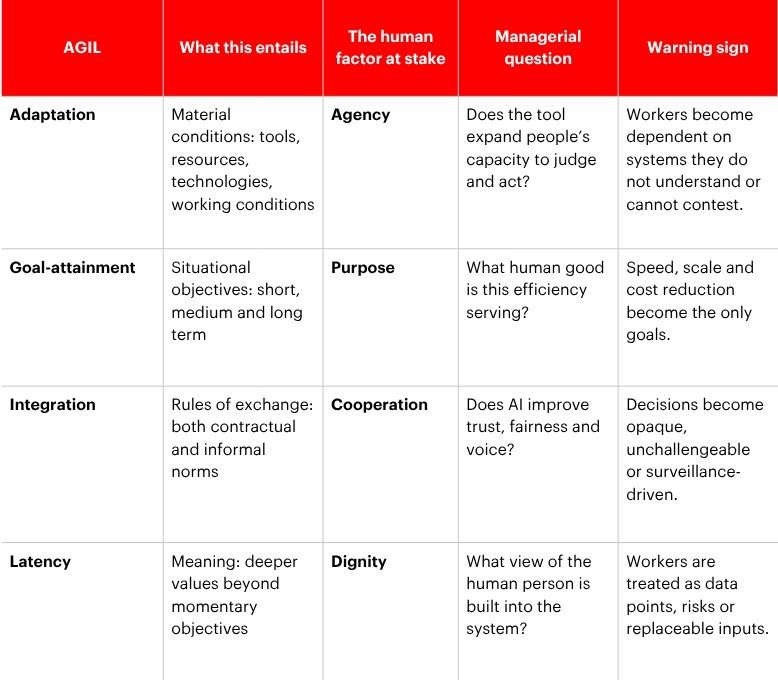
Most conversations about AI begin with tools: what can be automated, accelerated, predicted or controlled. In practice, however, what we need to focus on is how AI redistributes power, alters expectations and reshapes what people understand their work to mean. This can be summed up like this:
Adaptation/Agency
AI usually enters the organization as a resource, a tool that removes friction, accelerates access to information and/or performs tasks previously done by people. The relational test asks: Does this tool enlarge human agency, or does it make people dependent on systems they do not understand and cannot challenge? A technology that saves time while narrowing individual discretion may increase output yet still diminish work.
Goal-attainment/Purpose
AI can help organizations pursue better service, deeper learning, higher quality and more creative problem-solving. It can also narrow work to cost reduction, speed and volume. The relational test asks: What human good is this efficiency serving? Efficiency is never morally neutral when it reorganizes human time, attention and responsibility.
Integration/Cooperation
Work depends on rules, norms, expectations and forms of mutual accountability. When AI enters decisions about hiring, scheduling, performance evaluation, promotion or workflow design, accountability becomes harder to locate, and contesting a decision becomes more difficult. The relational test asks: Does AI improve trust, fairness and voice, especially when challenging seemingly “objective” data-driven decisions and outputs?
Latency/Dignity
The most important AI question may be the least technical one: What view of the human person is built into the system? A cost? A risk? A source of data? A bundle of skills? A creative agent? A member of a community? A person endowed with inherent dignity and worth, capable of personal/professional growth while contributing to a common project?
The strength of the relational test lies in the interdependence of all four elements.
Going back to our opening example, a company that introduces GenAI for customer service needs to really think about what counts as good service:
- Do customers value a human encounter or a simulation of one?
- How much discretion do human agents retain and how will they be evaluated going forward?
- How might this affect team trust and the dignity people feel when their work is being dictated to them by an algorithm?
- How might this affect their life beyond work, in their personal and familial relationships?
Measuring what matters
The challenge for companies is that they aren’t as used to measuring relational factors. But if the saying is right, “What gets measured matters,” then managers need to prioritize measuring relational goods just as much as they do cost savings. As discussed at our Dignity at Work Conference, relational goods are no less important for a business and deserve to be incorporated into our KPIs for evaluating AI implementation.
Trust is one important metric. A team that trusts each other can coordinate among themselves better. And a worker who feels recognized and valued will exercise their judgment with greater confidence. Trust could be measured through pulse surveys, administered before AI deployment and at regular intervals afterward, asking whether employees perceive the technology as reliable, fair, transparent and supportive of good judgment. Since surveys capture perceptions rather than trust itself, responses could be triangulated with behavioral indicators such as AI adoption rates and, tellingly, employees’ willingness to question or override the AI when appropriate.
Relational questions for managers
Before and after introducing AI, leaders should ask:
- Will/Has this system increase(d) or reduce(d) workers’ discretion?
- Are AI-assisted decisions intelligible and contestable?
- Will/Has the time saved become time for judgment, mentoring and service, or merely more tasks?
- What forms of (individual and team) contribution will/have become more visible, and which will/have disappear(ed)?
- Will/Do workers feel more trusted, or only more measured?
- Will/Has the technology strengthen(ed) the relationships on which good work depends?
These questions don’t cover everything, but they do help keep the relational issues top of mind. They are a useful check on whether the organization retains the vital human dimension as technology is increasingly implemented.
Another metric is time savings. What are we doing with all the time that AI is supposedly giving us back? The answer cannot simply be “more work.” A better metric might be “presence.” Giving each other our full attention. Not imposing our own schedules, but accepting and adapting to the time of the other person. Listening. Making space for personal encounters that nurture quality human relationships.
In this sense, we should be assessing the extent to which teams are becoming more present for one another, making room for deliberation, mentoring, gratitude, correction, constructive disagreement and care. In other words, making room for teams to be more fully human.
The same goes for how we understand productivity, not merely as the ratio between inputs and outputs, but as the quality of the relationships through which value is created. A technology becomes truly productive when it strengthens the relational fabric that allows people to contribute well over time. Conversely, if people trust one another less, learn less, care less or see less meaning in what they do, is that not counterproductive?
For managers, ensuring every AI implementation incorporates a relational view is a conscious choice that takes discipline. Assessing whether a system improves the quality of cooperation, learning, autonomy, mentoring, attention and reflection can be harder to quantify than cost and time spent, but that is no reason not to do it. In my experience, for managers who commit to take the relational view seriously, they are likely to see payoffs after three to six months.
The benefits of a positively relational workplace
Dignity at work is not an abstraction; it is made practical through how tasks are designed, how time is allocated, how performance is interpreted, how voice is protected, how mistakes are handled and how people are seen. A technology that ignores such factors may still produce efficiency gains, but it will do so at the cost of the relationships that allow work to be a human good.
A positively relational workplace sees workers as persons embedded in networks of relationship: with customers, colleagues and managers, of course, but also with friends, families, communities and with themselves. This does not make work less serious or less demanding. It makes it even more serious, because every redesign of work also redesigns a part of human life.
At its best, work has a gift-like dimension. Work remains paid, measured and organized. Even so, people give something of themselves in ways that exceed what can be extracted from them. A worker gives attention, skill, patience, imagination, loyalty, correction and service. An organization, in return, gives more than compensation: recognition, trust, development, belonging and a space in which agency can grow.
AI will test whether we still understand and appreciate this. It will ask, with ever greater urgency, whether work is merely a bundle of tasks waiting to be automated, or a human relationship that deserves to be cultivated. Adopted only to accelerate output, AI may bring efficiency while eroding the conditions of meaningful work. Used as a threshold (limen), it may help make more room for what remains properly human: judgment, responsibility, service and presence.
MORE INFO: “The digital transformation of work: a relational view,” by Carlos Rodriguez-Lluesma, Pablo Garcia-Ruiz and Javier Pinto-Garay, is published in Business Ethics, the Environment & Responsibility.
Giulio Maspero spoke on “The dignity of work: a relational view” and Ilaria Vigorelli spoke on “Being and thriving together: ontological relations and the future of work” during the Dignity at Work Conference, which was held at IESE Barcelona in March 2026, and which was organized by Mireia Las Heras, Carlos Rodriguez-Lluesma and Maria Puig, executive director of the Dignity, Diversity & Belonging Office at IESE.
A summary report on the Dignity at Work Conference, called “Dignity at work in the age of AI: Rethinking work, meaning and human flourishing,” by Carlos Rodriguez-Lluesma and Mireia Las Heras, is free to download here.
This article is included in IESE Business School Insight online magazine No. 173 (Sept.-Dec. 2026).
READ ALSO: