What great artists can teach us about great leadership
Vision, imagining possibilities, inspiring others: Art and business leadership have these in common. This is the art of leadership.
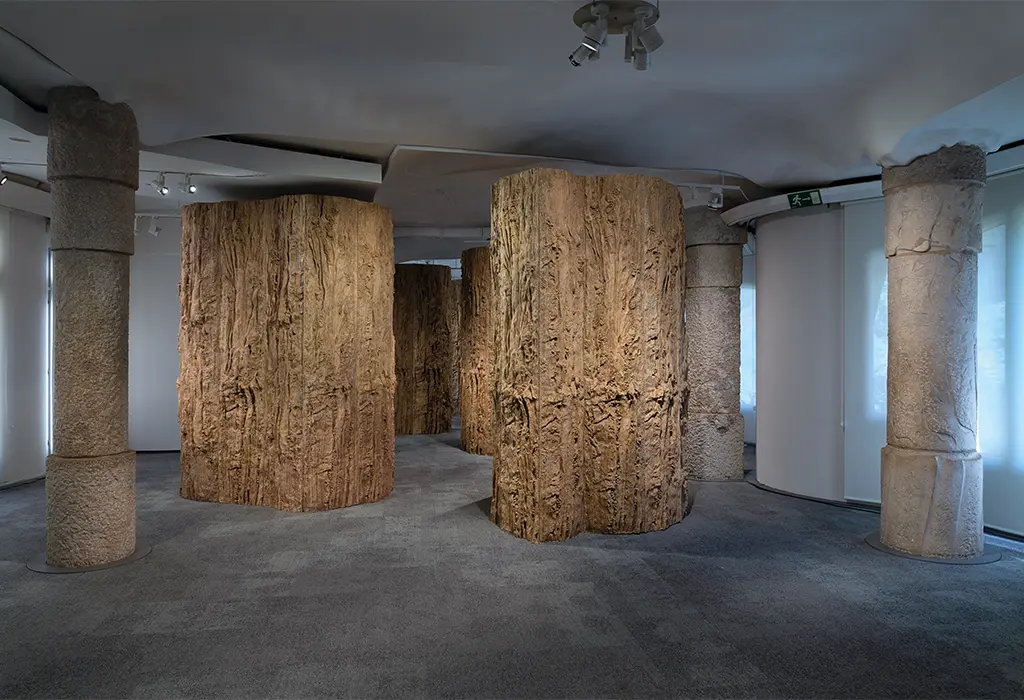
“What do great leaders and great artists have in common?” So asked McGill University professor Nancy Adler at the conference “Building Bridges in a Fragmented World Economy,” held on IESE Business School’s Barcelona campus in April 2026. Her answer: “They share three fundamental things: the courage to see reality as it is, the courage to imagine possibilities, and the courage to inspire people.”
Speaking on the same campus a month earlier as part of the Dignity at Work Conference, the Spanish artist and sculptor Cristina Iglesias also talked about having the courage of your convictions: “You shouldn’t wait for external recognition before doing good work.”
This capacity to see, imagine and inspire — as Adler describes it, and as Iglesias practices it through “the quiet dignity of excellence without recognition” — finds perhaps its most visible embodiment in Antoni Gaudi’s Sagrada Familia. Barcelona’s emblematic basilica is attracting global attention this year, thanks to an extraordinary convergence of events: the centenary of its architect’s death; the crowning of the last of its towers; the visit of Pope Leo XIV to bless it; and the imminent decision over who will finish the Glory facade, with Iglesias among the three finalists. “Gaudi’s Sagrada Familia offers profound lessons in how to imbue projects with vision, mission and innovation,” says IESE Prof. Yih-Teen Lee.
This is precisely what art has been doing for centuries. So what lessons can we draw for leadership?
The courage to see reality without delusion
What are you failing to see in your organization or competitive environment? The first attribute shared by great leaders and great artists is “the courage to see reality not as we would like it to be, nor as we fear it will be, but accurately as it really is,” says Adler. To develop this way of seeing, she recommends adopting “the eclectic perspective,” drawing upon “a much wider range of data to come up with ideas that are radically different, even those that might be considered absurd.”
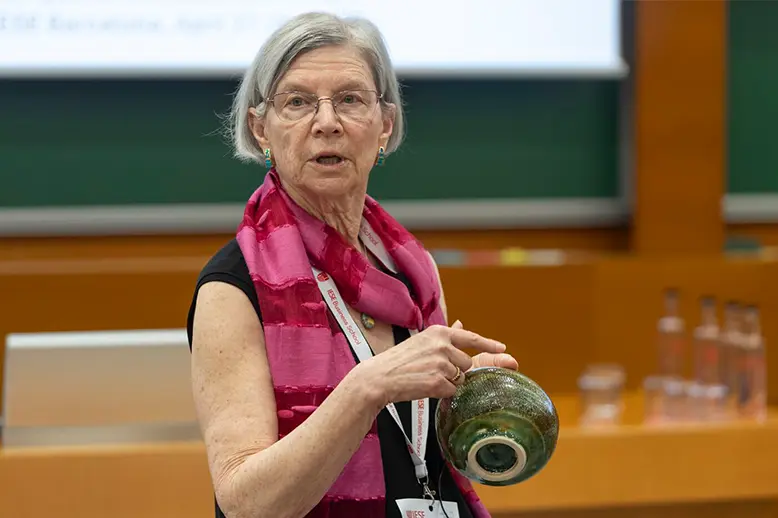
Nancy Adler spoke on “Finding Beauty in a Fractured World” at IESE Barcelona. © Roger Rovira.
Adler illustrates the point with a well-known experiment launched in the late ’90s at Yale, where medical school students were divided into two groups: one group took an art history class, and the other control group did not. The students trained in studying British paintings demonstrated better observational skills, asked more questions and made more correct diagnoses than those who had not received any visual art training. Her conclusion: “Being open to a whole wide range of what might be relevant helps you see more things. You have to be humble enough to accept you don’t know everything, and curious enough to keep looking.”
Similar thinking led Marc Badia and Julia Gifra to incorporate more humanities content into the IESE MBA program. “Humanities broaden one’s perspective and can help leaders think more critically and creatively in today’s complex world,” they observe.
Seeing reality accurately means taking a step back to avoid falling into the trap of certitude, leading to delusional arrogance. Adler suggests asking yourself two key questions:
- What are the overly convenient falsehoods that are guiding my thinking?
- What is the inconvenient truth that feels dangerous to say out loud, either because others will condemn me for it, or because I just don’t want it to be true?
Next, Adler calls for “positive deviance,” looking for the outliers that are performing well, and then moving them into the mainstream.
That is essentially what Yale did through its art experiment: Its Program for Humanities in Medicine is now part of the curriculum at Yale School of Medicine. This “positively deviant” idea has also been replicated at numerous leading medical schools around the world.
Med students contemplate life at the University of Navarra Museum
The Spanish artist Antoni Tapies believed that a work of art should leave the viewer perplexed and prompt reflection on the meaning of life. That same impact is what the University of Navarra Museum in Pamplona, Spain, has sought to instill since it opened in 2015.
Dr. Carlos Centeno Cortes, specialist in palliative medicine at the Clínica of the University of Navarra, experiences it every time he takes his med students to stand before one of the museum’s works — a canvas Mark Rothko painted just months before taking his own life — so they can explore themes of dignity, suffering and death.
Professors of medicine, nursing and other disciplines regularly teach classes in front of works from the museum’s collection in order to develop empathy, emotional intelligence and care for patients with serious illnesses.
“Our goal is to integrate art into our students’ lives,” explains Jaime Garcia del Barrio, director of the University of Navarra Museum.
The museum was recently commended by the International Council of Museums for its innovative use of art as an interdisciplinary learning tool.
For the fall of 2026, the museum is preparing an exhibition with the university’s Science Museum on color: how it helps us perceive things in context and see and value differences; how it enables living beings to distinguish themselves, protect themselves, feed and reproduce; and why color is fundamental to every field of knowledge.
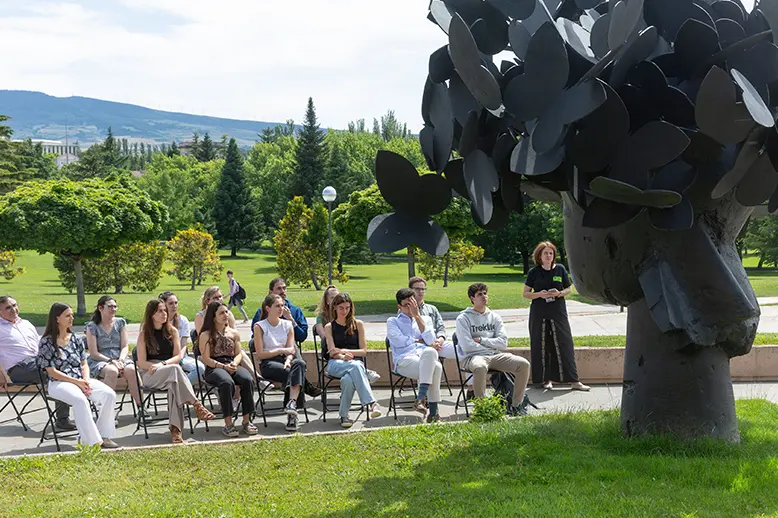
Students at the University of Navarra in Pamplona, Spain, ponder a work of art on campus as an integral part of their learning experience. Photo courtesy of the University of Navarra Museum © Manuel Castells.
The art of seeing the unseen
For Spanish artist Iglesias, opening one’s eyes fully means “listening to space,” being “in the atmosphere of perception.” Walking, running, reading or drawing helps her clarify ideas when she is away from the studio: “These activities take you to places you do not control, where ideas can emerge, as well as the attitude needed to face challenges.” It’s proof that seemingly unproductive activities can be revelatory moments.
A well-designed work environment, she adds, “should offer different degrees of intimacy, places for concentration and others for encounter. It’s not only about functionality but about creating an environment that enables richer, more collaborative relationships.”
The deep attention she calls for is not a solitary act. “An artist must demand the utmost of herself,” she says, but she demands the same of her team. Together, they treat each project as a unique challenge to do something they have never done before. “It’s essential that the team perceives that you are as demanding of yourself as you are of them, and that you remain alert to possibilities, always trying to find the best option.”
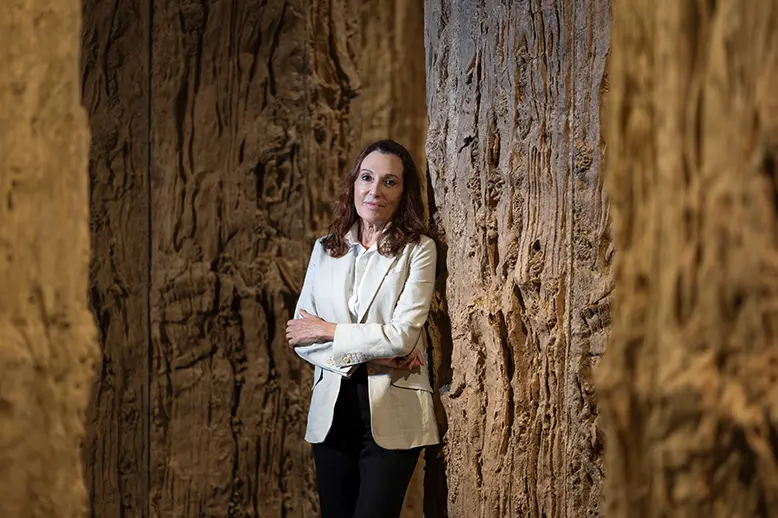
Spanish artist Cristina Iglesias stands beside her installation in Gaudí’s La Pedrera in Barcelona. © Fundació Catalunya La Pedrera/Pau Fabregat. © Cristina Iglesias, VEGAP, Madrid, 2026. Photo courtesy of the artist and Hauser & Wirth.
The most demanding work, she says, is often what no one sees. Working with a variety of materials (including steel, water, glass, bronze, bamboo and straw) requires “very precise attention to detail and designing solutions that, if they are really good, no one will actually see because they are invisible.” In both art and business leadership, the invisible is often what holds the project or organization together.
The courage to imagine possibilities
How many good ideas die in your company because they are dismissed too soon? Those who make a difference imagine possibilities, “even when others think you’re naive or uninformed, that you simply don’t get how complex the global business world actually is, and they list all the reasons why it won’t work,” says Adler.
The Venezuelan economist Jose Antonio Abreu encountered this when he proposed doing something radically different to address child poverty in the 1970s, having seen traditional methods weren’t working. His idea was to use music to improve the lives of Venezuela’s children. He founded El Sistema, a publicly funded program of youth orchestras and choirs in disadvantaged neighborhoods. It proved to be a highly effective tool for social development and poverty alleviation: Children stayed in school longer, earned better grades, learned discipline and teamwork, gained self-esteem, and became more engaged in their communities. The award-winning model of social-action music initiatives is now practiced in more than 70 countries.
One of El Sistema’s most famous alumni is Gustavo Dudamel, the Venezuelan conductor of the Los Angeles Philharmonic and the New York Philharmonic. Another Venezuelan conductor, Pablo Gonzalez, a disciple of Dudamel, founded Vozes in Barcelona to provide free music education for children and youth at risk of exclusion. In 2025, Vozes was awarded Spain’s Gold Medal of Merit in the Fine Arts.
Sir Clive Gillinson imagined similar possibilities when he moved from London Symphony Orchestra to become the executive and artistic director of New York’s famous Carnegie Hall in 2005. To raise money, he knew he needed to cast an inspiring vision. “You never chase the money,” he told IESE Insight. “Money follows vision, so you’ve got to start with a compelling vision. Then you share that vision with people who care about it, and special things happen.”
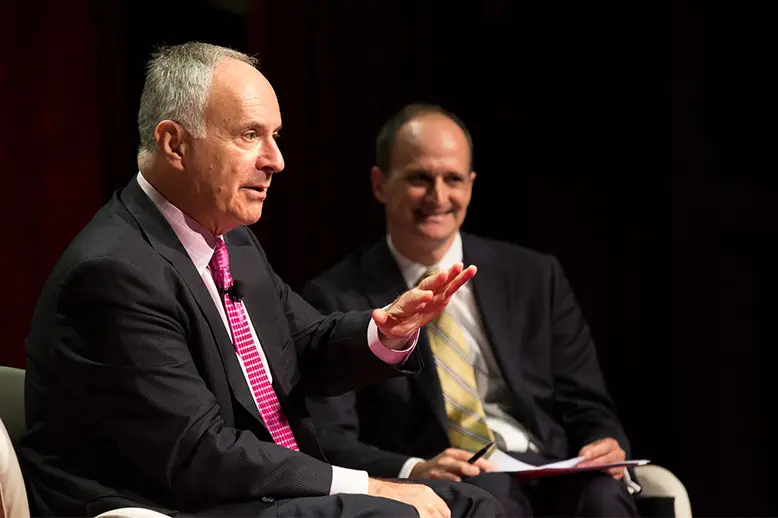
Sir Clive Gillinson, pictured here with IESE Prof. John Almandoz at the 2018 Global Alumni Reunion in New York City, is the subject of a new case study on transformative leadership insights from the arts.
His vision included a series of music education programs to make the arts accessible to people from all walks of life. This led to the setting up of a National Youth Orchestra as well as music programs for inmates at New York State’s Sing Sing prison. As Gillinson told IESE Prof. John Almandoz for a case study on transformative leadership insights from the arts, imagining possibilities requires the courage to ask: “Can the world live without this? It’s no good if people say, ‘That’s fine.’ When you talk to somebody about a project, you’ve got to create the feeling that it’s irresistible. And then engage other people as partners in making the dream come true.”
The courage to inspire people
Gillinson’s comment brings us to the third courageous thing that great artists and great leaders do: not just inspiring other people for inspiration’s sake, but, in the words of Adler, “inspiring people to move them from the current reality to the new possibility.”
Adler cites another “positively deviant” example, this time from war-torn Sarajevo in the ’90s, when a Catholic monk, Father Ivo Markovic, set up an interfaith choir to bridge ethnic and religious divides and help heal the wounds of war. He took a risk in inviting Muslims to sing their own religious songs in a Catholic church, but it proved to be a powerful means of reconciliation. The choir — called Pontanima, a portmanteau of pont, meaning bridge, and anima, meaning soul — remains active today.
Iglesias’ form of inspiration also invites people to cross boundaries and participate in the work, physically as well as moving them emotionally and spiritually. Many of her pieces are gates, passageways, mazes and pavilions that visitors must pass through, slowly and deliberately. She insists this is even more important in a world of artificial intelligence: “Our relationship with physical matter and space is unique. Memory is built through physical experience, through what is lived.”
Gaudi understood this, which is why his work continues to inspire, generation after generation, 100 years after his death.
Designing an inspiring context in which others can flourish and grow is, for IESE Prof. Mireia Las Heras, one of the great responsibilities of management. To preserve the meaning of work in the digital era, she urges HR managers, in particular, to ensure that “technological changes align with workers’ rights and welfare, designing opportunities for them to interpret digital work in ways meaningful to them and which will enhance their sense of meaningfulness and individual development. Understanding employees’ feelings and actions, and actively enlisting them in ethical and participatory design, is essential for creating practices that will resonate,” she states.
Courage is needed to do all this when it sometimes feels like the world is against us. As IESE Prof. Sebastian Reiche notes, “The challenge for many organizations today is how to persist and navigate in such a fraught, broken context.” Yet this is precisely when art and business leadership need each other more than ever. Adler ends by quoting singer-songwriter Phil Ochs: “In such ugly times, the only true protest is beauty.”
MORE INFO:
Based on comments delivered during the conference “Building Bridges in a Fragmented World Economy,” organized by IESE and the Social Trends Institute under the direction of Jordi Canals, Sebastian Reiche and Yih-Teen Lee; and the Dignity at Work Conference, organized by Mireia Las Heras, Carlos Rodriguez-Lluesma and Maria Puig, executive director of the Dignity, Diversity & Belonging Office at IESE.
The case study “Transformative leadership insights from the arts: an interview with Sir Clive Gillinson” by John Almandoz is available from IESE Publishing.
This article is included in IESE Business School Insight online magazine No. 173 (Sept.-Dec. 2026).
READ ALSO:
Jaume Plensa: “Art is a bridge between people and cultures”
Budding talent: Achieving management zen through ikebana flower arrangement