Transform your teams through proximity
Two real-world organizational designs show how closeness can be fostered in distributed and decentralized teams for innovative results.
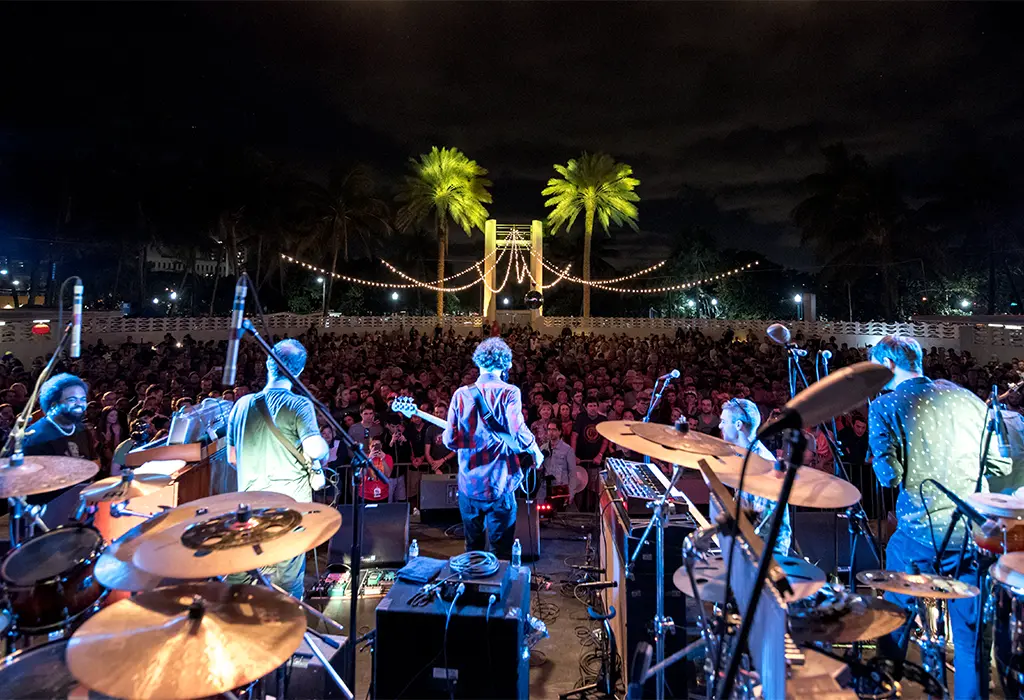
You’re in a small concert room, seated near the stage and among the musicians. From the quiet, there come a few staccato notes from the keyboard, joined by percussion, guitars and the brass section. Musicians riff off one another playfully, passing the melody back and forth between them, listening closely and creating a web of musical connections.
This isn’t just any band. It’s Snarky Puppy. Founded by bassist Michael League in 2004, this instrumental ensemble has recorded 10 studio albums that blend jazz, rock, world music and funk, winning five Grammy Awards.
Much of Snarky Puppy’s work is done remotely. With almost 30 musicians on the roster from countries as far-flung as Argentina, Japan and the United States, Snarky Puppy is what is known as a distributed team, where employees work together across geographical locations and time zones.
Song composition and rehearsals mostly occur asynchronously, and the band is a side gig for most members, who are also producers, lead artists and supporting musicians in other groups. Even on the same tour, band members may change from one concert to the next, which League likens to a line change in ice hockey. But a hockey team practices together. How can a band, or any team, create proximity when time, space and other commitments keep them apart?
A question of proximity
How do you cultivate closeness between people who often work far apart and on different schedules? This has become a defining challenge of our era. At its heart lies the question of how to manage autonomy.
Autonomy in management encompasses more than distributed teams, of course. For many years now, companies have experimented with reducing hierarchy. Startups and scale-ups have introduced novel, more decentralized forms of work design. This is no surprise: Traditional, hierarchical ways of working can stifle the autonomy, empowerment and distinctiveness we all appreciate and that young professionals, in particular, crave.
As organizations embrace new forms of working — decentralizing, reducing hierarchy or embracing radical distance — a key conundrum emerges: Without the usual organizational architecture, how does one promote proximity? Here, I consider two examples with some fascinating answers.
Jazzing up teams
Snarky Puppy (pictured below) is an example of a fluid empowered team with porous boundaries and high autonomy. Members come and go according to their respective commitments. Each contributes to composition and production, and each has the freedom to craft the live performance. Everyone has the same status and benefits. When disagreements arise, even though League reserves the right to make the final call, he usually sides with the majority.

Fluid empowered teams are not confined to the arts sector. They are common in open innovation projects or any place where many different people share a common concern or set of problems. For example, a distributed team of software developers in a global tech firm might come together to share coding tools and experiences when solving a complex programming problem. Alternatively, HR professionals responsible for different regions in a multinational company might collaborate to improve employee engagement or standardize HR practices globally.
There are many advantages to having a fluid empowered team, but it requires a new management tool kit. These are some practices that worked for League.
Embrace the side hustle
When League set out to form a band, he encountered a challenge that most startups and scale-ups know only too well: The talent was already committed elsewhere. To deal with this, he offered musicians the possibility of trying out his new band while maintaining their own projects — essentially, the promise of flexibility. It worked, and more than 20 years later, League remains the only full-time member of the ensemble.
Though it might seem counterintuitive to build a team in which everyone has a professional leg elsewhere, the Snarky Puppy model reflects some broader labor market trends, such as the desire for flexibility to fulfill one’s passions.
Research has shown that allowing employees their side hustle can actually boost their full-time job performance. It makes workers feel more empowered, resulting in positive emotions that they carry over into their day jobs, raising their performance overall. While being thrown into too many parallel projects can be overwhelming, being able to control the professional activities that are close to your heart is mentally engaging. And the more you have a highly motivated, high-performing team, the more you attract others in kind, achieving the desirable state known as “talent density.”
Make team members (in a positive sense) replaceable
Imagine you lead a team whose membership changes on a weekly basis. It is easy to foresee the chaos that might ensue unless team members can seamlessly slot in whenever it is their turn and hit the ground running. League’s solution is to have all musicians think like producers.
Producers need to understand the big picture of an entire song. While a typical musician tends to focus on learning his or her own part, Snarky Puppy members learn all parts of every song in their entirety, even though they might only play a few notes. This is essential because anyone may be asked on short notice to step in and fill a gap in a concert, and while members don’t need to play all instruments, they must know all parts of the song’s melody on their own.
Transferring this idea to corporate teams, it would be a tough sell to ask a customer relationship manager in a technology company to suddenly assume software maintenance tasks for a client. It could be argued that this isn’t an efficient way to operate. Why should people focus on the whole when their expertise is in one part? Yet it could also be argued that understanding some of the specifics of software maintenance would help the relationship manager better serve clients. Learning about colleagues’ roles might even lead to workflow improvements and innovation.
Create a demo culture
A fluid empowered team may cater to people’s need for distinctiveness and freedom, but how do you ensure high-level synchronous performance when most of the team’s interactions occur asynchronously and over distance? When rehearsals or meetings are impossible across time zones, how do you get everyone on the same page? This challenge calls for clear alignment.
At Snarky Puppy, uniting the team begins with every new composition. Each member is empowered to contribute ideas during composition and performance. However, whoever writes a song needs to draft it fully. Musicians present their compositions as a digital demo, which is available virtually and includes all different sections and parts. To provide more impetus for members to learn all parts of the new song, the demo doesn’t audibly differentiate between instruments.
Think of a demo as a minimum viable product, like startups use to secure venture funding or that product development teams present to obtain seed funding. In other words, a demo is a prototype that offers a taster and sketches a product’s main features. It provides direction and vision to the team, connecting everyone around a shared goal. In this sense, it is a source of alignment.
Snarky Puppy keeps the demo simple: Each song has a strong melody line, which is the glue that holds everything together, giving band members something to riff off, while offering easy recall to the audience. The time each musician must invest individually in learning the demo may be higher, but this means their collective meeting time will decline considerably.
In fact, collective rehearsal time is so drastically reduced that the band typically only rehearses once before recording a new album or immediately before going on tour. It is not that musicians spend more or less time on the job — they just spend their time differently.

Decentralizing with proximity
The second organization that has faced some of the same challenges is the Chinese white goods company Haier, but it has come up with entirely different answers. Between 2011 and 2017, I went to China and several other foreign locations with my IESE Business School colleagues Yih-Teen Lee and the late Carlos Sanchez-Runde to observe Haier’s unique management model up close.
Under Haier’s model, called RenDanHeYi, employees are expected to behave like entrepreneurs. There is no formal hierarchy. Instead, employees are directly accountable to their customers, and they operate on the principle of “zero distance to the customer.” To get close to their clients, employees work through roughly 4,000 autonomous units called microenterprises, comparable to startups but within firm boundaries.
These microenterprises are free to make strategic decisions in pursuit of value creation for their customers, recruit staff and distribute profits. Haier acts as an investor in each microenterprise and supplies them with resources, essentially creating a market within the firm. In the words of one director: “Haier doesn’t give you a job. You work in an open market. You need to find your own job and the resources to meet your goals.”
Within this internal market, employees remain mobile, as microenterprises are perpetually established and disbanded. Haier’s organizational boundaries are also porous, as microenterprises are encouraged to cultivate relationships with external partners.
To make this organizational model work, without each microenterprise drifting apart from core missions, there are some key features.
Make employees take ownership of their ideas
Say you’re working in Haier’s refrigerator unit and you have an idea for a fridge with a separate temperature gauge for each compartment, so wine, meat and vegetables can all be kept at optimum temperatures. It seems like something clients might like.
In this scenario, you would need to test your idea with prospective customers and write up a business plan. Your idea needs to be compelling and well devised because it will compete with other internal entrepreneurial projects.
You will also have to seek external funding before Haier will invest additional resources to develop your idea. Once financing has been secured, you create your microenterprise, hire employees and develop agreements with other microenterprises, such as the design unit that will model your product and the production unit that will manufacture it.
You will have full autonomy, like being the CEO of an independent company, but you are not untouchable. Fixed salaries are modest at Haier; most remuneration is performance-based. If you don’t achieve certain targets, fellow members of the microenterprise may vote you out of leadership. And if the enterprise fails, it will be disbanded and everyone will return to the internal talent market.
Autonomy, Accountability and Alignment
Neither the Snarky Puppy nor the Haier model is possible without what I call the AAA framework, standing for Autonomy, Accountability and Alignment.
In a typical organization, managers define work tasks and interfaces, and then evaluate results. As a result, accountability and alignment are inherently built into the formal work structure.
For companies that grant more autonomy, there’s an unofficial fourth A: alternatives. Put simply, the company needs to think about alternative means to craft additional accountability structures and provide more alignment. This might mean encouraging more feedback among peers to complement manager-led control. Or it might mean requiring staff to define, negotiate and regularly revise expectations to better align with other units.
Snarky Puppy’s solution to AAA is the demo, requiring each musician to learn all parts. Haier does it by having employees keep their own P&L statements, and their key objectives and performance indicators are tracked daily and displayed publicly. In Haier’s early days, footprints were painted on the factory floor, and each evening the lowest performers would step onto them and share their mistakes. Today, the footprints remain, though the approach is different. Top performers share best practices, or they hold group review meetings on the footprints to define and review targets. Frequent check-ins ensure continuous, sustained proximity among workers who might otherwise drift into unproductive disconnection.
Less conventional ways of working are not for every organization nor for every employee. Snarky Puppy’s musicians work within an ecosystem in which gig work is already the norm. Haier’s employees are often self-selecting, with those requiring a more predictable workplace choosing to go elsewhere while those with an entrepreneurial mindset flourish.
But one thing is for sure: Autonomy, done without sacrificing proximity, can lead to truly spectacular results.
Making it work for you
Not all teams can function with such high levels of empowerment as Snarky Puppy and the Haier microenterprises do. When I speak to executives, I tend to receive a long list of arguments for why fluid boundaries are difficult to implement, whether for compliance in highly regulated industries like banking and pharma, or due to structural constraints arising from the need to manage interfaces with many other internal teams.
Yet anyone who wants to boost their innovative capabilities should evaluate how open and self-directed their teams are. How rigid are current boundaries? How can you open things up while keeping people close?
Here are some ideas to consider:
MORE INFO:
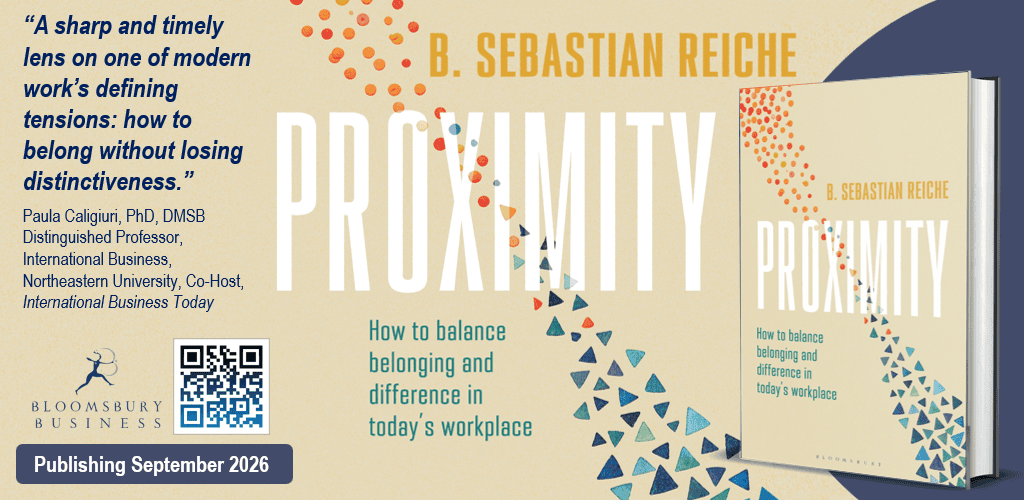
This article is adapted from the book Proximity: How to balance belonging and difference in today’s workplace by B. Sebastian Reiche (Bloomsbury, 2026).
This article forms part of IESE Business School Insight online magazine No. 173 (Sept.-Dec. 2026) and was also included in the special annual print edition, Insight for Global Leaders No. 2 (2026).
ALSO OF INTEREST:
Work design: What kind of workforce do you need?
All that jazz: how executives can inject improv into their organizations