
What’s the value of nature to your business? Nature on the balance sheet
From winemakers to data centers, natural capital is worth investing in. Here are the benefits of nature-based investment.
Vallformosa, a 150-year-old winery in Catalonia famous for its cava, became the first Spanish winery to earn B Corp certification. This resulted from a series of actions the company took to become more ecologically sustainable. They invested in solar panels to become energetically self-sufficient. They optimized production processes to use 40% less water than the industry average. To become 100% organic, they banned pesticides and fertilizers. To deal with climate change, they developed soil management protocols to improve rainwater infiltration during summer months, reduce erosion and enhance biodiversity, while also adopting special pruning techniques and erecting canopies to protect grapes from extreme weather conditions, such as heatwaves and droughts. They reintroduced native vine species, reused wastewater to revive a local stream, and reparceled area estates to revive local farming and foster local entrepreneurship.
This is an example, not just of a company caring about nature, but of how caring about nature ends up paying for itself. Vallformosa wasn’t doing all this just to achieve a certificate. It realized that doing this was the only way to stay in business and be profitable.
According to the European Central Bank, 75% of corporate bank loans are provided to companies highly dependent on at least one natural ecosystem service, such as clean water, healthy soil, flood protection or pollination. If you consider the record loss to nature and biodiversity that we have witnessed in the last year alone, through wildfires, heatwaves and flooding, that represents serious risk exposure.
Over the past decade, we have seen moves to put financial value on nature. The World Economic Forum (WEF) has estimated that half the world’s total GDP is moderately or highly dependent on nature and the ecosystem services it provides. The WEF has also identified 37 financial solutions to mobilize capital for nature, with investable returns.
It is more than just capital for conservation, the typical work of philanthropic foundations, which will always have its place. What we are talking about are businesses, banks and insurers interested in investing in eco services that reduce risks or mix the risks with rewards. For instance, if we preserve a natural ecosystem, an insurer can charge lower premiums. A winemaker like Vallformosa can reduce business risks while producing a better product.
This is about directing more private capital toward regenerative, rather than extractive, activity. It’s incentivizing everyone to find creative solutions, in each of their industries, to reduce the negative impact of their activity and increase the rewards of investing in nature, for themselves and for the positive spillovers on society as a whole.
Putting a price tag on nature
Making a risk/reward assessment is hard enough at the best of times, but when it concerns nature, it becomes even more challenging. It’s hard to put a price tag on nature.
A piece of land for building a hotel or apartment block will have a clear valuation. But what’s the value of leaving a wetland undeveloped? We can try to calculate it based on the known costs of flood damage from not having a wetland around. One study I conducted in the United States shows how wetland loss raises borrowing costs. In areas prone to flooding, investors demand higher interest rates (or yields) to compensate for their perceived risk. This means local governments (counties, municipalities and school districts) must pay more to borrow. Added to this are remediation costs and lower property values. We calculate a $74 billion hit to asset value just from the loss of this one ecosystem feature.
We can make similar calculations in relation to forests. In another U.S. study, I looked at the impact of forests on local economies, using data on temperatures, wind patterns, land cover and electricity consumption over a 38-year period (1985-2023). My co-authors and I found causal evidence that forests function as a natural hedge against extreme heat.
Basically, if you have a forest nearby, the local air temperature is going to be cooler than if the forest weren’t there. So, if you’re located downwind of a forest, you can substantially decrease your electricity consumption, specifically by using less air conditioning or less cooling energy in your business operations. Projecting ahead, we can model the effects of this pattern for companies located in areas subject to heatwaves, especially as temperatures are only expected to rise in the coming years.
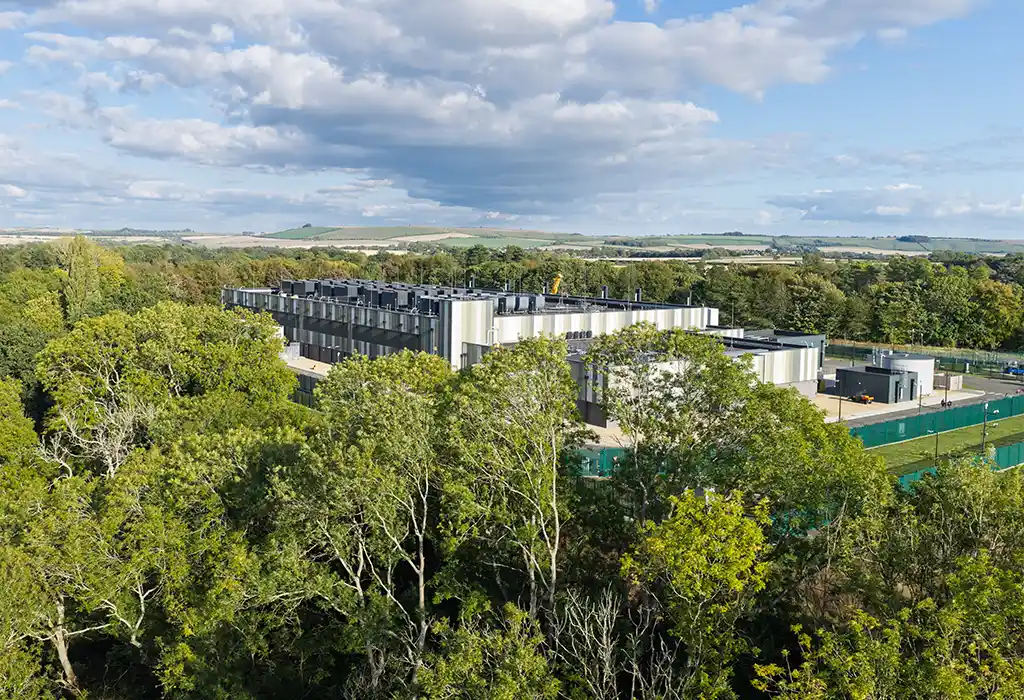
Our study holds implications for energy-hungry data centers, known for creating “heat islands” and whose electricity demand is rapidly rising. Crunching data on where these centers are built or planned to be built, we find that the existence or loss of forests in the vicinity has measurable economic impacts. The mitigation effect of investing in forests means less electricity needed for cooling, which lowers costs, but it also alleviates pressure on local power grids, lowers the air temperature and absorbs CO2 from the atmosphere, benefiting communities overall. We estimate the value gained from the cooling effect of forests to be $1.2 billion.
billion
The estimated value gained from the cooling effect of forests located near where data centers are built or planned to be built.
The mitigation effect
Investing in forests means less electricity needed for cooling, which lowers costs, but it also alleviates pressure on local power grids, lowers the air temperature and absorbs CO2 from the atmosphere, benefiting communities overall.
Working together helps diversify risk and boost impact
The challenge with investing in nature is that the gains, like those I’ve just described, are often localized. Encouraging nature investment at the national or global level is difficult when the benefits register at the individual or local level, and may not be extrapolatable.
But that is all the more reason to get creative with financial instruments. Exciting new things are being tried, such as water markets in Australia, another subject I am studying in earnest. Australia has a highly developed system of buying and selling water rights, bringing together public and private sector actors, from farmers and industries to cities and conservation groups. They trade water through exchanges, reallocating water to where and when it’s needed most, whether because of seasonal scarcity or for restoring river flows. Designing some type of system like this allows companies, municipalities and individuals to mutually capture positive spillovers. This dramatically incentivizes participation and investment. Everyone has skin in the game.
The way to attract more capital to nature is by demonstrating its value — measuring it, pricing it, and making the benefits of investment clear to everyone. Beyond investing in individual projects, it may be about investing in portfolios of individual projects that collectively have synergistic impact. If we start by defining all the things a region needs to be sustainable in the long term — the wetlands, the forests, the water sources — then our financial architectures, capital flows and investment instruments should reflect that systemic aspect accordingly.
A portfolio approach may also go some way toward convincing investors that nature is indeed investable. Generally, investors like to diversify their risks. Investing only in a locality carries more risk than diversifying that risk away through a wider portfolio of assets. This pooling or aggregation aspect can be more persuasive, both for spreading the risk and legitimizing the business case for institutional investors.
To incentivize governments to join with private investors, we must reinforce the idea of nature as a public good, with the positive spillover effects ultimately affecting the tax base.
I would also stress that nature investment is not necessarily investing in land (i.e., real estate). Again, we need to think at a systemic or ecosystem level, around all the services that support the land, which can be the real motivating factor for capital deployment.
Think of wildfires, which have devastating economic consequences, but the land itself is not doing any wildfire prevention. It’s the people who have access to the land who prevent the fires. The capital needs to be deployed to them, and their work is what increases the value of the land and the wider ecosystem that depends on it.
Wetlands are another example: Planting some native species or redirecting some water without owning the land can mitigate floods and their consequent damage. The capital needs to be deployed to wetland regeneration or water management projects, and that is how you generate impact. It’s almost counterintuitive, because the nature-based asset you’re investing in may not even be nature itself.
Caring is not a strategy
Finally, I would insist that the moral or ethical case for investing in nature (“because it’s the right thing to do”) is insufficient. I’m not saying we shouldn’t care, but in order to raise the big capital required to make a difference, the funding gap won’t be filled only by caring. The economic impacts of climate change will be massive, but the pitch cannot be, “We need to save planet Earth.” I’m not so sure that’s a sellable pitch for the relatively few people who command most of the world’s capital. And we need their investment.
Of course, it’s never either/or; it’s both/and. Recently we have seen some asset owners backing off their sustainability commitments because of the political backlash to ESG in the United States. At the same time, these are pragmatic people, moved by a value orientation. They understand this issue cannot simply be ignored. Many corporations and business leaders are still working to advance the agenda.
I recommend going to your Chief Sustainability Officer, CFO or even the CEO, and get them to value your company’s exposure to natural capital.
- What costs can you avoid if you invest in nature?
- What edge is nature providing during the bad times, such as when there is a drought, a wildfire or a flood?
- Enlist the help of academics, researchers and other experts in the field to really try to value your exposure and quantify the value of nature for your business.
- Involve policymakers who understand the importance of preserving nature.
- If you’re a local business owner, determine your place within the larger ecosystem or bioregion. Which other actors are ahead of you on this? Could you build an alliance with them, even if they seem unlikely partners? How can you pool the risk as well as the benefits?
Knowing where the value lies is key. That, in itself, is caring.
MORE INFO: This article is based on a talk delivered by Claudio Rizzi at the Invest in Nature conference held at IESE Business School in October 2026. It was organized under the auspices of the Institute for Sustainability Leadership, together with Nactiva, a platform to attract investment, develop business models, share knowledge and improve governance of the natural capital of the Mediterranean region.
“The market value of natural capital: evidence from wetland changes and immobile assets” by Claudio Rizzi and Ryan Lewis.
“The value of forests: impacts on extreme heat, electricity demand and municipal bonds” by Stefano Ramelli, Claudio Rizzi and Simon Xu.
Claudio Rizzi’s research has received funding from the European Union’s Research and Innovation Program under the Marie Sklodowska-Curie Actions 2023 call, Grant Agreement No. 101152801. Views and opinions expressed are, however, those of the authors only and do not necessarily reflect those of the European Union or European Research Executive Agency. Neither the European Union nor the granting authority can be held responsible for them.
Romain Boulongne and Francesc M. Arribas have prepared two case studies on Vallformosa winery, one on “Crafting a sustainability and impact strategy,” with Desiree Pacheco, and another on “Competing in a market of giants,” with Jordi Canals. Both are available from IESE Publishing.
This article is included in IESE Business School Insight online magazine No. 174 (Jan.-April 2027).
READ ALSO:
How destroying wetlands raises borrowing costs for local governments
The case for nature-based solutions, and how to finance them