
Leadership and sports, playing the long game
Beyond scoring goals, sports holds other powerful lessons for business: leadership excellence, decisive moves and game-changing strategies. Here’s how to play to win.

By Cristina Puig-Soler
Sports has never been just sports. At its best, “it elevates the human spirit, promotes discipline, perseverance and respect, and has the power to unite people from different cultures, nations and backgrounds in a way that little else does. Sports doesn’t just entertain, it connects.” So observed IESE Business School Dean Franz Heukamp shortly after the 2026 Winter Olympic Games wrapped up in Italy.
Yet sports can also reflect geopolitical divisions, as The Economist’s Tom Standage warned when he spoke at IESE Business School on 10 trends to watch in 2026, referring to tensions between the FIFA World Cup host countries of Canada, Mexico and the United States, where sports’ power to unite will be put to the test in summer 2026.
As sports professionalizes around the world, the industry faces new demands concerning governance, sustainability and value creation.
Against this backdrop, IESE Business School launched the Sports Management Center, a new research center aimed at promoting leadership, professionalization and excellence in the global sports industry. It was born thanks to the support of prominent business and sports leaders, notably Kristen and Alan Pace (IESE MBA 1994), owner of Burnley Football Club in England and RCD Espanyol de Barcelona in Spain, together with entrepreneur Antoni Martin (IESE Executive MBA 2011).
Pace embodies a key tension the center seeks to explore: “You have to balance ambition with reality, and community with professionalization. That balance is tough in any sector, but especially when there’s as much passion as there is in sports,” he said at the launch event in March 2026.
Led by professors Jan Simon and Albert Fernandez, the center is straight off the mark with a bank of sports-related case studies and sessions with elite athletes carried out at IESE over the years, exploring various dilemmas that most leaders will recognize:
- How do you stay motivated when success is slow to arrive?
- How do you decide with speed and agility when there’s no room for error?
- How do you manage results both in the short term and over the long term?
- And how best to manage the relationship with your most loyal fans?
The sports personalities that have passed through the doors of IESE suggest some answers.
The competition begins within
What keeps you going when no one is watching? For the Spanish ultramarathoner and mountaineer Kilian Jornet, “It can’t be external motivation; it can’t be about money or other kinds of rewards. You have to be able to find what intrinsically motivates you, what will make you truly own the goal, and then give it everything you’ve got to achieve it.”
This matters because “progress won’t be linear. There will be ups and downs, failures, and doors that close. That’s why you need personal passion. There has to be something — when you’re giving 200% and things still aren’t going your way and you find yourself wondering, ‘Is this worth it?’ — that still keeps you going because you’re emotionally tied to it.”
Having strong internal motivation helps not only when you doubt yourself but when others doubt you.
David Plana (IESE PDD 2006), CEO of Camiral Golf Resort on the Costa Brava, told IESE how the idea of hosting the 2031 Ryder Cup was initially met with disbelief. “Everyone on the board thought it was a joke,” he recalled. Everyone except for owner Denis O’Brien, who has invested heavily in the resort in order to turn it into a top-tier destination. IESE Prof. Fernandez used this anecdote as an example of how leaders must stick to their vision and find others who share it, not dismiss it out of hand just because it seems extraordinary.
At some point in a career, reinvention may be necessary. For basketball star Marc Gasol, that moment came when he retired from the NBA and had to find a new life purpose. “What happens when you suddenly stop doing the thing you’ve been doing your whole life? You have to identify who you want to become next because your identity changes. You have to refocus and understand what your goal is going to be for the next chapter of your life,” he said during a panel moderated by IESE Prof. Jan Simon.
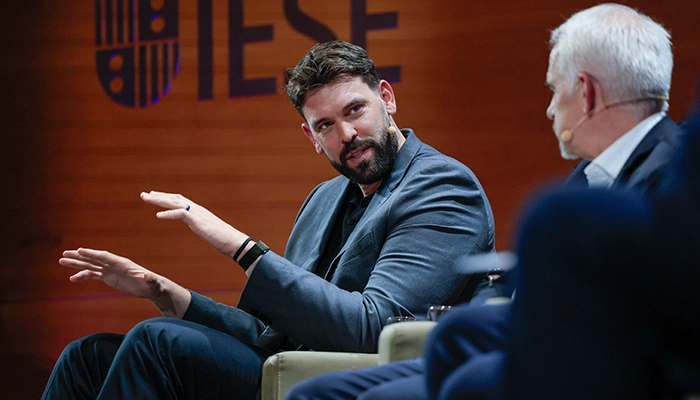
Marc Gasol had to reinvent himself after his retirement from the NBA, finding a new purpose aligned with his values.
Gasol channeled his motivation into Basquet Girona, a professional basketball club he founded in Girona, Spain, in 2014. “I’m a big believer in teams and team sports, and I knew I wanted to remain part of something that was aligned with those same goals and values.”
Marc Coma, five-time Dakar Rally champion, handled his own reinvention by enrolling in an Executive Education Program at IESE to gain a fresh vision and a network of contacts with whom he could grow professionally and personally, beyond motorcycling. To progress, sometimes you have to know when to stop, make an honest assessment of your skills and abilities, and then seek the development you need. Above all, “always believe in yourself,” Coma said.
Decisions under pressure
Sports forces split-second decisions. Race walker Paul McGrath experienced this at the 2025 World Athletics Championships in Tokyo, where he entered the final meters of the men’s 20km race walk with two penalties; a third would have meant disqualification. Suddenly, he found himself leading the pack, but he was fighting cramps. Entering the final stretch, he had to decide: Should he push himself harder and go for gold, but risk losing it all? Or should he slow his pace just enough and aim to finish well?
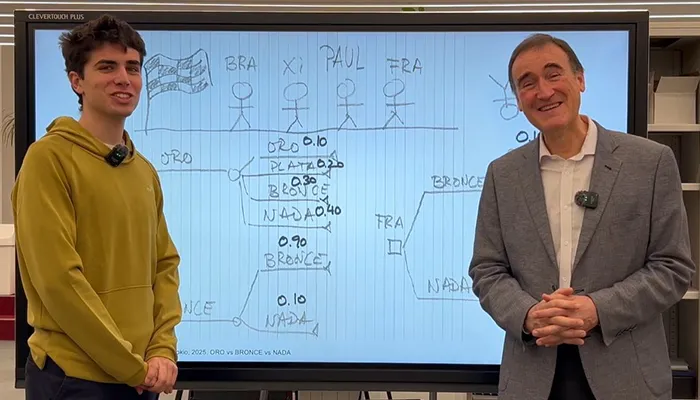
Race walker Paul McGrath (left) charted his winning split-second decision in an IESE classroom exercise with Jaume Armengou (right).
IESE Senior Lecturer Jaume Armengou reconstructed McGrath’s decision with him, charting his make-or-break choices using a decision tree. “I had about three seconds to decide what to do,” McGrath recalled. He chose to trust his instincts: He slowed his pace and secured the bronze.
“Paul made the right choice because he struck the right balance between ambition and risk,” Armengou concluded.
Once the focus shifts from the individual to the organization, decision-making stops being a solitary act and becomes a balancing exercise involving multiple stakeholders with divergent, sometimes competing interests.
The 37th America’s Cup in Barcelona is a case in point. The event’s success owed less to funding alone than to a public-private partnership built on mutual trust and shared interests, as described in a post-event analysis by IESE Prof. Joan Enric Ricart and Jordi Oliver. Key to pulling it off was Barcelona & Partners, a nonprofit organization that led the candidacy to host the Cup, uniting local authorities and private investors. According to calculations by the University of Barcelona and the Barcelona Capital Nautica Foundation, the multistakeholder collaboration resulted in over €1 billion in GDP for Barcelona and Catalonia, and created around 13,000 jobs.
Results are far less positive when stakeholders are ignored in decision-making. This happened when the CEO of the PGA Tour announced a partnership with the Saudi Public Investment Fund to stage an alternative golf tour without consulting board members or any of the PGA’s central stakeholders first: not players, sponsors, broadcasters or fans. That unilateral, behind-closed-doors decision unleashed a crisis of trust, causing serious reputational damage that undermined business relationships built up over decades.
IESE professors Africa Ariño and Ricardo Calleja, who wrote an award-winning case study on this incident, make three recommendations to ensure stakeholder perspectives are always factored into these kinds of major strategic decisions:
- Create a space for listening, a forum where key stakeholders can voice their concerns and discuss interdependent interests.
- Mediate and find compromises, to ensure that no single stakeholder dominates the discussion or imposes their interests at the expense of others.
- Be transparent, making sure everyone has access to the right information, so there are no hidden agendas, everyone is clear about each other’s non-negotiables and there is full disclosure. This builds trust between parties.
A changing business model
Sports is not just about the 90 minutes of play time. Increasingly, it is about the ecosystem of services and experiences surrounding it.
Kristoff Puelinckx (IESE MBA 1996) is founder and CEO of Tennium, a global events platform, rooted in tennis, which works closely with athletes, global brands and investors to handle all the experiences around the event itself. Speaking on the same panel with Marc Gasol, he explained, “A tournament used to be all about what was happening on the court, but now a lot more attention is paid to what happens around the court. People want to be entertained, they want to have a drink, eat something, hang out with friends, engage with some of the sponsors. There is a much greater focus on hospitality and the entire fan experience, beyond the game itself. This requires increasingly segmented, premium-type offers.”
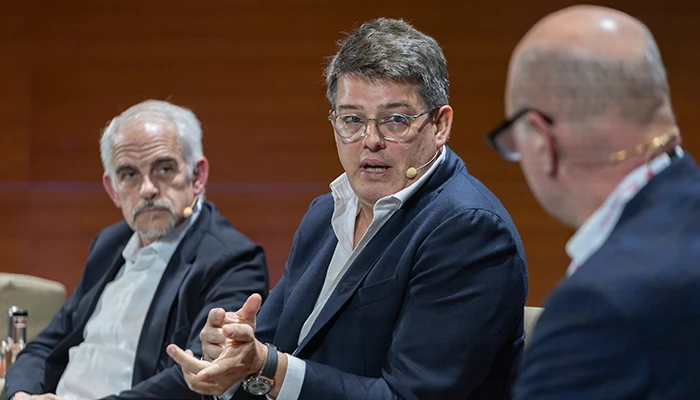
Kristoff Puelinckx (center): “There is a much greater focus on hospitality and the entire fan experience, beyond the game itself.”
The revenue mix is changing
Digital media rights have quadrupled over the past five years.
The traditional model, which revolved around ticket sales, is shifting toward other, diversified revenue streams. Digital media rights are an example of a revenue growth area, along with hospitality, that is rising faster than traditional sponsorship. This is not to say that sponsorship is going down, but rather, all other drivers are going up, making sponsorship a smaller share of overall revenue.
Technology has certainly played a key role in this expanded universe of experiences, such as the introduction of Video Assistant Referees (VAR) to review on-the-field decisions and make tough calls obvious and clear. However, such tech enhancements must be used judiciously.
Speaking about his own experience of VAR, which decided a crucial score in a match, Pace remarked, “We tend to think that technology is the solution, but maybe it isn’t the solution in all situations. If something is clear and obvious, then it shouldn’t take six minutes to debate what the technology is supposed to be telling us in order to make the call.”
The same question applies to any industry: When does technology improve the user experience, and when does it become an obstacle?
Another feature of doing business today is sustainability, as Plana explained in relation to Camiral Golf Resort. The Ryder Cup is not going to choose a setting that could damage its brand, which is why Camiral manages its property in line with the EU biodiversity strategy, earning sustainable golf certifications and awards for nature protection.
When players take to the pitch for the FIFA World Cup, many will be wearing kits made entirely from recycled textile waste, reflecting the sports industry’s embrace of the circular economy.
For Jornet, sustainability in business cannot be separated from his own respect for nature and love of mountains on which he built his entire career. This led him to collaborate with the Spanish footwear brand Camper to develop a new brand of sneakers and sportswear called NNormal, made from sustainable materials and offering repair services to encourage reuse and recycling.
One other requisite feature of doing business today: your legacy. “The real value is not what we get from the days of the competition itself, but the longer lasting effects of becoming a valuable, top-tier destination that fans will want to keep coming back to, year after year,” said Plana.
Ricart also stressed this in relation to the America’s Cup: “The key to success lies in investing not just in immediate, tangible financial outcomes but in intangibles like spectator experience, reputation, innovation, sustainability values and social capital. These are what create long-term benefits and define a lasting legacy.”
The human factor
Above all, in sports as in any business, you’re not just managing P&L but people. And that carries serious responsibilities, as Pace shared: “There’s so much passion involved. For some people, sports is as close as it gets to religion for them. And that passion spills over in every respect.”
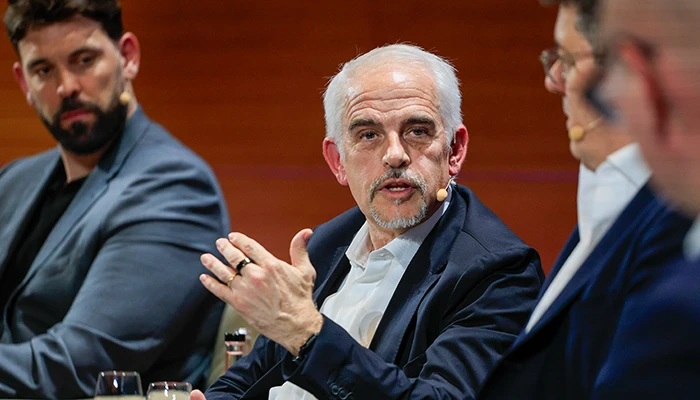
Alan Pace (center): “They don’t teach executives how to deal with mental health, but it’s a huge part of managing people.”
Pace recounted how one stadium had to erect suicide barriers because, depending on how the team performed that weekend, some fans took it very badly. “As a manager you may think, ‘Oh well, you win some, you lose some.’ But for some people, it’s deadly serious, to the extent that it affects their mental health. It’s not just entertainment; it’s their life.”
“They don’t teach executives how to deal with mental health,” he said, “but it’s a huge part of managing people. One of the challenges of sitting in the manager’s seat is knowing how to balance that — not letting the negative emotions drag you down, and not letting the positive emotions delude you into forgetting who you really are. It’s like being on a rollercoaster: the adrenaline is incredible, but the lows are incredible too, and they can be lower lows than you ever possibly imagined.”
Knowing how to create a culture of positivity is important, he added. “The reality can be hard. But being able to really listen to people and manage their expectations, creating a sense of community and belonging, can help make it better.”
Winning teams
Kristoff Puelinckx, founder and CEO of Tennium, offers these career-building tips.
MORE INFO:
The case study, “The summit is just the beginning: Kilian Jornet’s journey,” by Miquel Llado, Juan Roure and Isaac Sastre Boquet, is available from IESE Publishing.
“Governance of the 37th America’s Cup in Barcelona: A Public-Private Partnership Model” by Joan Enric Ricart and Jordi Oliver is published by PPP for Cities: Specialist Research Center on PPPs in Smart and Sustainable Cities.
The three-part business case study, “Shifting alliances in the golf industry: The PGA Tour, the European Tour and the Saudi Public Investment Fund,” by David Pastoriza, Africa Ariño and Ricardo Calleja, is available from IESE Publishing. It was recognized by the European Foundation for Management Development (EFMD) as the best case in the category of “Responsible Leadership.”
This article is included in IESE Business School Insight online magazine No. 172 (May-Aug. 2026).
READ ALSO:
Head above water: how Paralympic swimmer Teresa Perales turns trials into triumphs
Lessons from the America’s Cup for leading high-performance teams