
How to preserve the meaning of work in the digital era
AI’s potential to strip work of its meaning may pose a bigger threat than job losses. Here’s how to safeguard your team’s engagement.

The thing Jay liked most about being a self-employed delivery driver was the autonomy it gave him. He wasn’t tied to a desk. He could organize his own time, deciding when and how much he wanted to work. And he was a free agent: He could work for different platforms at the same time and in his own way. That was meaningful to him.
Maya was a copywriter for a marketing agency. She loved the variety of assignments and the creativity involved in coming up with catchy slogans and conceiving clever campaigns for diverse clients. She found her work fun, stimulating and exciting. That was meaningful to her.
In both cases, digital technologies enabled Jay and Maya to do their work better, reinforcing the aspects of the job most meaningful to them. Yet as artificial intelligence (AI) becomes the digital technology of choice in workplace settings, managers must be mindful of how they are deploying it, lest the positive affordances of technology tip over into negative consequences, stripping work of its original meaning for workers.
In a paper published in the Human Resource Management Journal, my co-authors and I reviewed the research on meaning and work, with the aim of identifying what makes work meaningful in the digital era. For people like Jay and Maya, the growing prevalence of AI is steadily disrupting their fields. Formerly free-spirited Jay increasingly feels a slave to the algorithm, forced to take on jobs he wouldn’t otherwise do, at all hours, for fear of missing out on work. Maya finds her days reduced to monotonous, unchallenging tasks, which mainly consist of checking the creative output of a machine.
Is this the only way? Not according to our research. In fact, there are five specific actions that HR managers, in particular, can take to ensure work remains meaningful and human-centered in the new era unfolding.
What do we mean by meaning? Key concepts and contextual factors
First, we should define our terms. While “meaning of work,” “meaningful work” and “work meaningfulness” are used interchangeably, my co-authors and I make some subtle distinctions. We avoid casting “meaning” in purely binary terms (subjective/objective, positive/negative). Instead, we see each concept as nested inside the other, being positive, neutral or negative at the base, and then hopefully becoming more positive as the experience of work is interpreted and shaped by individuals in line with their values. It’s a fluid process, as contextual and personal factors interact. Conceptualizing it this way can help HR managers distinguish where and how best to target their interventions. (See the figure below.)
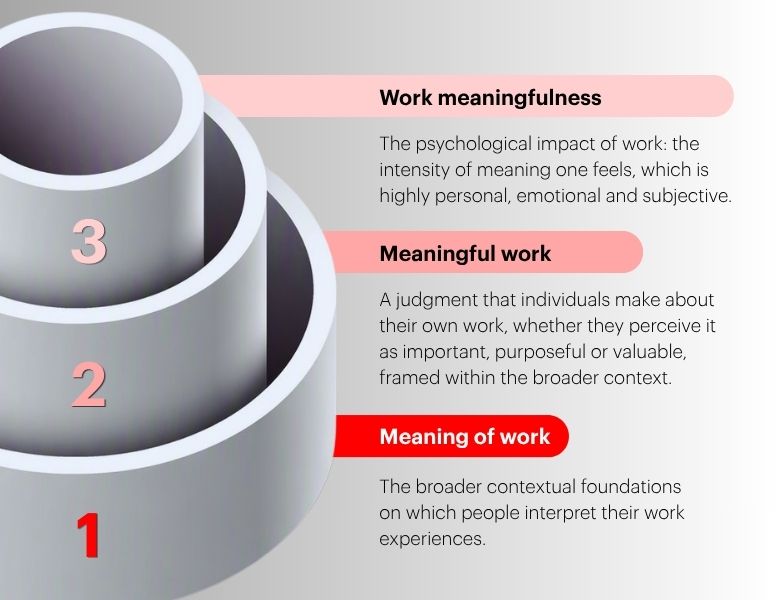
Given that meaningful work, and ultimately work meaningfulness as experienced at the personal level, is either supported or undermined starting at the base level, it’s worth paying closer attention to these key contextual factors:
The characteristics that can make or break meaning at work
Having defined how meaning may be shaped or constrained, we also group the four main ways that people may express meaning in their work. Disruptions to any or all of these meaning-making pathways will degrade the experience of work: People may feel threatened, less engaged and more likely to leave. Conversely, interventions thoughtfully targeted at these areas may succeed in boosting psychological engagement and emotional connection, recovering meaning and lowering exit intentions.
Autonomy
This is about individual freedom, control and influence over one’s own tasks. People who feel empowered in their areas of responsibility tend to find more job satisfaction and meaning. Digital technologies can foster this (as in the case of Jay). But the same technologies can also undermine autonomy when they regulate, monitor and control performance so tightly that workers lose agency and end up as passive executors of commands.
Skill use
This is Maya: happy to be putting her creative skills to good use. But once her job is stripped of her creative input, and she is reduced to merely accepting or rejecting machine outputs, she no longer loves her job. This is an example where AI may not replace her — she still has a job — but it has impoverished her skill set, and the new skills demanded of her may not be the ones that give her any meaning.
Feedback
Digital systems can provide real-time feedback on performance: productivity tracking, user metrics, engagement rates, goals achieved, “tell us how we are doing” surveys. People like to know their work matters and how good of a job they are doing. This may bring merit-based rewards. However, algorithms are no substitute for human interaction: the friendly nod, the supportive touch, gestures of appreciation. When metrics become punitive, selective, biased or disconnected from people’s workplace realities, then such feedback no longer rewards competence or contribution; it becomes a cause of distress and a mechanism of control.
Relational aspects
Humans are social animals, thriving on interpersonal relationships and social connections. Indeed, this is the exact feature exploited by social media networks, accounting for their dominance in our lives. When digital technologies facilitate and strengthen relationships with teammates, colleagues and clients, they can enhance work meaningfulness. Telemedicine, for example, can serve as a literal lifesaver for medical professionals to relate with patients in ways they never could before, giving them an even more profound sense of meaning and purpose. However, we also know such tools can become substitutes for face-to-face interactions. More generally, tech has the capacity to isolate workers, cutting them off from the vital social support they need for meaningful work engagement.
5 leadership actions to boost meaning for workers
Quality leadership, as with most change management initiatives, makes all the difference regarding the extent to which these work characteristics are prioritized and championed when rolling out digital technologies such as the latest generation AI.
It requires proactive management, above all by HR. They must ensure that technological changes align with workers’ rights and welfare, designing opportunities for them to interpret digital work in ways meaningful to them and which will enhance their sense of meaningfulness and individual development. Understanding employees’ feelings and actions, and actively enlisting them in ethical and participatory design, is essential for creating practices that will resonate.
Here are five concrete actions:
1. Design digital work systems with meaning in mind
Efficiency gains are not enough. Managers should bring workers and IT together to integrate worker feedback into the AI implementation process, making sure that cherished values such as autonomy and skill development are embedded practices. In digitally mediated work environments, social connection cannot be assumed but must be deliberately designed into the system. Design spaces for human interaction, fostering opportunities for peer support and shared learning. Remain on the lookout for when work becomes excessively fragmented and workers start to feel professionally isolated.
2. Provide upskilling to help workers adapt
Ongoing training and development must be widely available. To preserve a sense of meaning, workers must see pathways to the future open to them. Support their digital literacy, positioning skill development not just as an immediate productivity guarantee but as a means of sustaining professional relevance over time. This affirms a sense of irreplaceability and long‐term competitiveness, as a matter of human dignity and social justice.
3. Encourage job crafting
Job crafting is the practice of letting workers adapt their work to suit their own personal needs, preferences and abilities. When workers feel they have agency and can interpret digital work in ways meaningful to them, this has a measurable impact on motivation and engagement. Without such flexibility, workers may end up feeling like Jay and Maya, disempowered and looking to quit.
Leaders should invite employees to “job craft” and make their own decisions regarding how they will integrate AI and other digital tools into their workflows. Then, encourage them to share their discoveries and showcase their achievements. Importantly, do this before problems arise.
4. Be mindful of how you frame the change
How digital technologies are framed is critical. When leaders frame technology as a tool for personal growth and development, and support that narrative with implementation choices that are consistent with it, employees are more likely to perceive the change as meaningful to them.
HR can support managers to align corporate narratives with workers’ lived experiences. A policy is only effective when people within the organization buy into it and believe in it enough to put it into practice. Understanding where employees are coming from is essential for framing practices that resonate with them and their values. Employees will see through any false framing, and as soon as they detect inauthenticity between words and actions, meaning will likely erode for them, and you will face resistance.
5. Engage with public policymakers
A final action requires engaging with the public sector. For one thing, there may public funding available for lifelong learning programs aimed at upskilling or reskilling the workforce, preventing professional exclusion and helping workers adapt to future labor market needs.
But there is another public duty: advocating for policies that protect workers’ rights as new digital tools are rolled out. Whether AI is used for good or ill depends on the regulatory frameworks and labor laws devised to deal with it. Bearing in mind the accelerating pace of AI development, and that laws often lag behind on-the-ground realities, business managers play a key role in helping to set the guardrails. Numerous issues are arising daily, from intrusive surveillance and automated decision‐making that undermine human autonomy, to failing to understand the “black box” of how work is done and the biases that might be baked in, not to mention the “right to disconnect” to protect the boundaries between work and home life, which are crucial for maintaining mental health and wellbeing.
Private companies, in collaboration with the public sector, can incentivize the development of human‐centric technologies, where the values of worker dignity and social connection are prioritized.
Together, we can shape workplaces where digital tools serve to enhance, rather than erode, the human experience of meaningful work.
MORE INFO:
“The meaning of work in the digital era: a systematic review and research agenda,” by Yukun Liu, Qi Fang, Yasin Rofcanin, Mireia Las Heras and Xiao‐Yun Xie, is published in the Human Resource Management Journal (2026).
IESE Prof. Sampsa Samila has joined with nearly 200 other signatories to urge policymakers and institutions to steer AI in a direction that complements humans and benefits society.
The chapter “Work Design and Identity,” by Giverny De Boeck, Mailys George and Ausrine Vysniauskaite, is published in the book, Transformative Work Design, edited by Sharon K. Parker et al. (Oxford University Press 2025).
A summary report on the Dignity at Work Conference, called “Dignity at work in the age of AI: Rethinking work, meaning and human flourishing,” by Carlos Rodriguez-Lluesma and Mireia Las Heras, is free to download here.
This article is included in IESE Business School Insight online magazine No. 173 (Sept.-Dec. 2026).
Get meaning clear in your own mind
One reason why meaning may suffer when rolling out AI is that leaders haven’t worked out in their own minds what they’re using it for. IESE Prof. Sebastian Hafenbrädl has prepared a practical guide to help clarify thinking, separating the issues into three categories:
- Matters of truth: in other words, what can the system actually do or not do?
- Matters of usefulness: envisaging the effects of AI on workflows, decision-making, organizational processes, etc. over time.
- Matters of meaningfulness: how AI shapes human interactions and their sense of purpose.
Each category raises different sets of questions, requiring different reasoning. Conflating the issues is what leads to confusion or breakdowns.
To help ground your thinking, start with the following questions, though these are only suggested starting points. The important thing is to consider them separately before seeing how they fit together.
MORE INFO: “What is true, useful and meaningful? A leadership lens for AI,” a technical note by IESE Prof. Sebastian Hafenbrädl, is available from IESE Publishing.