IESE Insight
The generational differences in consumption, explained

Boomers lead in essential spending; non-independent Gen Z leads in discretionary spending. Life stage and changing habits are behind this phenomenon.
Do the young, the middle-aged and the old spend in the same way? In answering this question, we often fall back on stereotypes — for example, the idea that baby boomers are tech-averse or that Gen Z no longer cooks but just orders food delivery. But how much of that is true?
A study by IESE’s José Luis Nueno, who holds the Intent HQ Chair on Changing Consumer Behavior, together with Alfonso Urien and Jaime Soroa, offers a snapshot of generational consumption in Spain.
The study analyzes 500 million transactions from 350,000 users and segments the population into four cohorts: baby boomers (in U.S. terms, those born between 1946 and 1964), Generation X (1965 to 1980), millennials (1981 to 1996) and Generation Z (1997 to 2012). Within the latter group, it distinguishes between young people who have left their parents’ home and those who haven’t. The research also examines each individual’s total spending, allowing analysis of how budgets are distributed across different consumption categories.
A key question for companies and analysts is what will happen as Spain’s baby boomers (those born between 1958 and 1975) start retiring and their share of total consumption declines. The follow-up question is: To what extent will younger generations be able to replace that spending?
Young people’s consumption is more limited due to lower income and daunting housing costs. But they also consume differently.
Each generation has its retail formats, business models and brands, and Gen Z has its own distinct preferences.
What determines each generation’s spending?
Differences in consumption between generations are not explained by age alone. Some are linked to life stages: income levels, leaving the family home, forming a household, raising children. Other differences reflect structural changes in consumption driven by digitalization and new priorities in how people use their time.
Behaviors linked to life stage tend to moderate over time, while structural changes tend to consolidate and spread across all generations.
One of the main differences between generations lies not so much in how much they spend, but in how much of their budget is mandatory versus discretionary.
Impact of life stage on consumption
Baby boomers allocate the largest share of their budgets to essential expenses: More than 46% of their spending goes to housing and healthcare. The proportions were similar for Gen X-ers, who spend 45% of their budget on mortgages, family costs and other fixed expenses.
When mortgages are paid off, part of that budget becomes available for discretionary consumption, which among older generations tends to go on leisure, travel and wellbeing.
At the opposite end are the Gen Z-ers who still live at home: Only 17% of their spending goes to essential items. Meanwhile, 70% goes to discretionary spending, in a phenomenon the authors describe as “prolonged financial adolescence.” This group has income but very few fixed expenses.
Structural changes in consumption and their impacts
Technological advances in recent decades have inevitably affected both culture and markets. Their effects are especially visible among Gen Z.
- Digitalization. Smartphones are used for almost every transaction. Immediacy and convenience — sometimes more important than price — have led to more home delivery orders and fewer face-to-face interactions.
- Experience culture. Experiences (travel, concerts, restaurants) are prioritized over material goods.
- Flexible mobility. Owning a car is no longer a status symbol, giving way to car-sharing or subscription models. In fact, only 58% of people born after 1995 have a driver’s license, compared with 81% of baby boomers at the same age.
Do young consumers connect with your brand?
Nueno proposes a matrix that classifies business models and brands according to two criteria: their affinity with and their dependence on Gen Z. He considers sectors such as mobility, food, fashion and finance.
- Affinity measures how aligned a company is with the habits and expectations of young consumers.
- Dependence reflects how significant these consumers are within the business’s current customer base.
Companies that score highly on both dimensions are better positioned to remain relevant in the market. In the case of finance, these include neobanks such as Revolut and N26 (pictured below). Mobility services like Uber and Cabify, food delivery platforms such as Uber Eats and Glovo, and ultra-fast fashion or resale companies like Shein and Vinted are also better positioned.
Gen Z affinity and dependence of brands in the financial sector
A matrix showing how strongly certain financial brands depend on and align with Generation Z.
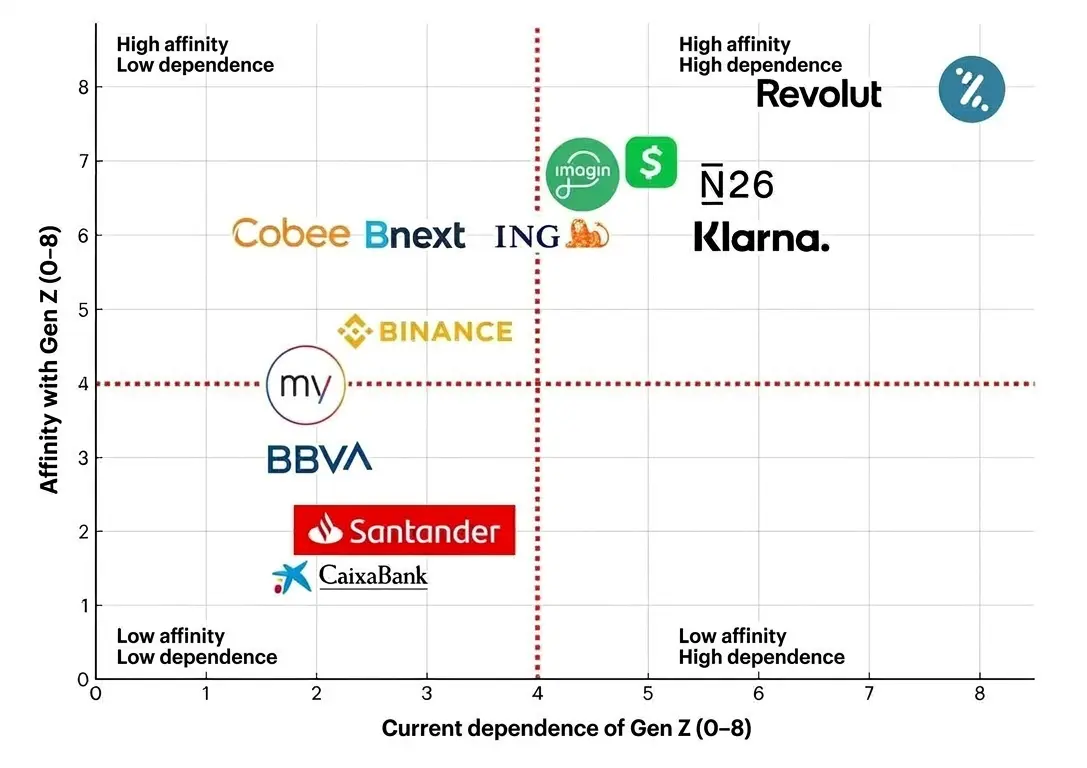
Many current business models are still heavily dependent on baby boomer spending, while having lower affinity with Gen Z (bottom left corner). For these sectors, the challenge is to use the resources currently generated by older cohorts to adapt to younger consumers before they become the dominant spending group.
Advice for executives
The study offers several recommendations for managers:
- Segment consumers not by age but by life milestones, such as getting a first job or moving out of the family home.
- Introduce more flexibility in product offerings through subscription services or pay-per-use models.
- Move toward hybrid, omnichannel strategies, where physical retail integrates experiential and community spaces that attract younger consumers.
- Be transparent about sustainability, demonstrating responsible practices with actions rather than relying on messaging alone.
About the study
The research is based on the analysis of 500 million real financial transactions from nearly 350,000 users in Spain between 2022 and 2024, obtained through the Fintonic platform and analyzed by the Intent HQ Chair on Changing Consumer Behavior at IESE.
ALSO OF INTEREST:
7 out of 10 Gen Z shoppers use AI to buy online