IESE Insight
To lead better, make time for data-free leisure

We all need to rest to operate at our best, but it’s not about doing nothing; it’s about doing things that liberate the mind and spirit. And your data, like your time, should be your own.
If we added up all the hours we spend eating, sleeping, commuting, working and on leisure, it might well amount to 36 hours a day. That’s because we’re always multitasking: checking emails or sending texts while watching TV; commuting or doing household chores while listening to an educational podcast. We live in a so-called performance society, where our worth is defined by how productive we are, where the quest for self-optimization is relentless. In such a world, there’s never an end point, a moment when we can finally say, “I have arrived, and now I can rest.” And so we feel endlessly restless.
Yet leisure, rest and the right to be unproductive are essential for human flourishing. And while many companies would agree with this in theory — adopting measures like flextime and teleworking, which are meant to support work-life balance — the reality is far different.
At IESE’s Dignity at Work Conference, professor Santiago Alvarez de Mon moderated a panel on this topic with a leading business practitioner, Jose Maria Alvarez-Pallete, former CEO and Chair of Telefonica, and with a philosophy professor, R.J. Snell, director of academic programs and editor-in-chief of Public Discourse for the Witherspoon Institute in Princeton, New Jersey.
We’re generally not very good at disconnecting, they agreed, but perhaps total disconnection is impossible in today’s world; rather, it’s about connecting in better ways, as they explain.
Santiago Alvarez de Mon: In speaking about work and leisure, let’s discuss what we actually mean by the word leisure. What is it?
R.J. Snell: At least in the United States, there’s a view that leisure is what happens when you take a break. It’s about not doing something, as opposed to doing something. But in the broader philosophical tradition, leisure isn’t just stopping work or the cessation of all activity. It is a specific kind of activity, one that is intrinsically worthwhile, practiced for its own sake.
So, playing with children, sports, art and music fit the bill. So do studying and reading, but again, done for their own sake. Studying to pass an exam is not leisure. But contemplation, for the love of knowledge, is leisure. This is different from rest or entertainment, though those are important, too.
Jose Maria Alvarez-Pallete: In addition to having value for its own sake, leisure is necessary for being able to face work and life calmly and competently. Personally, I have needed to strike a balance between a professional life and a contemplative life, in order to come back refreshed and do my job to the best of my ability.
SAM: Do we have a right to leisure? And if not, what’s stopping us?
JMAP: We should have a right to it, but much of our current cultural context strips it away. The loss of our leisure time, and our relationship with work and technology more generally, became more apparent during the COVID-19 pandemic, when we were all forced to work remotely. COVID changed the relationship of the workforce with the company. The social contract changed, and technology has become omnipresent in our lives in ways not contemplated by labor law.
RJS: In the U.S. context, most people don’t feel they truly have the right to disconnect, even if a labor agreement formally acknowledges it. It’s not part of our lived experience. There’s a deep-seated habit of checking email. I’ve known people working for high-powered firms who are at the firm the day before delivering a baby, and they’re back at the firm not long after delivering the baby, and they’re checking email and dictating notes while in the hospital. As a culture, we’re not very good at rest.
SAM: Beyond leisure is the right to be unproductive. Do we have a right to that?
RJS: To be clear, this isn’t a call to down tools and stop working altogether. As Plato said, “Fine things are difficult.” In other words, things that are beautiful or good are hard to achieve and maintain without some effort. There is drudgery in life: late nights, early mornings, working overtime. So, we do have a duty to be productive. However, we cannot flourish as human beings if we don’t also make time for reflection. Nor can we ever achieve focus. When we are forever distracted, we end up in a frenzy of activity that achieves little. So, we have a commensurate need to contemplate, and in that sense we have a right to be unproductive, too.
JMAP: Company culture is essential in framing our downtime as a right. This can include workplace policies around after-hours communication and flexibility, for example. Decisions made by individuals and families are also important. For example, my wife and I have an agreement to put our smartphones away at 8 p.m. We’re also active in parent groups that advocate for children not to be given smartphones too early. Technology feels inevitable, but it isn’t invincible. You can actively choose to reduce its impact.
SAM: How has technology changed our concept of leisure, and what does it mean for rest and disconnection?
RJS: I recently asked a group of high-achievers at Princeton, “What’s the first thing you do when you wake up in the morning?” All of them said they checked their phones. Then I asked them, “What’s the last thing you do at night?” They all said the same thing.
One thing we see with the internet and social media is that they contribute to disenchantment of the world, stripping away mystery, wonder and meaning. Our modern tech creates a world that is horizontal: You read a document with five or six links, and every time you click on a link, it doesn’t take you deeper, it takes you sideways. You open a second document, then a third, and your attention moves laterally. It becomes very difficult for our attention to go deeper into an idea, or vertically, toward transcendent or sacred thoughts, because the technology keeps our world flat and our attention disperse and distracted, by design.
JMAP: The other aspect to this is that we are generating massive amounts of data through these platforms. All the time we spend online equals millions of years of human attention, which is being constantly mined. Who owns that data? And how much is it really worth? We’re in the middle of exponential technological change, many times the size of the Industrial Revolution, and technology is moving faster than the social contracts between human beings can guide it.
That’s why, in addition to defending leisure, rest and the right to be unproductive, I am advocating for a new Digital Social Contract.
From DatAIsm to HumAIsm
Since stepping down as CEO and Chair of Telefonica in 2025, Jose Maria Alvarez-Pallete has pursued a new vocation at Comillas Pontifical University in Madrid, where he launched Dignum, a research center dedicated to putting human dignity at the center of AI development. In that capacity, he coauthored the paper, “Personal data as a human right,” which served as the basis of his recent conference, “Human dignity in the data age: the pending social contract.”
He and his coauthors have put forward a new organizing framework for AI, one that resists “reducing persons to datapoints” (what they call DatAIsm) and demands instead “a dignity-centric Digital Social Contract grounded in data sovereignty, human dignity and data personalism” (an alternative vision they term HumAIsm).
As part of this framework, Alvarez-Pallete calls for a fair (re)distribution of the value created by personal data. He argues it’s not fair that tech companies are able to reap all the benefits of monetizing user data while externalizing all the harms onto society. He proposes that data generation be treated like a form of labor, with individuals properly compensated for their data contributions, akin to receiving dividends. He estimates that, in Europe, a person’s data could be worth between €3,800 and €5,000 per person per year, and questions why the wealth we generate should go to just a few corporations.
This may require the establishment of data cooperatives or data unions, so individuals can pool their data and negotiate better terms, like revenue-sharing agreements or improved privacy safeguards.
“We must stop letting our attention be captivated by a small number of platforms not predicated on our personal wellbeing,” he insists, adding that the right to disconnect from pervasive surveillance deserves the highest legal protection, worthy of being enshrined in constitutions or international human rights frameworks.
MORE INFO: “Personal data as a human right: a new social contract based on data sovereignty, human dignity and data personalism” by J.M. Alvarez-Pallete et al.
SAM: How can we recover our focus amid all the distractions?
RJS: When you step away from the noise, time feels very slow. Appreciating the quiet doesn’t come immediately, as anyone who has done a silent retreat can attest. Instead, it’s like building muscle. You have to work for it, but then you are transformed.
My advice to senior leaders is that the first and last moments of every day should be intentional and quiet. Taking control of the very beginning and the very end of the day goes a long way toward building the muscles of contemplation, which is what allows you to truly possess yourself.
JMAP: I would just add, from a business perspective, something that many senior executives probably know instinctively: Often the solution to a problem comes when you’re not actively thinking about it. People feel guilty when they’re not actively doing something, but we need to preserve space for that. Resist the pressure to always be productive, even in your hobbies. So if you’re running or baking or whatever, just enjoy yourself; but if you’re putting it on Instagram, then you’re monetizing it, and other people are making money off your data on top of that.
RJS: Also be careful about perfectionism. Very talented people can be incredibly driven, but sometimes they’re driven by an intense fear of failure. Being governed by perfectionism leaves little time for genuine rest. One of the great benefits of true leisure is that it makes us freer. When we focus on what has intrinsic value, we worry less about maintaining a flawless external image, which frees us from perfectionism and, to an extent, from social media. Enjoyment doesn’t come from perfection; it comes from freedom — free of the need to be incessantly optimizing and performing.
This article is included in IESE Business School Insight online magazine No. 173 (Sept.-Dec. 2026).
Power down to power up
Jose Maria Alvarez-Pallete and R.J. Snell offer these tips to reclaim your time and attention.
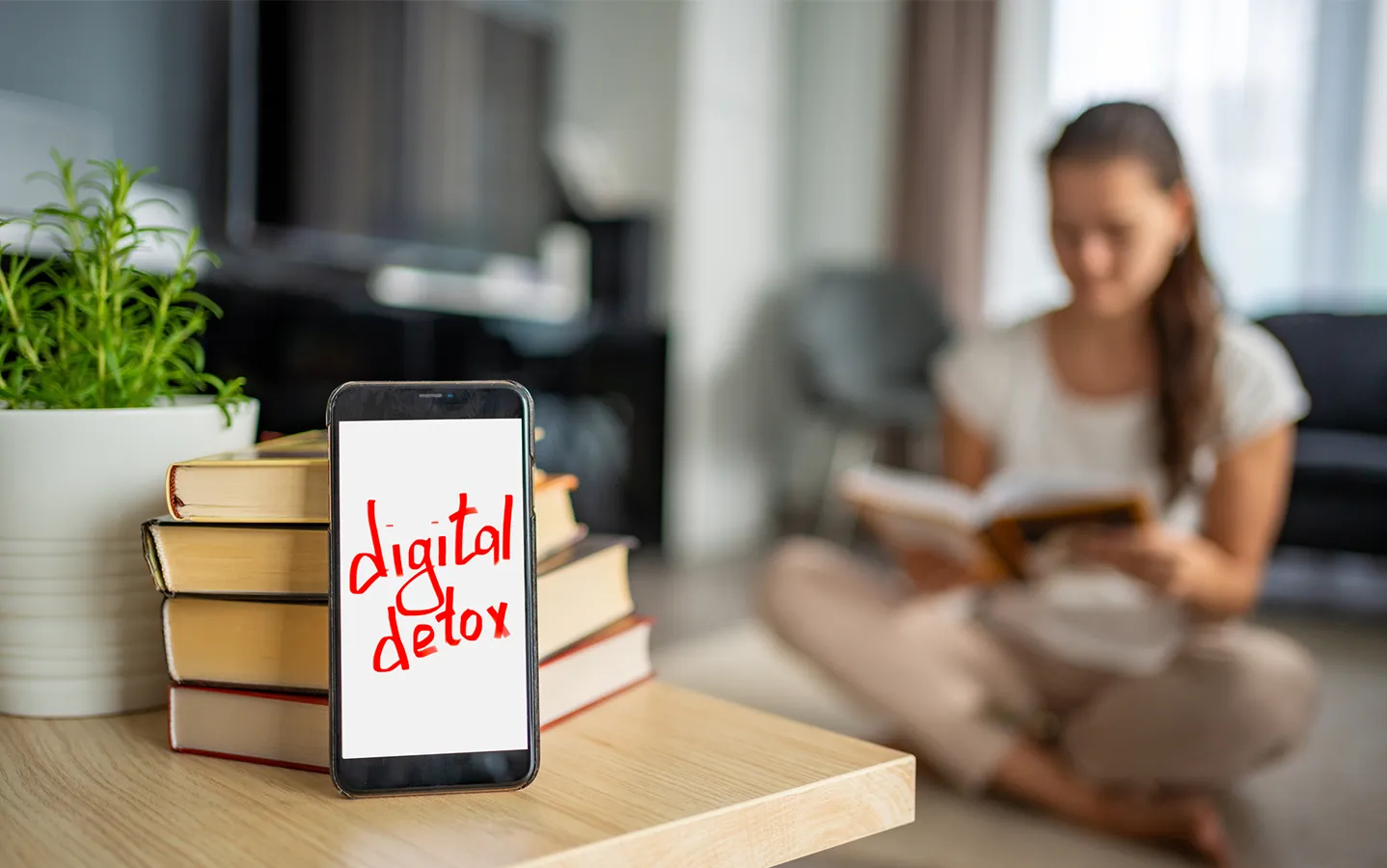
Put down your phone
Have experiences for the sake of having experiences that are not generating data. Let your time reflect your true loves and priorities.
Build in recovery time
Set aside time at the beginning and end of every day. Create a habit of reading for pleasure at least half an hour before going to sleep.
Make time for play
Allow for experiences of beauty, for activities that touch the soul, for healthy pursuits like exercise, sports and running. Preserve family life and friendships, and treat your most important relationships as sacred.
Beware of “the noonday demon”
Anxieties and depression can arise in the middle of the day, distracting you from attending to the things you really ought to be doing. In such moments, resist pulling out your phone and checking messages for distraction. The noonday demon needs to be confronted to be slayed.
Write an essay to yourself
Envision where you would like to be 10 years from now and what legacy you would want to give back to society. Then, take the steps to get there, remembering that you’re in charge, not governed by the choices of other people.