
AI at IESE
AI is changing management.
We’re preparing leaders and organizations for what comes next.

Human
AI strengthens the need for human judgment, responsibility and leadership.

Transformation
AI is reshaping organizations, strategy and work. We prepare leaders to manage this transformation.

Impact
We help leaders deploy AI expertly and responsibly to create lasting value for business and society.
Human
AI strengthens the need for human judgment, responsibility and leadership.
Transformation
AI is reshaping organizations, strategy and work. We prepare leaders to manage this transformation.
Impact
We help leaders deploy AI expertly and responsibly to create lasting value for business and society.
Artificial intelligence is transforming how organizations operate, how decisions are made and how work gets done. As AI changes management itself, it also changes what leaders need to know, how they learn and the capabilities that will define success.
At IESE, we see AI not as a technology to master but as a new context for leadership. Today’s leaders need to combine technological understanding with sound managerial judgment, the ability to redesign organizations, and make decisions that create lasting value for people and society. Organizations must also rethink how they develop talent and build advantage in an AI-enabled world.
That is why AI is integrated across our programs, teaching and research. Through our humanistic approach, we prepare leaders to harness AI effectively and responsibly.
Our approach to getting AI right.
We develop judgment, not just AI skills.
As AI makes analysis faster and more accessible, the ability to ask better questions, evaluate information critically and make sound decisions becomes an even greater source of leadership.
We treat AI as a management transformation.
AI is changing every business function. Preparing leaders means understanding how AI reshapes strategy, organizations, governance, decision-making and the way work is designed.
We prepare leaders for Human + AI organizations.
The future belongs to organizations where people and intelligent systems work together. Leaders must know how to redesign work, build trust, govern AI responsibly and align technology with business purpose.

We put people and responsibility at the center.
The biggest questions raised by AI are ultimately human. Leadership requires accountability, judgment, trust and the ability to decide not only what AI can do, but what it should do.

We form leaders for the long term.
Technology will continue to evolve. Character, curiosity and the capacity to learn, adapt and lead through uncertainty will endure. Our goal is not simply to teach today’s tools, but to develop leaders for tomorrow’s challenges.
Programs.
From early-career professionals to senior executives, CEOs and boards, IESE helps leaders understand and navigate the opportunities and challenges AI presents at every stage of their careers.
AI is embedded across IESE’s degree and longer executive programs rather than just taught as a standalone discipline. Participants explore how AI is transforming strategy, finance, marketing, operations, entrepreneurship and leadership while developing the capabilities needed to apply it effectively and responsibly.
We also have specific short courses for executives on AI, including:
We work with individual companies to design programs specific to their needs around AI.
New capabilities for a new era.
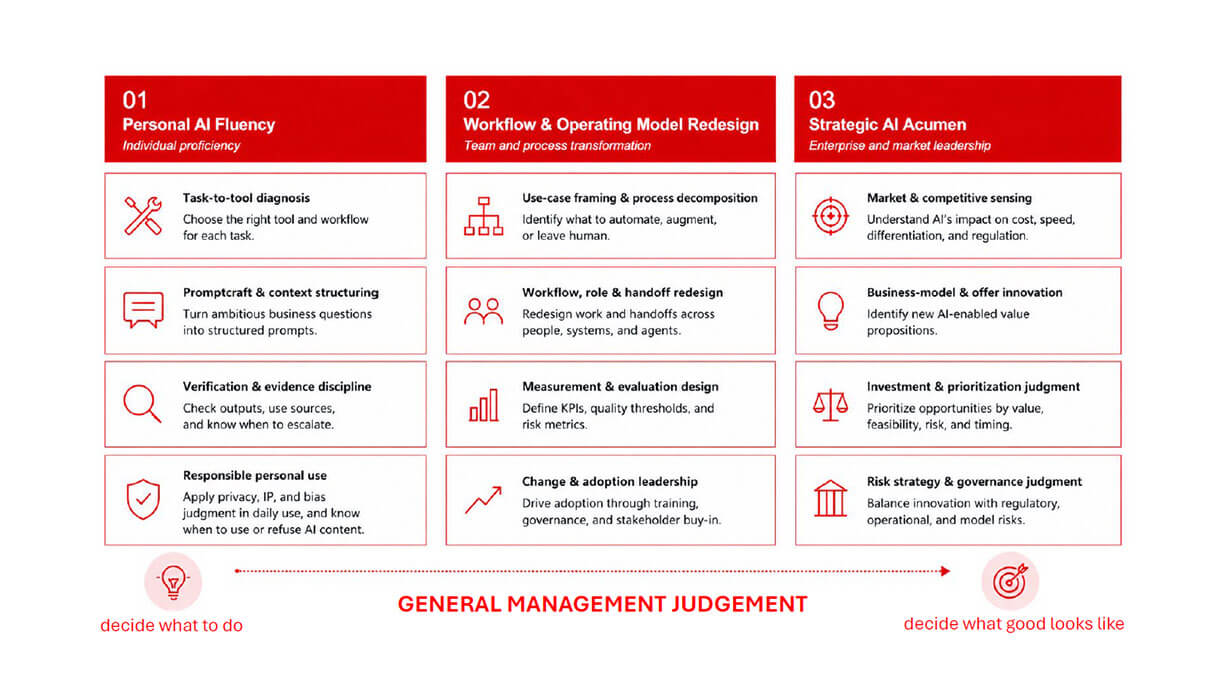
Leading with AI requires more than understanding the technology. It requires new capabilities that combine technological fluency with managerial expertise.
We have developed an AI competency framework that is being progressively introduced in all our degree and executive programs. These are the new competencies:
Learning with AI.
At IESE, we embrace AI as a powerful learning tool while preserving the experiences that develop deep expertise, leadership, critical thinking and sound judgment.
The case method remains core to learning at IESE. It develops judgment by placing participants in situations where they must make consequential decisions under uncertainty, defend those decisions in front of peers and learn from immediate faculty feedback.
Across our programs:
- Cases increasingly include AI-generated analyses for participants to assess, challenge and improve.
- Cases explore managerial dilemmas specific to how AI is reshaping organizations, leadership and the future of work.
- Discussions focus not only on whether an analysis is correct but also on whether the chosen course of action will achieve the intended outcome.
Learn more about the IESE case method and learning methodologies.
Each program establishes clear policies on how and when AI should be used, according to its impact on how people learn and the specific learning objectives.
Rather than relying only on policies, we also help participants understand how AI influences their own learning process so they can make informed decisions about when it is helpful and when independent work is essential.
AI dramatically reduces the time from idea to execution. Throughout our programs, participants use AI to prototype ideas, test assumptions, analyze business problems and apply new concepts to real managerial challenges.
As access to information becomes easier, the value of learning from people only grows. Close faculty interaction, peer learning, exposure to diverse perspectives and developing lifelong networks remain defining features of the IESE experience.
Careers & Organizations.
AI is reshaping leadership roles across every industry. Organizations increasingly seek leaders who can combine business expertise, technological understanding and the ability to lead organizational transformation.
IESE works closely with recruiters, corporate partners, organizations and alumni to understand how these expectations are evolving. This helps us prepare participants for emerging leadership roles while helping organizations access the talent, executive education and research-backed insights they need to thrive in the age of AI.

"I’m increasingly hearing comments like, ‘If we can do the same work faster and cheaper with AI, why do we need as many employees?’ And my answer to them consistently is, 'Why would you do the same work? There’s a once-in-a-lifetime opportunity to build something entirely new. "
Research and Thought Leadership.
Leading the new architecture of work.
AI raises technical questions, but its greatest challenges are organizational and human. IESE research explores how AI is reshaping work, organizations and leadership, bringing those insights directly into our classrooms, executive education and engagement with business.
Main areas of focus:
- Labor markets and the job ladder.
AI is disrupting labor markets as well as career progression within firms, from junior roles through to the most senior positions. - Organizational design.
AI demands new organizational design in which the boundary between human and machine tasks is a new challenge. It requires building a human organization that continuously renews and develops tacit knowledge around judgment, values and culture. - Leadership and ethics.
True firm-level transformation is a management as much as a technological challenge. Leaders must have the skills to spearhead AI transformation along a moving frontier, guided by an ethical compass to know what to automate and augment and what to protect and refuse.

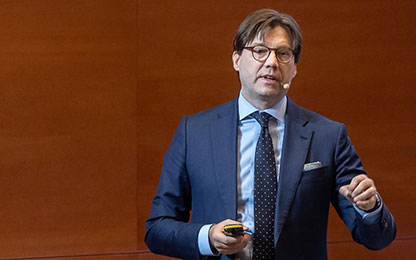


The Observatory for AI & Ethics in Organizations aims to identify and understand ethical and organizational issues emerging due to the pervasive adoption and use of Artificial Intelligence in business and society.
Considering the rapid expansion of AI applications, discussions about ethical and responsible use of AI in organizational settings have indeed become urgent for managers, policymakers, NGOs, customers, activists, etc.
The Observatory for AI & Ethics in Organizations will explore these issues conducting research projects that will involve experts in organization science, human resource management, innovation management and applied philosophy.
Learn moreMore insights from IESE faculty






Technology will change. Leadership endures.
AI will continue to evolve. Our commitment will not.
IESE prepares leaders who can understand new technologies, redesign organizations and strengthen the uniquely human capabilities that enable people, companies and society to thrive in the age of AI.