IESE Insight
The global grammar of workplace norms

How changing social norms are reshaping workplaces and the leadership of diverse teams.
Social norms — the invisible rules that determine which behaviors we consider appropriate in a workplace or personal context — profoundly influence human behavior. For leaders, they affect how we choose job candidates, run meetings or manage international teams.
IESE’s Alvaro San Martin and coauthors analyzed more than 150 everyday norms across 90 societies to understand our expectations of one another, and how that moral map is changing.
More permissive norms, but also more sensitive ones
Over the past two decades, many everyday norms have become more relaxed. Behaviors such as crying in front of others, eating in public or wearing headphones in the street are now widely accepted in most societies.
But this relaxation coexists with an opposite trend: Norms have become stricter when consideration for others is at stake. Arguing in public, flirting in formal situations or invading others’ personal space is now judged more harshly than previously.
According to San Martin, it isn’t a loss of civility we’re seeing so much as a shift in the moral axis: “The world is moving from purity to care.” In other words, what used to be judged by standards of decorum is now judged by its impact on others.
A global grammar of manners
One key finding for companies is that national culture matters less than is often assumed. The study showed that there’s a lot of consistency across cultures on which behaviors are seen as inappropriate. What varies from place to place is how severely these are penalized.
In the context of a job interview, for example, kissing the interviewer on the cheek is perceived as inappropriate almost everywhere in the world. The same is true of singing in a library or arguing at a funeral. The authors refer to a “global grammar” of manners — a shared moral language that transcends borders and can help leaders working with diverse teams.
Color-coded matrix illustrating global appropriateness ratings
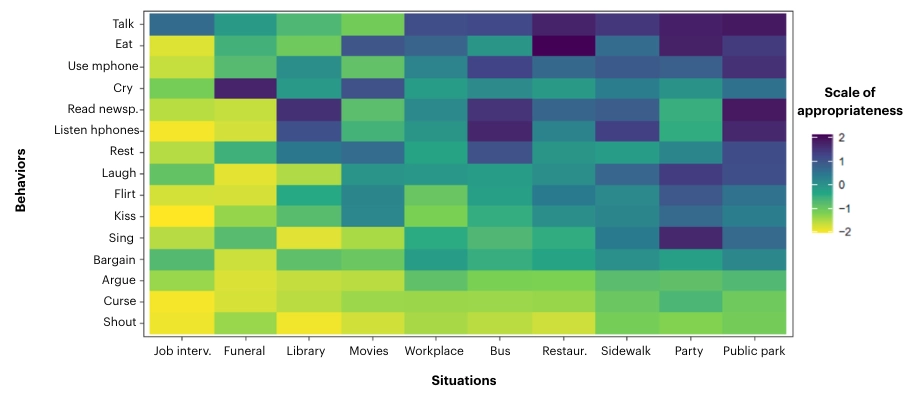
What does vary significantly is context. Norms change far more across situations — meeting, restaurant, party, interview — than across countries. For managers, this means that clearly explaining “which context we are activating” (informal meeting, executive committee, selection interview, etc.) can prevent many misunderstandings.
How we sanction people who break the rules
In a separate study, San Martin and coauthors analyzed which reactions are considered appropriate when someone steps out of line. The conclusion is universal: The more inappropriate a behavior is seen to be, the more acceptable it is to sanction it, whether through confrontation, social exclusion or reputational consequences.
However, there is nuance that can affect organizations. More prosperous and egalitarian societies prefer indirect sanctions: Visible forms of punishment (reprimands, public confrontation) lose legitimacy, while reputational sanctions (comments, evaluations, subtle exclusion) gain importance, circulating through formal and informal networks within the organization.
What executives need to know
The key takeaway is that social norms are not disappearing but instead evolving toward greater interpersonal sensitivity. For leaders and people managers, this means that:
- Professional norms are more universal than they may appear.
- Context matters more than nationality in defining what is appropriate.
- Reputation is a powerful informal regulatory tool.
- Managing diverse teams requires making situational norms explicit and fostering cultures based on mutual care.
In a fast-paced, global business environment, the grammar of behavior is not just a matter of courtesy but a strategic leadership tool.
MORE INFO:
“Everyday norms have become more permissive over time and vary across cultures” by Alvaro San Martin et al. is published in Communications Psychology (2025).
“Perceptions of the appropriate response to norm violation in 57 societies” by Alvaro San Martin et al. is published in Nature Communications (2021).
READ ALSO:
The age of sanctions: how we punish one another says a lot about our emotional state
Collectivists or individuals? How relational mobility affects worldview