
IESE Insight
Workplace conflict: three paths to peace

Here are conflict management systems to reduce, mitigate or resolve conflicts, so companies can enhance effectiveness and boost commitment.
There is perhaps no more extreme example of the deadly toll that conflict can take on a workplace than the case of France Telecom. Between January 2008 and April 2011, more than 60 employees committed suicide, with many leaving notes blaming stress and misery at work.
At first, the company played down the problem, saying these were isolated incidents. But as the scale of the problem grew, France Telecom was forced to recognize that the concerns being raised by staff needed to be taken seriously, and it launched a series of measures to deal with them. These ranged from instituting a suggestion box to opening legal inquiries to formally investigate employee complaints.
As strategies for managing organizational conflict, these measures are quite common. However, the efficiency or effectiveness of such remedies can leave much to be desired.
Indeed, if the organizational policies and processes that underpin the conflict are not fundamentally addressed in some meaningful way, the effects may be even more devastating.
Though not every organization will have a situation as dramatic as France Telecom’s, every company will experience conflict, to a greater or lesser extent, and will have to come up with some kind of management strategy to deal with it. If handled well, instead of being a source of alienation or destruction, conflict can increase employees’ sense of participation in an organizational community.
This article examines three distinct conflict management systems or clusters of strategies that organizations can use to deal with conflict.
Based on extensive research and business examples, I will show how thoughtfully chosen conflict management systems can be used not only to resolve the conflict in question, but also to boost commitment across the organization.
Whichever approach or combination of approaches is chosen, it is important to remember that perceived fairness in the conflict resolution process tends to increase employees’ evaluation of workplace justice, while control over the outcome of conflict can improve a sense of empowerment.
Furthermore, employees gain organizational “voice” when their needs, concerns and perspectives are given serious consideration during the conflict process.
Is conflict necessarily a bad thing?
As private enterprises become nationalized or as public sector institutions are sold off to private investors, growing numbers of people are finding themselves caught in the crossfire of painful workplace reorganizations.
A paper on “Stress at Work” by IESE Prof. J.R. Pin et al. cited this trend as one of the factors behind the France Telecom case. A partial privatization of the public utility led to 22,000 job cuts and 14,000 transfers: “Management sought to compel workers whose jobs were no longer considered useful or of a high priority to either leave the company or change their role. During this period, some France Telecom workers were psychologically weakened to the point of developing depression and mental illnesses that could drive them to suicide or suicide attempts.”
Amid these harsh market realities is the paradoxical belief that conflict is something best avoided at all costs. Yet ignoring or wishing away workplace conflict is a costly mistake in terms of morale, productivity and turnover, not to mention litigation.
It also misses the potential upside: that conflict can be a positive spur for organizational change. In fact, by realistically acknowledging that conflict is inevitable and, in some cases, desirable within groups and teams, and between various divisions and levels, managers are in a much wiser position to develop constructive strategies and forums, not just for airing grievances, but to expand their knowledge base.
Many times, problems are better identified and solved more creatively when a range of organizational stakeholders offer their perspectives on the impact of a firm’s decisions, actions and strategies — an impact that managers may fail to see.
Such ground-level knowledge, as mounting research shows, is a vital business commodity today — but only when it can be liberated from organizational silos and freely shared beyond the occupational and professional contexts in which it is frequently embedded.
A new desire to deal with conflict
Traditional strategies to deal with workplace conflict include lockouts, legal proceedings and arbitration. The effectiveness of these measures generally depends on a host of often overlooked variables, such as a company’s corporate and management cultures, as well as its operational structures, workforce and competitive environment. When companies adopt wrongheaded conflict management strategies — as is, unfortunately, all too often the case — they can exacerbate rather than reduce conflict.
Even in relatively non-litigious contexts, the negative consequences of unresolved organizational conflicts can exact a heavy toll on a company’s long-term performance. In the face of escalating court costs, prolonged trials, damaged reputations and poor productivity, companies are beginning to show genuine interest in conflict management.
At the same time, the dynamics of conflict have changed, due to shifts in the wider business climate — from the rise of flatter organizational structures and team-based project work, to more diversity and increasingly interdependent stakeholder groups.
Although these new workplace dynamics have certain advantages, this does not mean that all the old conflicts have magically disappeared, merely that they are surfacing in entirely new ways. This, in turn, requires new ways of viewing and dealing with them.
As a core element of the new approach to conflict resolution, companies are trying to deal with conflict at the lowest organizational level possible.
3 kinds of conflict management systems
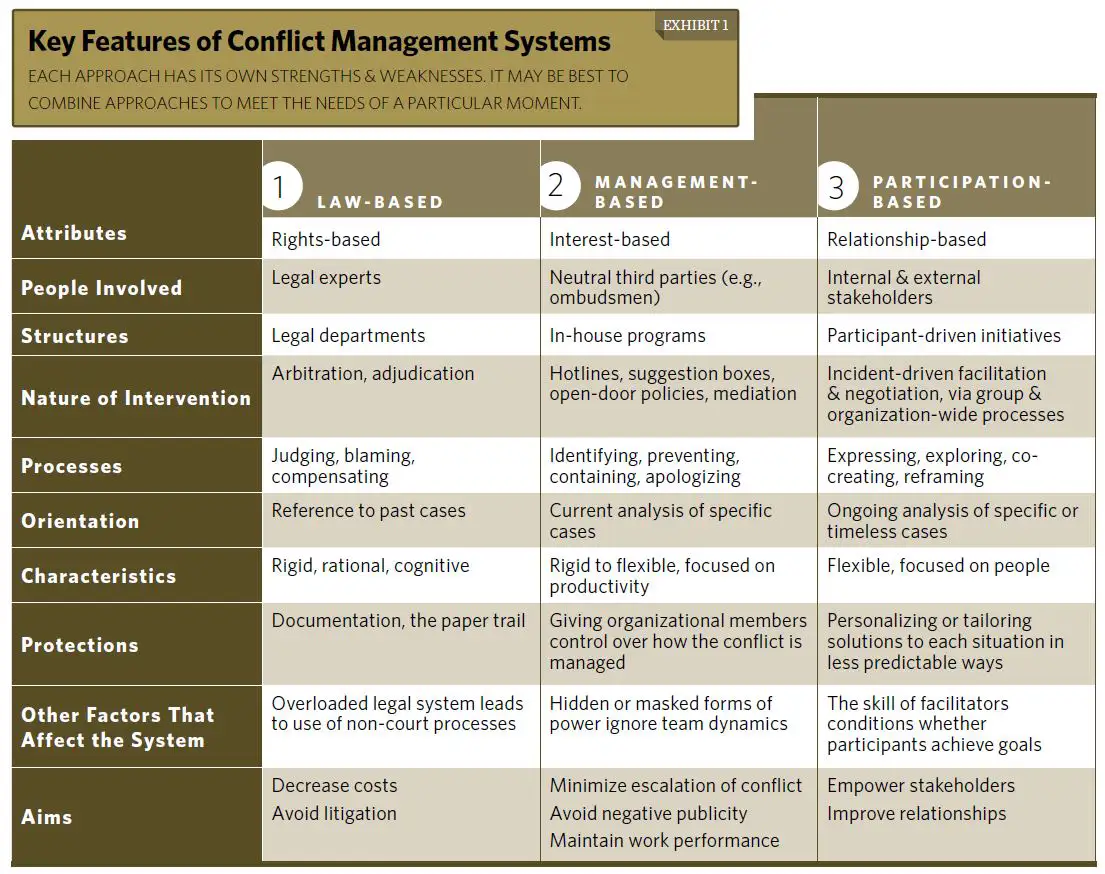
Broadly speaking, there are three kinds of conflict management systems that companies draw upon to reduce, mitigate or resolve conflicts: law-based, management-based and participation- based measures. Each approach has its own particular strengths and weaknesses.
I will consider each in turn, highlighting their particular features, so that companies can enhance the effectiveness of their approach according to the nature of the conflict at hand.
1. Law-based systems
Law-based strategies originated in an era when unions took on a third-party role to remedy the power imbalance between workers and management. Today’s industrial relations focus on ensuring that organizations recognize and implement workplace conditions and rights.
Law-based systems generally work best when addressing bilateral conflicts about substantive concerns that have clearly defined parameters. But for them to work effectively, they must adhere to the following principles.
They must address clear violations. As these kinds of disputes involve a perceived transgression of rights, there need to be some explicit policies or practices set out in relevant documents — related to harassment, discrimination or working conditions, for example — in order for organizational members to make legitimate claims regarding a specific, identifiable violation or omission.
Herein lies the problem: Policy documents may be vague, inadequate or nonexistent. Companies need to have some specific guidelines in place, so that those called upon to judge the facts of the case have some clear objectives for their lines of inquiry.
Adjudicators need to be perceived as neutral. The facts of each case must be judged by an expert third party and not by any of the stakeholders involved. The idea here is that, through arbitration, adjudication, peer review, employee appeals boards, executive panels or mediation, neutral third parties are able to assign responsibility, ensuring that the party to blame for the transgression makes appropriate reparations to the wronged party.
Although this sounds good in theory, experience reveals many imperfections. For one thing, rarely do conflicts fit neatly into a right/wrong binary, making the assignation of blame not so clear cut.
More important, it is hard to find third parties that are genuinely neutral with regard to the organization, and large organizations have disproportionate power and resources to manage the system to their advantage.
Another weakness is that some arbitration processes, such as ethics committees, are frequently resolved by voting, rather than by applying standardized procedures. What you can end up with is a mock trial that operates outside of normal legal proceedings, which would otherwise have to be made public. Instead, these extra-judicial processes are kept private and confidential. This institutionalizes a conspiracy of silence. In such circumstances, employees seldom emerge the winners.
They must be seen to be fair. The procedure whereby facts are selected, presented and adjudicated must be perceived as fair by all parties involved. To that end, the facts of the case must be unambiguous, and the terms of reference about what is included and excluded must be acceptable to both parties involved in the conflict.
Once again, such ideal conditions do not always exist. Organizations are able to avoid challenges through strategic system design. When claims to rights threaten highly institutionalized policies and practices, more powerful parties may structure the conflict management system in such a way that the weaker party cannot initiate a case.
For example, many employers institute trial periods for new employees that deny them the right to file personal grievances during their first 90 days of employment.
In addition, arbitration designed by one side can result in the deliberate creation of transaction costs so excessive that the other side decides not to pursue the claim. The conflict gets buried under a barrage of onerous judicial procedures and red tape.
Moreover, by framing the conflict in adversarial, rights-based terms, “fair” strategies to resolve the conflict may take the form of simply separating the disputing parties through a legalistic restructuring or reorganization of workplace arrangements.
While this may succeed in making hostilities less overt, the root causes of the conflict are not dealt with in any meaningful way, if for no other reason than because there is no precedent to be found in the company handbook. The conflicts are left to simmer beneath the surface, making them that much harder to identify and manage when they erupt again — and erupt again they will.
To make up for these deficiencies, other approaches to conflict management, besides purely law-based ones, are needed.
2. Management-based systems
Unlike the crime-and-punishment model for resolving conflict, management-based systems treat conflict as a natural, albeit avoidable, phenomenon. They aim to address conflict close to the source, encouraging groups to define the terms of their interactions and adapt to changing conditions.
Doing this has transformed conflict management in three crucial ways.
- First, the treatment of conflict is broadened beyond legalistic discussions of workplace rights, and may include interpersonal differences and disagreements about task processes or organizational goals.
- Second, instead of framing conflict as a zero-sum game, management-based systems enlist a range of interest-based policies and procedures that emphasize mutual gain by all parties involved.
- Third, management-based systems can foster more democratic workplaces, by attending to workers’ grievances and giving participants more control over final outcomes.
Hotlines, suggestion boxes, open-door policies, ombudsmen, employee assistance programs and interest-based alternative dispute resolution are a few of the systems that managers typically adopt to alert them to potential problems brewing at the lowest possible organizational level, so they can address them before they mushroom into full-blown conflicts.
However, as with their legal-based counterparts, these systems have shortcomings. To get the most out of them, people must be aware of how these systems can be abused.
Relativizing claims. Some of these procedures may amount to little more than thinly disguised HR strategies, designed primarily to serve managers’ rather than employees’ interests. Instead of addressing the root causes of conflict, managers may use the new information that these systems yield to make comparative judgments, pointing to others in the organization who are worse off, in order to relativize claims and, in doing so, brush them off.
Deaf-ear syndrome. Systems like open-door policies are only effective provided that the information shared does not fall on deaf ears. Given the tendency of upper management to support the decisions of other managers below them, for many employees, the open door, for all intents and purposes, might as well be shut.
A survey done in one company with a longstanding open-door policy found only 12% of employees said they actually used it. Why might this be?
Employees’ reluctance seems to stem from a fear that using the open door will be poorly perceived by senior managers and slow their career progression. As one ombudsman put it, the open door effectively functions “so that employees and managers voluntarily conduct themselves in the way management would like them to, with a minimum of surveillance or coercion, but backed up by the twin threats of discipline or social disapproval.”
In other words, unless the organizational culture actively cultivates the expression of dissent, employees will worry that their complaints will be viewed as a form of protest, and they will start to self-censor.
All talk, no action. Sometimes the use of these systems does not translate into organizational action.
Returning to the case of French Telecom, apart from the fact that disputes were largely framed in judicial terms, even when management-based systems were employed to try to involve workers in the process, they rarely led to any meaningful action. Take the suggestion box idea: Out of the more than 90,000 suggestions received, only 7,600 (little over 8%) were acted upon. Even then, the actions taken were almost exclusively product-related, not employment-related.
Bitter victory. To resolve the problems of managerial bias and organizational inaction, it can help to call in external, trained, neutral mediators. Although alternative dispute resolution measures can succeed, it’s difficult to judge their efficacy in organizational contexts where confidentiality clauses make company records unavailable for public scrutiny.
Apart from a lack of transparency, another way that alternative dispute resolution can be weaker than traditional litigation is that its individualized, organizationally contained nature can lead to inconsistencies. At least with legal-based systems, they have to take past as well as current cases into account, cognizant of their role in setting future precedents.
Usually, these forms of mediation work best when both parties in the organization want to find points of agreement. Otherwise, if the case is highly contentious, the outcome is likely to be less than satisfactory, especially for the employees concerned.
Even if they should win their case through mediation, the bad feelings generated can make it hard for them to go back to doing their jobs as before. Many of them are forced to resign, due to the resultant climate of insecurity and loss of trust.
The main takeaway from all this is that management-based conflict resolution systems can be twisted to serve organizational ends. In companies with strong top-down hierarchies, people should be aware that the use of consultative or relationship-based methods may be being used only insofar as they are seen to benefit organizational goals and interests.
3. Participation-based systems
The third type of conflict management system — participation-based — recognizes that there are multiple ways for an organization to achieve its goals and to manage conflict at interpersonal as well as at intra- and inter-organizational levels. At the heart of this approach is a focus on relationships and an underlying assumption that participation has benefits at personal, organizational and societal levels.
The reasoning is simple: a collaborative organizational culture can improve the way a company operates and enhance the quality of life for those working in it.
One major influence on this approach has been the raised awareness of stakeholders — that is, any group who will affect or be affected by an organization’s decisions, actions or strategies. Stakeholders can alert the organization to factors, issues and concerns that managers may fail to see. If a company is open to unexpected input from internal and external stakeholders, it is more likely to respond better to internal as well as environmental changes and challenges.
To this end, companies need to view conflict and conflict management through a markedly different lens. Rather than seeing conflicts as discrete episodes erupting outside of the norm, companies need to see them as the inevitable result of natural, ongoing tensions among organizational goals, stakeholder concerns and an evolving sociopolitical environment.
Viewed this way, managers should not just allow but actively encourage stakeholders to initiate change at different stages of the conflict process. But for this to happen, there need to be certain conditions in place.
Define your mission. The first major step toward conflict prevention is to get participants to determine and agree on the overall purpose of the organization. This, in turn, enables different stakeholders to form a clear idea of how the work they do contributes to the organizational mission. Such participation may include focused or strategic conversations to understand different viewpoints on the issue at hand before taking action.
Promote self-regulation at various levels. Crucially, companies looking to adopt a participation- based approach to conflict management must be willing and able to have or embrace an organizational culture and goals that enable employees to develop appropriate interpersonal conflict management skills at various levels:
- interpersonal.
- group, team and departmental.
- organizational.
- external relations.
Facilitate an interactive group process. Organize facilitated group methods for meetings, teams and large groups of people who rely on each other to achieve specific goals. Select a neutral facilitator to manage the group process and attend to the relational dimensions of the group.
Facilitative mediation can spur deeper understanding among stakeholders and the co- or reconstruction of a conflict situation. Interactive methods have the added advantage of engaging a wide spectrum of stakeholders, emboldening them to provide input on vital issues, as well as raising their commitment to finding solutions.
Focus on common issues. Focusing stakeholders’ attention on common issues serves to build a relational foundation, which allows conflict to be addressed as it emerges.
Facilitated mediation, for example, has powerful effects on groups in conflict by enabling them to exchange points of view and reach a solution independently.
It also encourages participants to recognize the value of agreement and compromise, generating long-term benefits for both the organization and its stakeholders, while also calming tensions.
Engage in dialogue. Conflict management methods that rely on dialogue foster a sense of self-determination, relational commitment and organizational justice.
The San Francisco-based Public Dialogue Consortium is a good example: This group of consultants specializes in using dialogue “that results in collaborative problem-solving, appreciation for different perspectives and identification of common ground.”
In one instance, the PDC used small dialogue groups and reflecting teams at two California universities to address the controversial issues of affirmative action and multiculturalism in higher education.
Another time, it led a five-day dialogue between Christian and Muslim leaders in Maluku, Indonesia — a province ravaged by religious violence — to restore peace and reach a common vision based on shared values.
These approaches are more typical of public sector settings, such as hospitals and government agencies, perhaps because public servants or elected officials have a clearer mandate to listen and respond to stakeholder groups to whom they are ultimately accountable.
Nevertheless, the growing number of public/private partnerships may lead to higher levels of participation-based strategies being adopted in for-profit settings, given that these strategies are particularly effective when dealing with contentious issues and complex projects with large-scale, long-term outcomes.
However you choose to adopt or adapt these participation-based processes, make sure that the outcomes and relational goals are compatible with those of the organization.
Above all, remember that organizations that remain closed to input from unexpected but influential quarters risk atrophying and failing to adapt to emerging environments.
Deciding on the right model for you
As you can see, each conflict management system has its own particular strengths and weaknesses. Choosing which system to apply depends on the nature of the conflict and the organizational systems and environment within which the conflict is embedded.
Organizations are fundamentally systems that depend on the perceptions of, and the interactions between, the individuals in those systems. At the same time, an organization’s culture, and its relationship with its environment, also influence those individuals and the choices they make.
The management strategy adopted is not merely a response to conflict; the strategy chosen is also creating, contesting and reinforcing particular conflict patterns.
- For example, by adopting a law-based approach, companies are signaling that their view of conflict is primarily adversarial and aimed at apportioning blame. A decision to pursue non-court arbitration would be justified on the basis of expediency, to save time and money in the process of making the conflict go away.
- Companies that embrace a management-based approach would see the conflict in terms of interests. By adopting strategies such as mediation or open-door policies, they may be trying to contain the conflict at the lowest possible level, so as to protect organizational interests, perhaps at the expense of employees.
- This is different from a participation-based approach, which seeks to engage all stakeholders in organizational planning and problem-solving, through focused conversations or facilitated mediation. Such methods look to empower stakeholders and foster ongoing relationships across the organization.
There is no one-size-fits-all approach to conflict resolution. An approach that might work well for one company could be counterproductive for another.
Instead, organizations should select an appropriate framework by combining elements from diverse approaches, ever mindful of the impact each might have on the system as a whole.
Unfortunately, much of the current discussion about conflict management focuses on the adoption of a specific set of best-practice strategies. In my view, implementing off-the-shelf solutions to conflict management is problematic, to put it mildly.
The paradox of best practice is that the more one prescribes how conflict management ought to operate, the more inflexible systems become.
To avoid atrophy, implosion or explosion, system designers need to consider whose rights, interests and voices are privileged, and to what extent they are flexible within the system as a whole.
Best practice, then, means having the courage to look at all the approaches on offer, and adopting, or even developing, approaches that meet the needs of the stakeholders involved at that particular moment.
MORE INFO: “Systems within systems: law, management and participation-based conflict management systems within organizations” by Kirstie McAllum and Mary Simpson. Chapter in The Sage Handbook of Conflict Communication (2013).
READ ALSO:
What meaning at work means for caregivers
From stress to success: a diagnostic for navigating identity and change at work
This article is published in IESE Insight magazine (Issue 18, Q3 2013).
This content is exclusively for personal use. If you wish to use any of this material for academic or teaching purposes, please go to IESE Publishing where you can purchase a special PDF version of “Workplace conflict: three paths to peace” (ART-2415-E), as well as the full magazine in which it appears, in English or in Spanish.


Enter your email below to unlock
EXCLUSIVE FREE CONTENT FOR INDIVIDUAL USE
* Required fields
Note: Entering your birthdate enables us to send you info relevant to your life stage and career.