
IESE Insight
Why wages stagnate in areas with few employers

What happens when just a few employers hold most of the hiring power? Here’s why areas with high labor market concentration have lower wages.
When giants like Amazon or Walmart come to new communities, it’s usually seen as a boon for the local labor market. After all, they bring jobs — and, presumably, a positive knock-on effect for the area economy.
But along with lower unemployment, the arrival of such a giant may also lower wages, which may help explain wage stagnation in many areas. The key is labor market concentration. IESE’s José Azar explains:
In 2017, Ioana Marinescu, Marshall Steinbaum and I released a paper that takes a first step at measuring labor market concentration for various occupations across U.S. cities.
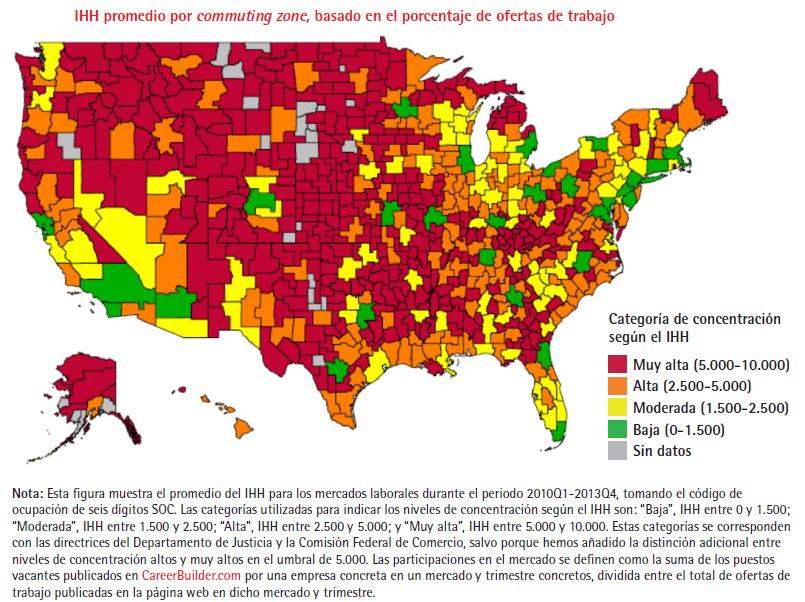
We used a unique dataset, from CareerBuilder.com, the largest job-search website in the United States, containing about a third of all vacancies in the country. The dataset contains about 30 of the most common occupational categories, such as nurses, truck drivers, secretaries, accountants and computer support specialists. For each year quarter, city and occupation, we calculated the Herfindahl-Hirschman Index (HHI), which is the most commonly used measure of market concentration and is generally used to gauge market power in product markets.
We found that labor markets in the United States were highly concentrated, on average, with higher concentration especially in smaller cities, as illustrated in this figure:
Concentration has a negative effect on wages
We also found a strong negative relation between labor market concentration and wages.
We controlled for city and occupation characteristics, and for changes over time that are common within a city across all occupations. We also controlled for labor market tightness — a measure of how many vacancies there are for each worker searching for a job in a labor market.
Note the key difference between tightness and concentration: tightness is based on the number of vacancies, even if they are all posted by a small number of firms. Thus, tightness can be high but the market can still be highly concentrated.
Concentration has a negative effect on wages, holding the level of tightness constant.
The fact that many labor markets are concentrated may change our assessment of the economic impact of the growth of large firms, such as Walmart and Amazon.
For example, The Economist has provided data showing that counties where an Amazon warehouse is located tended to see a decline in wages relative to other counties.
In other words, when most of an area’s hiring is done by a relatively small number of companies, those companies may not have to compete with other potential employers for local talent. So, they acquire the power to keep wages lower: it’s a buyer’s market, with negative consequences for the average paycheck.
Understanding how this comes about can lead to better policy and organizational decisions to help foment wage growth and healthy competition.
Methodology
With proprietary data from CareerBuilder for 2009 to 2012, and calculations of the concentration of employers across more than 8,000 labor markets, the authors find that an increase in labor market concentration is associated with lower wages for the job titles tracked. They also find higher labor market concentration is linked to a higher number of job titles linked to lower wages.
José Azar gratefully acknowledges the financial support of Secretaria d’Universitats i Recerca del Departament d’Empresa i Coneixement de la Generalitat de Catalunya (Ref.2016 BP00358).
READ ALSO:
Do minimum wage hikes result in job losses? It depends on the labor market
Why are wages so low in so many markets?
AI is increasing demand for managers — and changing their skill sets