IESE Insight
Ben-Ami and Borrell: The keys to the new world disorder

The two veteran diplomats examine the major sources of global tension, from the Middle East to Ukraine, China and Europe’s strategic vacuum.
The world has gone PLUTO (polarized, liquid, unilateral, tense and omnirelational), and to understand its various twists and turns, nothing is as good as an insider view.
At the 2nd Geopolitics Summit, held on IESE’s Madrid campus, Josep Borrell, former EU High Representative for Foreign Affairs and Security Policy, and Shlomo Ben-Ami, former Foreign Affairs Minister of Israel, offered their takes on the major sources of global tension today. Professors Santiago Alvarez de Mon and Jordi Gual moderated.
Asymmetric war in Iran
Borrell was blunt: “Netanyahu had been trying for 20 years to convince a U.S. president to bomb Iran, and with Trump, he finally succeeded.” Trump did so against the advice of the U.S. military, which clearly warned the White House chief that “Iran would close the Strait of Hormuz.”
The problem now, Borrell emphasized, is not so much the price of oil. If the strait remains blocked long enough, there will be no fertilizers — made with sulfur and nitrogen derived from Gulf oil — to plant the next harvest in 80% of African and Southeast Asian countries. “We’re playing with fire. If the Strait of Hormuz isn’t opened soon, we will have a bigger problem.”
Forcing it open, he added, is “beyond the military capabilities of the United States,” so it can only be “achieved through negotiation.”
During his session, Ben-Ami compared the Israel-Iran conflict to the Thucydides Trap described by the political scientist Graham Allison: two non-Arab powers in an Arab environment, one established (Israel) and the other emerging (Iran), both competing for regional hegemony without any border or resource disputes. His prognosis was grim: An agreement will be reached, “but it will be a hollow one, leaving many loose ends,” without addressing Iran’s ballistic missiles or its network of allied armed groups. He also noted that Iran “is certain it won the war.” In asymmetric conflicts, he reminded us, “the strictly military sphere is not what determines the outcome.”
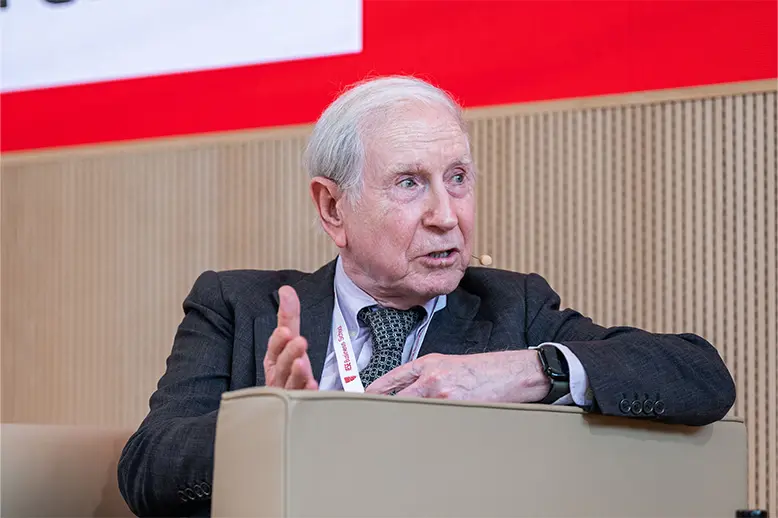
Shlomo Ben-Ami on the Iran conflict: An agreement will be reached, “but it will be a hollow one, leaving many loose ends.”
Ukraine at a stalemate
Borrell recalled a visit to the Donbas two weeks before the Russian invasion, during which the Ukrainian prime minister had asked him what Europe would do if Ukraine were invaded. He didn’t know how to respond. Today, the answer is clear: €200 billion from the EU so far, plus €90 billion in loans “that we’re not going to get back.”
But the real Achilles’ heel of the conflict is technological: If Trump were to cut off access to American satellite intelligence, “Ukraine would be blind.”
The front line, which has expanded into a kilometers-wide kill zone that neither side can break through, illustrates Russia’s logic: “a war machine that sells hydrocarbons and uses the money to manufacture weapons,” riding on “a kind of military Keynesianism” that Putin can finance. “Putin is in no hurry,” he observed. “He has men and he has money.”
Ben-Ami spoke to the internal Russian dimension. Putin has recruited soldiers from ethnic outposts and brought in troops from North Korea precisely to avoid mobilizing the Russian heartland. Authoritarian regimes do not survive defeat: “Democracies can change the government; dictatorships collapse by defeat.” Russian history is illustrative of this, with the 1905 revolution following a war, and the 1917 revolution following a defeat.
Ben-Ami didn’t rule out the tactical use of nuclear weapons if Putin really found himself up against the ropes. After all, “what is the point of being the country with the most nuclear weapons on the planet and losing a conventional war?”
China, the unsustainable electrostate
What China has achieved in 40 years “is unparalleled in human history,” Borrell asserted. The Asian superpower accounts for a third of global industrial production, has more surface ships than the U.S. Navy, and has a stranglehold on the critical minerals that fuel the energy transition. “The United States is a petrostate,” he said. “China is an electrostate.”
Although coal still plays a significant role in its energy mix, China is at the forefront of technological developments in all areas of renewable energy. Yet Borrell cautioned that there was a structural contradiction to China’s success: The model is sustained by suppressing domestic consumption to export at all costs, and “the world cannot live with this structural imbalance generated by China.”
Ben-Ami added that the key to understanding Xi Jinping’s inflexibility is the fear of “historical nihilism” that destroyed the USSR. The political openness that Gorbachev promoted in the 1980s (glasnost) precipitated the Soviet collapse, and Beijing has no intention of repeating the experiment. So China, in Ben-Ami’s view, will make no geopolitical concessions in either Ukraine or Iran. Beijing will continue to back Moscow and Tehran, exert greater pressure on the seas, and will not yield on Taiwan.
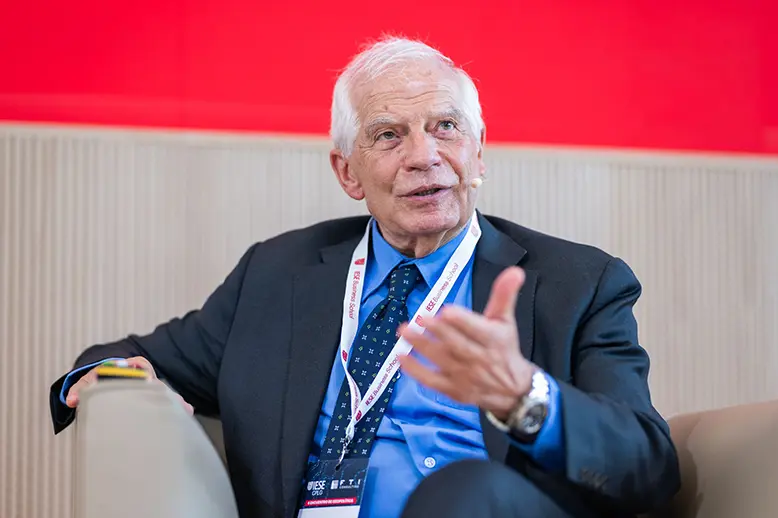
Josep Borrell: “Europe must learn to speak the language of power. We still haven’t learned it, perhaps because we lack power.”
Latin America and the lithium that’s slipping away
Borrell issued a warning to business leaders and asset managers: “Europe has invested more in Latin America than in China, Russia, Japan and India combined, but it is Chinese companies that are mining lithium in the Andean Triangle (Argentina, Bolivia, Chile). The lithium goes to China, where it is refined, and that powers all the electric gadgets in our daily lives.”
The region is home to the two raw materials essential for electrification: copper and lithium. It also produces food for more than a billion people.
But Latin America’s great challenge, Borrell said, remained its institutions. “What China has in abundance, Latin America lacks.”
Europe still hasn’t learned the language of power
Borrell recalled the phrase he used when addressing the European Parliament in 2019: “Europe must learn to speak the language of power.”
Seven years later, he noted, “we still haven’t learned it, perhaps because we lack power.”
The internal division is palpable. Regarding the Gaza conflict, he said, “there could not be two more different positions” than those of Spain and Germany, and European institutions “have shown not the slightest empathy for the suffering of the Palestinian people.”
On NATO, he pointed out that Article 5 only obliges member states to act “in the manner each deems appropriate.” Regarding Article 42.7 of the Treaty on the European Union (the mutual defense clause), he noted it requires defense “with all means at its disposal,” but that it “lacks the operational command that would make it effective.”
Ben-Ami framed the dilemma in nuclear terms: Only France is truly an independent nuclear power, because 90% of the non-nuclear components of British nuclear capability are American. “The question now is whether the French are willing to sacrifice Lyon to save Berlin.” In other words, to risk their own territory to defend their allies most exposed to Russia.
In his view, Europe needs a gradual withdrawal of the United States, but an abrupt withdrawal would be a major tragedy and leave Europe defenseless.
Technical leaders vs. loyal leaders
Borrell concluded with a reflection on leadership. The generation of the Spanish Transition (late 1970s–early 1980s) came to power with established professional careers and what he called a cursus honorum — a gradual progression from smaller to larger responsibilities. Today, he lamented, “political appointments are made to secure loyalties or to build coalitions.”
And he highlighted a difference that seems anecdotal but which he considers significant: In China, leaders are almost all engineers; in Europe, they are mostly lawyers. “The technical training of Chinese leaders is overwhelming.”
SOURCE: Edited from sessions with Josep Borrell (moderated by IESE Prof. Santiago Alvarez de Mon) and Shlomo Ben-Ami (moderated by IESE Prof. Jordi Gual), both held as part of the 2nd Geopolitics Summit organized by IESE Business School in Madrid.
ALSO OF INTEREST:
Geopolitical and economic crises: an uncertain future for the United States, China and Europe
Prepare for a new age of conflict, warns Spain’s defense chief