IESE Insight
Purpose, partnerships and people: the keys to transformational change

JERA Global CEO and Chair Yukio Kani explains how mission-driven leadership powered a global energy transformation after Fukushima.
When Yukio Kani was a child, he remembers wanting to build a fort in the woods: “But it was the dead of winter and I couldn’t do it by myself. To build it, I needed others to join me; I needed to assemble a team. I had to come up with a compelling reason to get my friends to march out into the dark, wet forest and build this fort with me. And that’s exactly what I did.”
That was the first of what he likes to call “dangerous adventures,” a recurring theme of his career, but unlike a childhood adventure, the stakes were considerably higher when he faced his most dangerous adventure yet: the 2011 earthquake and tsunami that hit Japan, taking out the Fukushima nuclear power plant and causing a meltdown. This time failure could mean power shortages for Tokyo and a deeper crisis for Japan’s energy system.
Tokyo Electric Power Company (TEPCO), which ran the plant, needed urgent restructuring. Yukio Kani had a plan, akin to building a new fort: “First, if you want to transform something, you need to have a clear vision and an exciting story to get there. Second, you can’t do it alone, so you need to build a team you can trust. Third, to increase supporters, your story has to be good for society — if we achieve it, we’ll make the world a better place.”
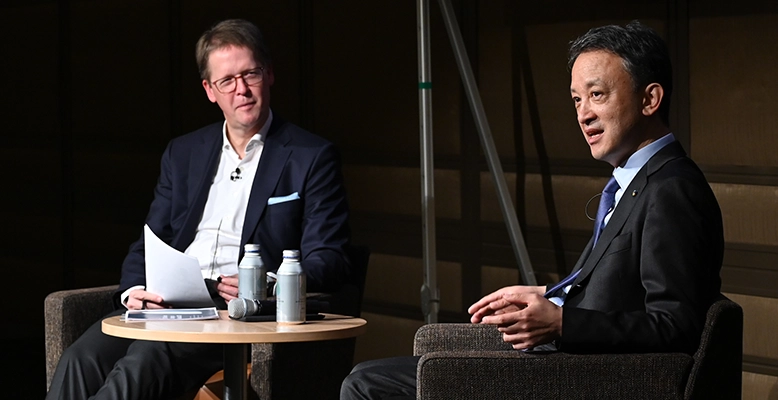
He sat down with IESE Dean Franz Heukamp (pictured left) during a special session in Tokyo to talk about what happened next. Throughout the conversation, a consistent leadership philosophy emerges: While the destination must remain clear, the path to reach it must continuously evolve.
Franz Heukamp: Take us back to 2011. You faced an unprecedented challenge. What were you thinking?
Yukio Kani: I was one of many managers working at TEPCO’s headquarters when everything changed overnight: nuclear capacity disappeared, financial confidence evaporated and the assumptions underpinning our entire system were suddenly cast in doubt. Many believed it was game over. But I refused to give up. I was convinced we needed additional gas‑fired power capacity to replace the nuclear generation we had lost. Yet expanding that capacity — and securing the necessary Liquefied Natural Gas (LNG) — required financial strength and a high credit rating. Since we were effectively bankrupt and unable to borrow, it was evident that we needed to make a fundamental shift.
To move forward, we first had to visualize a new future — one that would allow me to assemble a strong team and seize a once‑in‑a‑lifetime opportunity to transform a very traditional industry. Some colleagues and I developed a proposal, which I took directly to the chairman. He liked it and urged me to present it to the top management team. But when I did, every single leader rejected it. At that time, taking the bold step of establishing a new, independent company — especially under such extreme conditions — was simply too much for them to accept.
A short time later, however, the situation shifted dramatically. Members of the new TEPCO management team appointed by the Japanese government reviewed our proposal and supported the move. With their backing, we publicly proposed seeking a partner to establish a 50/50 joint venture (JV) and create a new company. This structure would finally give us the ability to borrow funds, expand our power‑generation capacity and procure the LNG we needed.
FH: So you persisted. It took a few years, but you found a partner, Chubu Electric Power Group, and formed JERA in 2015. And it was not just to invest in more LNG but to become a global leader in energy solutions, with a focus on clean-energy renewables and low-greenhouse-gas power supplies in Japan and around the world. How did you make that transformation?
YK: My quick answer is the same for any kind of transformation: You need a clear vision and a story of how to get there. You need to build your team carefully. And your vision has to be good for society, which ours is: to help solve the world’s energy issues and contribute to the sound growth and development of the world. Transformation only works when vision, people and purpose reinforce each other. Without one of them, the story collapses.
Creating a new organizational culture from scratch
FH: Let’s talk about the organization you built. You didn’t want to carry over traditional practices or culture but wanted to create something new. How did you do this?
YK: Under the terms of the JV, we agreed that each of our old ways of doing business should not be exported to JERA. We were clear that we wanted to move from a male-dominant, seniority culture to a diverse, horizontal culture. When people think of change, they tend to think it should come from the top. But I see my role as Global CEO as doing two things: one is setting the governance system or operating framework; the other is putting soul into it — the team-building. Both must support and encourage the diverse, horizontal culture we seek.
Our mission serves as a guide for people to follow, based on core values that we’ve decided can’t be compromised. If you have the mission-vision clear, then you can identify the gap between the status quo and where you want to be, and produce a business strategy to get there, which differentiates you from others. That’s what the leader provides.
Having that shared purpose or mission-vision also gives you a clear understanding of what type of people you will need to find, so you can start tapping the right people. When I meet potential candidates, my pitch is: “This is who we are, where we’re at and what we’re trying to achieve — do you want to join us? And if you do, you can create your own idea, you can build it from scratch, but you must confirm one thing: that you are serious about making JERA a global company.”
Leadership is often framed as choosing the right people and partners. For me, the real leadership challenge is building an organization strong enough that the best people and partners choose us. I need to feel that person-to-person connection, that passion and commitment, especially in the top management team, because we will be tested, and if we don’t have the right people, we won’t succeed.
Balancing trade-offs when market conditions shift
FH: When JERA started, the world was in a much different place, perhaps with more enthusiasm for decarbonizing energy in favor of green investments and projects. How are today’s more adverse market conditions affecting how you pursue your strategy?
YK: Your question is ultimately about the trade-offs that need to be made between purpose and financial profit. To answer, I go back to our mission, which is to provide cutting-edge solutions to the world’s energy issues. And that requires achieving sustainability, affordability and stability of energy supply all at the same time, which is, admittedly, difficult.
From an investment point of view, we focus on three key areas: LNG, renewables and hydrogen/ammonia. Some, like offshore wind and hydrogen, aren’t yet profitable. So, should we just quit making those investments? Some might say yes. However, in the case of JERA, we refuse to give up. Some organizations change their destination when conditions become difficult. I believe the destination should remain constant, even when the route requires adjustment.
Besides, I think there’s more important capital in a company: the human capital. If we just focus on one area, like LNG, we won’t be able to attract and keep talented people. And without them, we cannot do transformation. So, we stick to the destination — we just have to be more innovative and agile about how we get there.
FH: Can you give us an example of how you’re doing that?
YK: Offshore wind is a good example. We decided not to do it by ourselves, but to find a capable, trustworthy partner, and in 2025 we signed a JV with BP. We work as a team to scale up operations, which means we have a more balanced portfolio of investments and more financial discipline to pick the right projects. My bet is that the business environment for offshore wind will improve sometime in the 2030s, by which time I can pass this option on to the next generation of management to accelerate offshore wind as an energy alternative.
AI and geopolitics: preparing for future change and disruption
FH: Is AI another area where the future is difficult to foresee but you still have to make some investments, given the amount of power that AI data centers will increasingly consume?
YK: Renewables are not yet options for powering data centers, yet we don’t want to waste or reduce efficiency or redirect energy supplies just to feed those “hungry caterpillars,” which will only increase CO2. In our talks with data center players, we’re proposing several things. One is using the thermal power station system that cools down turbines using sea water to likewise be used to cool down data centers. Another thing is LNG is typically stored and transported at -164° — maybe that could be used for cooling data centers. When offshore wind comes online in 2030, we will connect that to the data centers. Another possibility is carbon capture and storage — extracting CO2 and transporting it elsewhere. These would enable us to stick to our long-term mission of increasing efficiency while reducing CO2, and not make hasty business decisions based on current market conditions.
FH: Geopolitics, especially related to the energy mix, is also generating market volatility. How are you dealing with that risk?
YK: LNG is a giant cross-border business that’s always tied to geopolitics. As the biggest LNG buyer in the world, we’re always thinking about diversifying our sources to reduce the risks. We’re not just a buyer. We invest in the entire value chain, from upstream to downstream, from gas fields to liquefication plants, everywhere from the U.S. to Australia, controlling nearly 30 vessels, together with global asset-backed trading in Singapore and London. We have multiple options to manage demand-side as well as supply-side risks, giving us the unique ability to connect ourselves with literally every single seller and buyer of LNG in the world should something happen to one of the sources through a geopolitical issue. On the downstream side, we’re the only ones doing this at this scale. On the upstream side, there are only a few, namely Shell and BP.
The key for reducing geopolitical risks is preparing beforehand. Take Germany: It relied too much on cheap pipeline gas from Russia and now, with the war in Ukraine, that supply is gone. How have they chosen to resolve the trade-off between sustainability, affordability and stability of energy supplies? By burning coal in old plants! They weren’t prepared. This is something we learned the hard way.
Purpose and culture are the keys to collaboration
FH: In addition to preparation, the other key word I’m hearing from you is working in partnership. What are the ingredients of a successful collaboration?
YK: It goes back to my idea of the “dangerous adventure.” Are you going to venture out in search of those green fields with or without partners?
Whether LNG, renewables or hydrogen/ammonia, each represents a big investment, so if you can team up with capable, trustworthy partners, then you’re much more likely to achieve the mission-vision than going it alone.
The same is true for attracting individual talent. Find a partner with whom you can work, who chooses you as much as you choose them.
Think of your company like a ship. Before boarding a ship, you confirm two things: the destination and the crew. Leadership is about building both — a purpose people believe in and a culture they choose to stay in. That is why having a diverse, horizontal culture is so important to me. Those two things — purpose and culture — are the keys to collaboration.
This interview is included in IESE Business School Insight online magazine No. 172 (May-Aug. 2026).
READ ALSO:
Lessons from Fukushima: the gains from environmental disclosure
Suntory CEO Tak Niinami: “Harmony with people and nature is in our DNA”
Creating new knowledge the Japanese way
Budding talent: Achieving management zen through ikebana flower arrangement
The future of capitalism (special report by IESE Business School and Shizenkan University, Japan)