IESE Insight
IKEA CEO: Leading with humility, determination and values

Juvencio Maeztu on balancing affordability and sustainability while preserving foundational values in a polarized, fast-changing world.
For Juvencio Maeztu, CEO and President of Ingka Group, which manages IKEA operations, leadership is about striking the perfect balance between staying true to enduring values of the past while building the future; it’s about sticking to sustainability, affordability and inclusion in an increasingly polarized world.
Maeztu (IESE MBA ’94) has spent 25 years at IKEA, managing stores in Spain and Britain, serving as head of HR for the Iberian Peninsula, and setting up operations in India. From 2018 to 2025, he was Ingka Group’s Deputy CEO and CFO, before taking the top job in November 2025, the first non-Swede to hold this role.
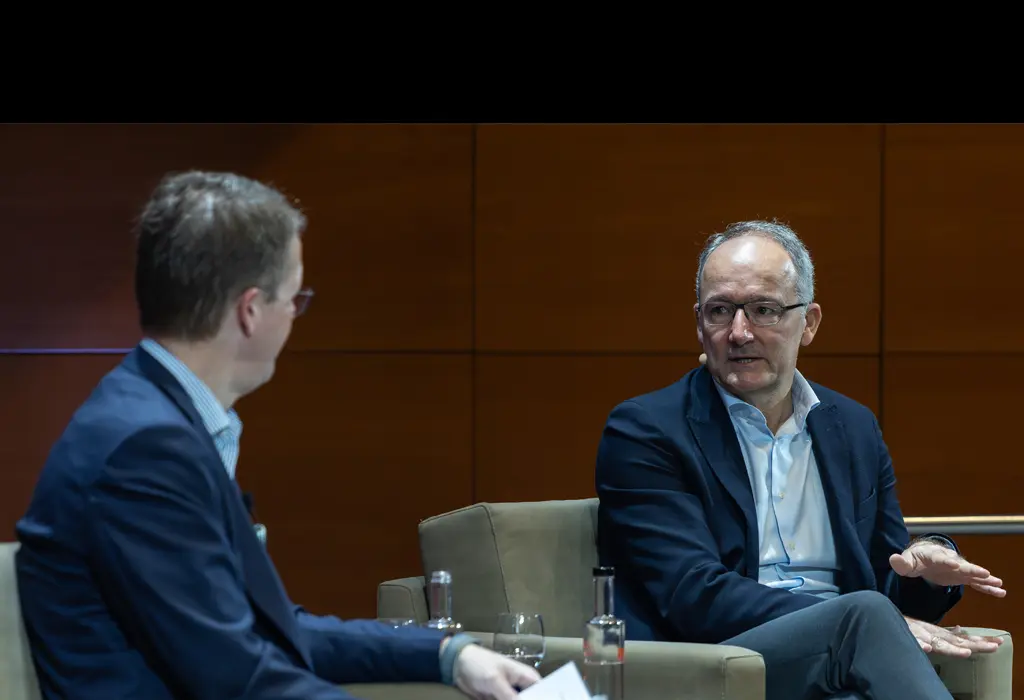
In this edited interview with IESE Dean Franz Heukamp, he talks about leading this iconic company.
Franz Heukamp: You’ve been with IKEA for 25 years. Stepping into the CEO role, how does your perspective change?
Juvencio Maeztu: I’ve been part of the history, but I feel certain things cannot keep going in exactly the same way. Especially when leading such a big company, there’s a risk of becoming more bureaucratic, more complacent, of viewing reality through executive committee PowerPoints. I need to be a bit more of a rebel now.
So, over the past few months, I’ve been traveling around the world to be with people on the shop floor, to be with customers, to be with competitors, to be as far away as possible from PowerPoints and meeting rooms. This has not only helped me define exactly what is needed, but also humbled me and strengthened my determination to do many new things, anchored in our core beliefs and values. I live in this constant state of humbleness and willpower to deliver.
FH: Affordability has always been a hallmark of IKEA. Becoming even more affordable has become even more of a priority. Why?
JM: The IKEA vision is “to create a better everyday life for the many people,” and that gets executed through the business idea of offering affordable home furnishings for a better life at home. A better life at home isn’t possible if it’s not affordable and sustainable — that’s in our DNA.
Growth, for us, has to come through volume. It is less about the money than it is about achieving this business idea. And when you really understand the depth of people’s needs, then affordability is not a commitment but a mission and the means of achieving the business idea.
Affordability goes hand-in-hand with sustainability. Over the past year, we’ve grown by 24% but reduced by 30% our CO2 in Scopes 1, 2 and 3. Why is this important? Because it’s how we make sustainability affordable. The day that affordability becomes a luxury for the few is the day when we won’t decarbonize our world and we stop being accessible to the many.
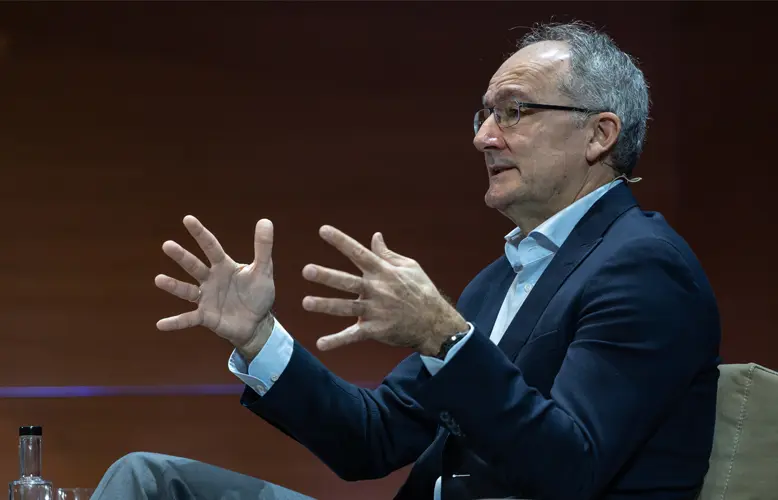
Juvencio Maeztu (pictured) believes sustainability and affordability are sources of competitive advantage
FH: How hard is it to reduce carbon emissions while still growing?
JM: We try to optimize both decarbonization and financial returns. But the world is pushing costs up, while our beliefs are to keep prices low, which creates thin margins. We have to double down on creating competitive advantage. I know some companies are being more prudent, backing off sustainability and affordability, but I am convinced this is precisely when competitive advantage becomes decisive. Take circularity. If you produce with circularity in the regions where you operate, you become more independent, less reliant on global trade or exposed to geopolitics.
FH: With operations in more than 60 countries and roughly 200,000 employees around the world, how are you navigating today’s geopolitical challenges?
JM: I prefer to see the world through similarities instead of differences. My family and I spent several years living in India, and there you can choose to see the differences. However, dig a bit deeper, and there are many similarities: the love for family, the love for food, the love for low prices, the importance of home. People have the same basic needs, the same dreams, as well as the same frustrations. As a company navigating global complexity, the more rooted you are in the everyday lives of most people, the more comfortable you will be in your decision-making.
This is why, in a world getting more polarized, we choose to be inclusive, not only for ethical reasons, but as proof that it is a better way to do business. It’s important that we, as a company, speak up and make our values clear, because people may understand what we do but they also need to understand why and how we do it.
FH: What else about your experience in India shaped your leadership philosophy?
JM: India was one of the most humbling experiences of my life. When things go wrong, you can choose to get frustrated or you can see the opportunities — I chose to see the opportunities. I tried to see India from the inside, not from the outside, and that changed my mindset completely. We in Europe or North America are a bit arrogant in the way we see the world. We represent no more than 15% of the world’s population, yet we tend to have opinions on 100% of the world. We should be more humble in the way we understand the world. It doesn’t mean we’ll agree on everything, but at least we’ll have a better understanding of why things are the way they are. And once we understand what’s happening, we can approach them in a different way.
FH: Apart from the physical stores for which you are famous, IKEA has built a strong digital presence. How do you see the physical and the digital channels evolving?
JM: People ask me about our digital goals, and we have massive digital capabilities. But for me everything is melded together: many online sales started offline; many offline sales started online. What I really care about is bringing people to the stores as much as possible. People still need to meet, socialize and do something with their children on a Saturday morning. The more we keep bringing people into the stores, the more we will cement the uniqueness of IKEA. Digitalization and AI, though necessary, are enablers of efficiency and makers of revenue — but they’re not the goal or the source of our uniqueness.
FH: How do you balance preserving IKEA’s unique culture without becoming resistant to change?
JM: I’m not Swedish and I’m the first person to lead the company without the founder still with us. I’ve been reflecting a lot on how I can be a custodian of IKEA’s culture and values — and also amplify them. I feel this responsibility. That’s why I’ve been going through the company archives, recovering fantastic, simple, down-to-earth booklets, which have inspired me greatly. It’s about finding the essence of IKEA and amplifying that essence in a new world. I am also determined to stay true to the basic principle of simplicity. I think companies become too complex, whereas simplicity is about renewal and improving.
FH: What advice would you give to others moving into C-suite roles?
JM: Don’t always follow the normally accepted, established ways. Follow your gut. Do what you believe is the right thing. Do what gives you energy. Because if you have passion, it’s very likely your performance will be good. And if your performance is good, it’s very likely you will develop and advance.
FH: How do you handle the greater visibility and responsibility you have in this new role?
JM: In my case, there’s a perfect match between my own deep beliefs and what IKEA stands for. In a polarized world, I choose to be inclusive. In a world with climate impacts, I choose to be more competitive in sustainability. In a world where you don’t know what the truth is, I choose to be truthful and authentic. In a world where costs are rising, I choose to be more affordable. In a world that’s more volatile, I choose to be more flexible. In a world that’s full of disruption, I choose to be more resilient.
FH: If you were asked why IKEA matters in the world today, what would you say?
JM: I strongly believe that companies are instruments for a better society. You need to be profitable, because profit provides the resources to keep investing in the future, but the goal cannot be just to maximize profit — it has to be to maximize impact on society and people. For IKEA, performance comprises four dimensions: It’s better homes for customers, the commercial part. It’s a better life for people, the social part. It’s a better planet for all, the climate part. And it’s a better company, the long-term financial part. When you combine these four, you have a mission to contribute to a better society. And the world needs more of that.
IESE Dean Franz Heukamp discussed leadership lessons with IKEA CEO Juvencio Maeztu during a special Global Leadership Session held on IESE’s Barcelona campus on December 15, 2025. The session is available for Members of the IESE Alumni Association to watch on demand here.
This interview is included in IESE Business School Insight online magazine No. 171 (Jan.-April 2026).
READ ALSO:
Business and Inequality: Purpose-driven strategies to create a more equitable world
Juvencio Maeztu: “We’ll always do things because we believe they’re right” was part of the magazine IESE Business School Insight #154 on Countdown to 2030: The new responsibilities of business for people, the planet and our future prosperity