Stories
IESE's North America Summit: growing community and a shared future
IESE alumni gathered in New York to explore how leadership is evolving across industries, from artificial intelligence to sport
April 15, 2026
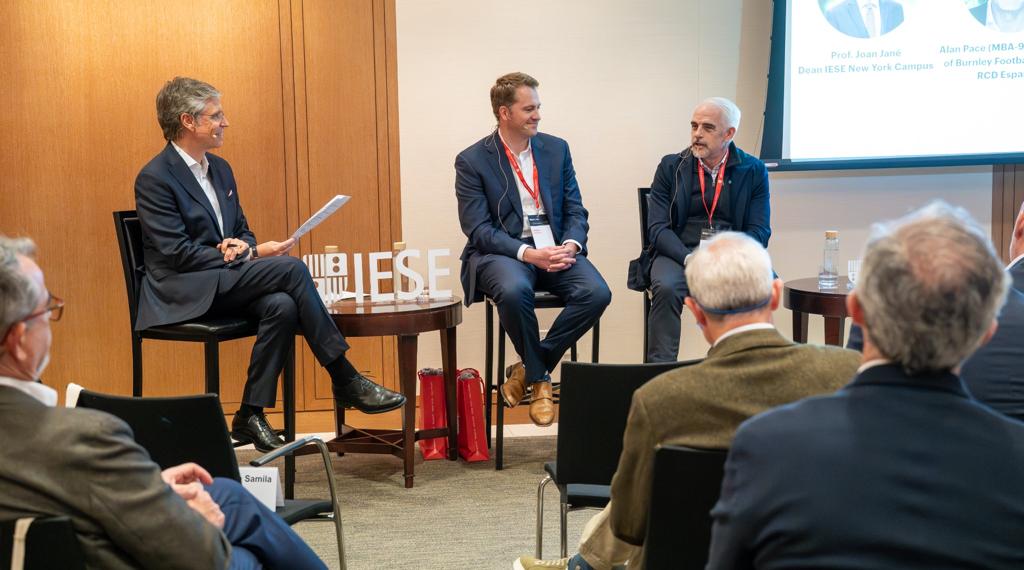
IESE’s first North America Summit, held on April 10 and 11 at its New York campus, brought together alumni, faculty and leaders from across the continent to reflect on a shared journey and look ahead to what comes next.
Marking 15 years since IESE established its presence in New York, the gathering was both a celebration and a statement of intent. What began as an ambitious step into one of the world’s most dynamic ecosystems has evolved into something broader and more enduring.
“We have built more than a campus. We have built a platform. A platform for education, engagement and community,” said Joan Jané, Dean of IESE’s New York Campus, in his opening remarks.
Over two days, IESE alumni from across North America came together not just to reconnect, but to engage with a shared question: how should leadership evolve in a world that is changing faster than ever?
From artificial intelligence to sports and purpose-driven business, the Summit brought together diverse perspectives to explore that question. While the contexts varied, the conversations revealed a common reality: leading today requires greater judgment, adaptability and a deeper sense of responsibility.
Navigating uncertainty in the age of AI
The opening academic session, Leading the Game: How AI Is Transforming Leadership, set the tone.
Professor Sampsa Samila, alongside Ismael Faro, VP Quantum and AI, IBM, and Ariadna Font, Co-Founder and CEO, Alinia AI, examined how artificial intelligence is reshaping not only industries, but the nature of decision-making itself:
- Rather than focusing solely on technological capabilities, the discussion centered on what this shift demands from leaders. In an environment where change is constant and outcomes are harder to predict, hesitation carries its own risks. “Waiting and seeing is the riskiest action,” said Font.
- Leaders, Faro suggested, must learn to operate without complete information, testing, adjusting and remaining open to revising their assumptions. Leadership becomes less about certainty and more about judgment.
- The panelists also emphasized the importance of optionality: making decisions that preserve flexibility in the face of rapid change.
- At the same time, Faro and Font noted that the acceleration of AI is bringing ethical considerations to the forefront. As innovation outpaces regulation, responsibility increasingly rests with decision-makers inside organizations. Leaders must not only develop new capabilities, but also be willing to “unlearn” established ways of thinking while investing in talent for the long term.
Leadership beyond the numbers
If technology is redefining how leaders act, other sectors highlight why leadership matters.
In From Ownership to Leadership: A Vision for Sports Management, Alan Pace (MBA 1994), Chairman of Burnley Football Club and RCD Espanyol, and Andrew Checketts, Managing Director at Cynosure | Checketts Sports Capital, explored the challenges of leading organizations rooted in identity and community:
- Professional sports operate at the intersection of business and emotion. Decisions are not experienced only as strategic or financial; they are felt by communities that see clubs as part of their identity.
- Both Pace and Checketts noted how this dynamic places different demands on leaders. Beyond financial discipline, it requires sensitivity to context, relationships and long-term trust. Being embedded in a strong ecosystem creates opportunities for innovation, but also calls for a deep understanding of stakeholders.
- Pace also underscored the importance of emotional intelligence when leading in environments where communities are highly engaged and outcomes carry symbolic weight.
Purpose as a guiding principle
The final session, Leading for a Purpose: Humanistic Leadership for a Modern Business, with Isabel and Ignacio Torras (GCP 2013), Founder and CEO of Tricon Energy and Founder of Genuine Cup, brought the discussion to a more foundational level:
- Their reflections focused on how leaders define success and the responsibility that comes with it in today’s context.
- In a context shaped by social and technological change, leadership increasingly involves balancing performance with purpose: creating value while contributing to broader societal goals.
- The emphasis was clear: long-term impact depends not only on results, but on the principles that guide decisions and the people those decisions ultimately serve.
Fifteen years of IESE in New York
The Summit also marked 15 years of IESE in New York, a milestone that reflects both growth and ambition.
When IESE opened its New York campus, it took a pioneering step as the first European business school with a permanent presence in the United States.
Since then, IESE has expanded its activity across the country through executive education, degree-program modules and partnerships with institutions such as MIT Sloan School of Management and NYU Stern.
As Joan Jané reflected, the campus was always intended to be more than a physical space. “Today is not about the campus but something bigger. What IESE can be in North America.”
That vision is reflected in a growing alumni community of around 2,000 across the region, diverse, international and increasingly connected.
As Joaquín Quirante, President of the IESE US Alumni Association, said, “This is not just about reconnection but reaffirming a project that belongs to all of us.”
Across North America, that shared project is already taking shape, driven by a growing community committed not only to reconnecting, but to shaping what comes next.