



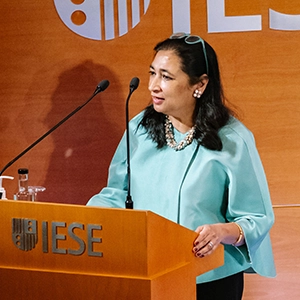
Just one bad apple can contaminate the entire group, until everyone’s opinion eventually converges around misinformation. Mathematical modeling by IESE Prof. Manuel Mueller-Frank demonstrates the contagion effect in networks. He offers two key takeaways to prevent misinformation from spreading.

IESE Insight
Managing in Polarized Times
Polarization: the challenge, and opportunity, of our time
Polarization has become one of the defining challenges of our time, not just in politics, but in organizations, markets, communities and even families. Strikingly, this division is deepening precisely at a moment of unprecedented prosperity. For all our economic progress, we are experiencing a weakening of relational bonds and shared frameworks that once held societies together. As interactions become more transactional, trust in institutions and in one another has eroded. The paradoxical result: We are richer than ever, yet more fragmented, suspicious and prone to conflict.
Why now? Psychological and identity-based explanations only tell part of the story. A deeper driver lies in the loss of institutional balance. Societies, and especially corporations, markets and the state, have increasingly come to rely on a narrow set of logics, while relational institutions such as family, community and religion have weakened. This imbalance matters because these institutions provide different sources of meaning, belonging and legitimacy. When relational institutions are absent or marginalized, individuals become more atomized and more susceptible to anchoring their identity in adversarial categories, often political ones. Polarization, in this sense, is a structural outcome of weakened institutions.
Moreover, this polarization is sustained by systems that reward outrage, simplify complexity and erode face-to-face human connection. Though technology amplifies these tendencies, it doesn’t create them. When people lack meaningful relationships that cut across differences, when they see each another not as individuals but as categories, this division becomes self-reinforcing.
This is why polarization is so important for managers: It directly shapes the environment in which firms operate. Companies face increasingly polarized stakeholders, with volatile expectations and pressure to take sides on contentious issues.
These dynamics can undermine trust, distort decision-making and erode organizational cohesion.
Yet, rather than becoming victims of polarization, businesses can be part of the solution. Organizations are among the few places left where people with different backgrounds, beliefs and identities still come together around a shared purpose.
IESE’s vision speaks directly to this opportunity. As a people-centered institution that fosters purpose-driven leadership, IESE emphasizes the importance of building strong communities grounded in personal relationships. This is good for people, firms and society; and it is a strategic response to fragmentation.
Strong communities foster trust, belonging and mutual understanding — conditions that make dialogue and collaboration possible even amid disagreement. When individuals are connected through genuine relationships, they are more open to learning from one another and less likely to retreat into polarized positions.
For managers, this implies a shift in perspective. Polarization challenges leaders to think beyond efficiency and performance, and toward the kind of institutions they are building — organizations that function as spaces of integration.
It means fostering shared purpose, strengthening relational ties and creating environments where disagreement is properly channeled, so that it does not lead to exclusion. It also requires prudence: Companies must avoid both the excesses of narrow shareholder primacy and the risks of being hijacked by agendas detached from their core mission.
Whether firms amplify division or help restore cohesion depends on whether they cultivate trust, dignity and shared purpose in the everyday experience of work. In a fragmented world, this may be one of the most important responsibilities of management — and one of its greatest opportunities.

Space, the final frontier of global cooperation
Despite global fragmentation, there’s one area where international cooperation remains strong: aerospace missions. In a panel moderated by Prof. Joan Jané during Aerospace Day held at IESE Madrid, Juan Carlos Cortes (Spanish Space Agency), Philip Baldwin (NASA) and Heriberto Saldivar (European Space Agency) discuss how rivals can still work together for good.
Social media platforms are dividing us. Here’s how we fight back.
Social media, once hailed as champions of democracy and dialogue, have become commodified spaces in which their business models incentivize hate speech, misinformation, polarization and the political fragmentation of society, benefiting corporate and political elites while eroding democracy. Here’s what managers and policymakers can do to address social media’s threats to our democratic norms and the wellbeing of our societies.


This report is included in IESE Business School Insight online magazine No. 172 (May-Aug. 2026).