IESE Insight
What Africa can teach the world about retaining young talent

With 60% of its population under 25, Africa offers lessons for organizations everywhere on how to attract and engage the next generation.
Article by Suzanne Hogseth
Every year, roughly 12 million young Africans enter the job market, competing for just 3 million formal jobs. Yet many of those who secure one soon leave for other opportunities, eroding both short-term performance and the leadership pipelines organizations are working to build.
So how can companies retain the leaders of tomorrow? IESE research spanning Africa, Europe, Asia and the Americas offers some clues.
A new generation at work
Between March and September 2026, IESE Prof. Jeroen Neckebrouck, Africa Initiative Director Ermias Mebrate Mengistu and researcher Saloni Biyani surveyed nearly 7,000 employees across 26 countries to learn more about their lives at work. As detailed in their report “Growing people, growing legacy,” the survey asked participants to assess their opportunities for learning and growth, how fairly they were treated, their job satisfaction and whether they intended to stay with their employer.
Respondents worked at a wide range of organizations, from family businesses and investor-backed firms to nonprofits and government agencies. Roughly half were based in 13 African countries: Algeria, Cameroon, Democratic Republic of Congo, Egypt, Ethiopia, Ghana, Ivory Coast, Kenya, Morocco, Nigeria, Senegal, South Africa and Tanzania.
In nearly all of these countries, the median age is under 30, and in most it is around 20 or younger, compared with almost 45 in the European Union. With workforces this young, keeping talent largely means keeping young people.
The researchers’ findings center on three themes, with lessons for organizations anywhere.
1. Professional development pays off
Investing in people’s learning and development has a broad ripple effect, from greater job satisfaction and stronger commitment to weaker intentions to leave. According to the survey results, workers were much more likely to stay if they felt they had learned new skills, improved in their jobs and had ample opportunities for ongoing learning.
Talent retention also affects the bottom line. “Replacing an employee costs between 15% and 30% of a worker’s yearly salary for most jobs, and far more for senior roles,” says Neckebrouck. “Across the 26 countries in our study, employees who reported the most learning were also much less likely to say they intended to leave, even after accounting for country, industry, firm size and personal characteristics.”
High employee turnover carries indirect costs as well, such as lower productivity during onboarding and the loss of institutional knowledge.
Professional development has a further advantage: It tends to pay for itself. In a large-scale study of Belgian firms, trained workers were about 23% more productive but were paid only about 12% more. A 2023 study from Ethiopia points in the same direction: Manufacturers that offered training were about 30% more productive than those that did not.
But development works best when it’s part of a broader culture of learning. Among African respondents, the top drivers of growth were peer support, mentoring, stretch assignments, pride in the organization’s purpose, knowledge sharing, self-directed learning and structured learning on the job.
2. Engaged leaders and owners help retain talent
In the IESE survey, engaged ownership made a notable difference in family businesses. Where employees saw the family as visible and involved, they reported more learning, higher satisfaction, a greater sense of fairness and weaker intentions to leave. Other research suggests the same holds for leadership in any organization: Gallup has found that 70% of the variance in engagement between teams comes down to the manager.
In practice, effective management depends less on grand gestures than on everyday behavior: setting clear expectations, recognizing people’s contributions and offering frequent, meaningful feedback. Gallup’s research underscores the importance of feedback in particular. Employees who receive daily input from their supervisors are three times as likely to be engaged as those who receive it once a year or less.
“In the end, managers determine whether a company’s learning culture flourishes or falls flat. They decide who gets mentored, who gets the plum assignment and whether helping a colleague counts as real work or a distraction,” notes Mengistu. “When they prioritize their employees’ development, people learn more and have more reasons to stay.”
Family businesses add another layer, since the family itself can either help or hinder. The researchers measured two factors in these firms — family involvement and favoritism — and found that both were closely tied to how employees viewed their workplace.
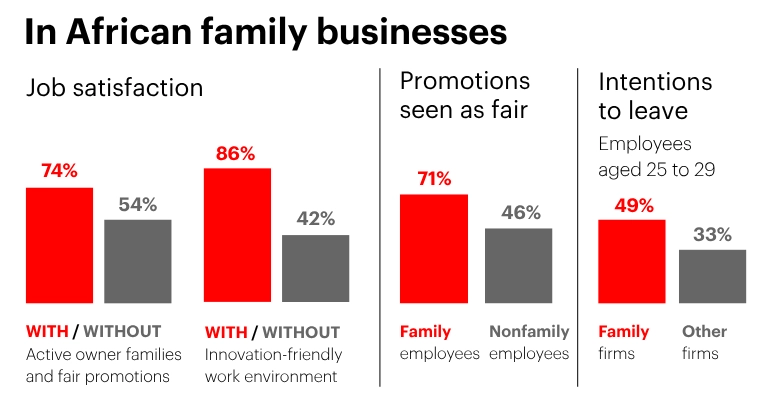
In African family firms where owner families were actively involved and promotions were seen as fair, 74% of respondents said they were satisfied with their jobs, compared with 54% in those where the owner family was distant and promotions favored family members. High family involvement paid off in other ways, too: Respondents saw more room to grow and felt more committed.
Yet favoritism — when family ties, rather than results, decide who gets ahead — can undo those gains, and the study suggests a blind spot among owner families. In the African family businesses surveyed, 71% of family employees believed promotions were handled fairly, compared with just 46% of nonfamily employees.
Young employees are especially at risk of leaving. Among African family-firm employees aged 25 to 29, 49% said they often thought about leaving, compared with 33% in other African organizations. For family businesses, visible involvement and fair promotions are not just good practice; they may be what persuades young talent to stay.
3. Innovation keeps talent invested
The advantages of innovation extend well beyond new ideas. In the survey, employees at companies where they were encouraged to propose improvements and allowed to experiment were more satisfied with their jobs, had more opportunities to develop and were less inclined to leave.
These patterns were especially pronounced in African family businesses. In those that actively fostered innovation, 86% of respondents were satisfied with their jobs, compared with 42% in those where the climate for new ideas was weak.
“In the African family businesses we studied, employees at innovation-friendly companies were about half as likely to think often about leaving and three times as likely to trust the promotion process. They were also more likely to say colleagues share their knowledge,” says Neckebrouck.
The connection between a culture of innovation and employee outcomes held beyond Africa and across types of organizations. Because employees rated both the innovation climate and their own experience, the study shows a strong association rather than proof of cause and effect. Even so, few other factors are as tightly linked to how employees feel about their employer.
Despite its benefits, innovation is still not a priority in many of the organizations studied. Just over half of respondents said they felt free to experiment with new ideas. For employers, this gap presents an opportunity: Opening the door to fresh perspectives and approaches is one of the most promising ways to help people grow and keep them from looking for greener pastures.
MORE INFO: “Growing people, growing legacy: How Africa’s family businesses develop, engage and retain their talent” by Jeroen Neckebrouck, Ermias Mebrate Mengistu and Saloni Biyani. IESE Africa Initiative (2026).
This article is included in IESE Business School Insight online magazine No. 174 (Jan.-April 2027).
5 takeaways for retaining young talent
Make professional development a priority
A sense of growth plays a key role in employees’ intentions to stay. Give people real opportunities to learn, and run regular pulse surveys to check whether they feel they are getting better at their work.
Foster a culture of learning
Make knowledge sharing, mentoring and mutual support part of employees’ everyday experience. Many already learn on their own, so harness that motivation with structured learning that helps them do their jobs better.
Stay involved and accessible
Visible, engaged owners and managers give people more reasons to stay. Some of the simplest gestures are also the most powerful: Walk the floor, get to know people by name and take an interest in their progress.
Welcome new ideas
An open climate for innovation goes hand in hand with greater employee development and satisfaction. Give people permission to experiment, a platform for putting their ideas into practice and recognition when they succeed.
Show young talent a future
Young employees are the most likely to have one foot out the door. A thoughtful welcome, a mentor from day one, regular feedback and a clear career path help young professionals envision a future with your business.