IESE Insight
What penalty shootouts teach us about pressure at work

In football, the team that shoots first in a penalty shootout wins more than 60% of the time. A study that proposes a way to reduce that advantage also sheds light on the effects of psychological pressure in the workplace.
For the third consecutive time since 2018, Italy has failed to qualify for the FIFA World Cup. The four-time world champions will not be at the 2026 FIFA World Cup after losing the European playoff final to Bosnia and Herzegovina. The match was decided by a penalty shootout, with Bosnia shooting first. Italy lost 1-4.
Sports analysts pointed to Italy succumbing to pressure. This is a common phenomenon: In penalty shootouts, where around 75% of kicks result in goals, shooting second creates a clear disadvantage. If the first kicker scores, the pressure immediately shifts to the second, who knows they cannot afford to miss.
IESE professor Govert Vroom, Tom Vandebroek and Brian McCann mathematically represented these pressure points and other factors that could influence outcomes.
Using an advanced mathematical model, the researchers created an expanded decision tree covering all 1,024 possible scenarios in a five-kick penalty shootout. They also quantified the effects of different forms of psychological pressure on penalty-taking performance. Their analysis reveals the optimal kicking order for a team’s best penalty takers.
The advantage of shooting first
According to the authors, the disadvantage faced by the second shooter can be reduced by changing the order of kicks.
Their model is based on the well-established observation that it is psychologically more difficult to come from behind in a penalty shootout. Building on this insight, the researchers were the first to mathematically demonstrate that a new rule tested by the Premier League can reduce the first-shooter advantage by between 74% and 85% when one team is trailing.
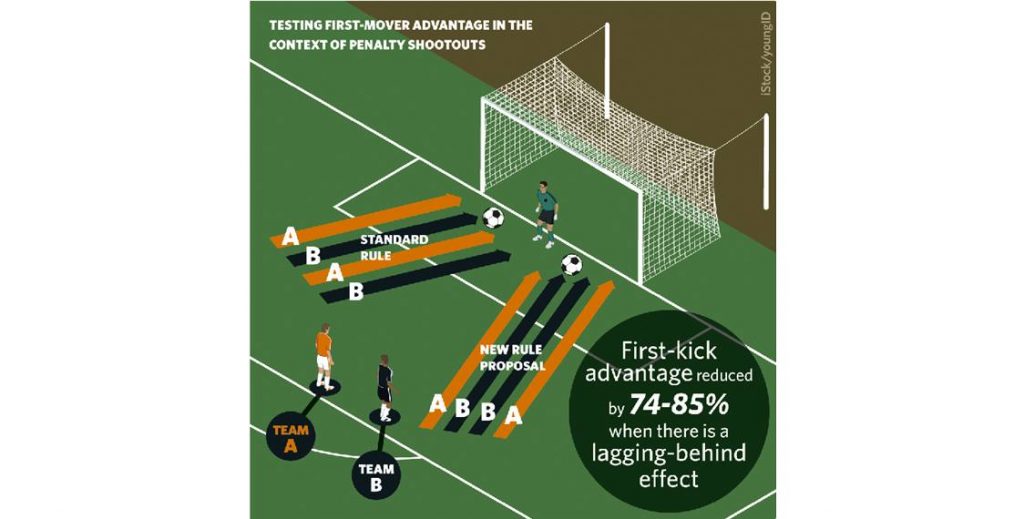
The proposed format is inspired by the tie-break system used in tennis. After Team A takes the first kick, Team B takes the next two kicks. The resulting sequence is ABBAABBA for the first eight kicks, rather than the current ABABABAB pattern.
Although this format has only been used on a limited basis, it has already received support from FIFA.
The researchers also identified even fairer shooting sequences. The Prouhet-Thue-Morse sequence reduces the first-shooter advantage even further.
Corporate strategies for managing pressure
Despite their focus on rationality and optimization, businesses are inseparable from emotions, says Vroom. After all, organizations are made up of people who make decisions every day and, like footballers, are not immune to psychological pressure.
Just as there are ways to reduce pressure in penalty shootouts, there are also ways to reduce pressure in organizations and limit its impact on performance. Vroom suggests two approaches:
- Match task difficulty to individual capabilities. Assigning tasks that align with employees’ skills helps build confidence and improve performance.
- Reframe failure. Viewing mistakes as purely negative increases pressure and can distort decision-making. Treating failure as a natural part of experimentation and learning reduces tension and creates room for improvement.
About the research
Published in the Journal of Sports Economics, this paper presents a formal model of soccer penalty shootouts to determine the links between psychological pressure and first-mover advantage. With their model, the authors show that this relationship varies according to the specific rules governing the shootout and the nature and magnitude of the pressure. In essence, they provide a tool allowing for quantification of the effects of pressure on first-mover advantage according to these specific circumstances.
The authors gratefully acknowledge the financial support of the Spanish Ministry of Economy and Competitiveness (Project ECO2015-71173-P) and the Public-Private Sector Research Center at IESE.
ALSO OF INTEREST:
Leadership and sports, playing the long game
Lessons from sports to compete with AI
Benchwarming or bias? Do coaches in the NBA discriminate based on race?