Stories
Josep Borrell: "Europe hasn’t learned to use the 'language of power'"
Geopolitics take center stage at IESE as experts exchange views on Ukraine, Iran and NATO and tips for effective leadership
May 14, 2026
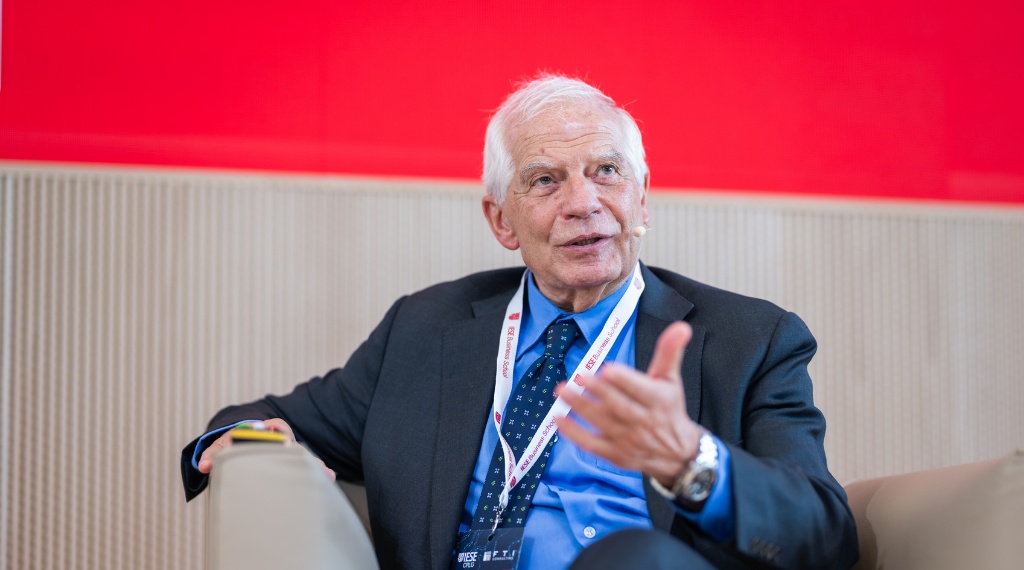
As Europe grapples with the impact of Russia’s invasion of Ukraine and aggressive posturing by U.S. President Donald Trump, Europe still hasn’t learned to use the “language of power,” Josep Borrell told a packed audience at IESE Business School.
The stark reason, perhaps, is “because we don’t have power,” the veteran Spanish politician and former European Union foreign policy chief said at the second edition of the Geopolitics conference held at IESE’s campus in Madrid.
Asked what Europe should expect from Russia’s President Vladimir Putin, Borrell replied “everything bad” as the Ukraine conflict settles into a murderous stalemate. Meanwhile, Trump’s assault on Iran has strengthened the radical regime of the Islamic Republic, while a prolonged blockage of the Strait of Hormuz threatens to cause widespread food shortages by limiting supplies of fertilizer to the world’s farmers, he warned.
“We are playing with fire,” he said. “If Hormuz doesn’t open soon, we will have a greater problem.”
These themes framed a conference that brought together academics, policymakers, diplomats and business leaders to examine the geopolitical forces reshaping the global economy and international order. Discussions ranged from China’s industrial and economic expansion to the future of NATO, the impact of geopolitics on global trade, and the growing role of artificial intelligence in modern warfare.
Reflecting on China’s rise, Borrell praised the country’s extraordinary economic transformation, noting that the country now accounts for roughly one-third of global industrial output. At the same time, he questioned whether such levels of concentration were sustainable over the long term, both economically and politically.
The implications of the war in Ukraine for European security were also addressed by Javier Colomina, NATO Secretary General’s Special Representative for the Southern Neighbourhood. He argued that Russia’s invasion has placed “the stability of Europe in play,” reinforcing the importance of transatlantic cooperation despite tensions within the alliance.
Even amid disagreements between the United States and fellow NATO members, Colomina stressed that existing security arrangements remain far less costly and complex than any potential alternatives.
The conference also explored the human and political dimensions of ongoing conflicts. In a conversation with IESE Professor Santiago Álvarez de Mon, Borrell said he radically rejected the violence inflicted on the Israeli state on Palestinians.
Former Israeli Foreign Minister and historian Shlomo Ben-Ami acknowledged Borrell’s comments, while attributing the radicalization of Israeli public opinion in part to repeated failures in the peace process. “Netanyahu is the result of this,” he observed.
The event concluded with reflections from former Spanish Prime Minister Mariano Rajoy on the qualities required for effective leadership in uncertain times. Rajoy emphasized the importance of wisdom, flexibility and consensus-building, noting that Spain’s major political and economic milestones — including its democratic transition, entry into the European Union and adoption of the euro — were achieved through broad agreements across society.
“One important way that leaders can achieve success is by surrounding themselves with intelligent and good people”, he said.
Organised by IESE’s Centre for Public Leadership and Government in collaboration with FTI Consulting, the event was also led by professors Jordi Gual, Marta Elvira and Juan Luis López Cardenete.
Also taking part were institutional leaders and diplomats such as Ana Palacio, Mariano Rajoy and Qu Xun; experts in energy and the energy transition such as Luis Atienza, María Sicilia and Patxi Calleja; and executives and specialists in trade, industry, technology and defence such as Beth Baltzan, Anthony Gooch, Luis Furnells, Raül Blanco and General Carlos Javier Frías Sánchez.